⛳ Golf Wolf Game Calculator
Score one Wolf hole, apply partner or solo multipliers, carry ties forward, rotate the Wolf, and update every player's point standings.
| Step | Value | Formula | Note |
|---|
| Wolf Call | Teams Created | Typical Multiplier | Point Movement |
|---|---|---|---|
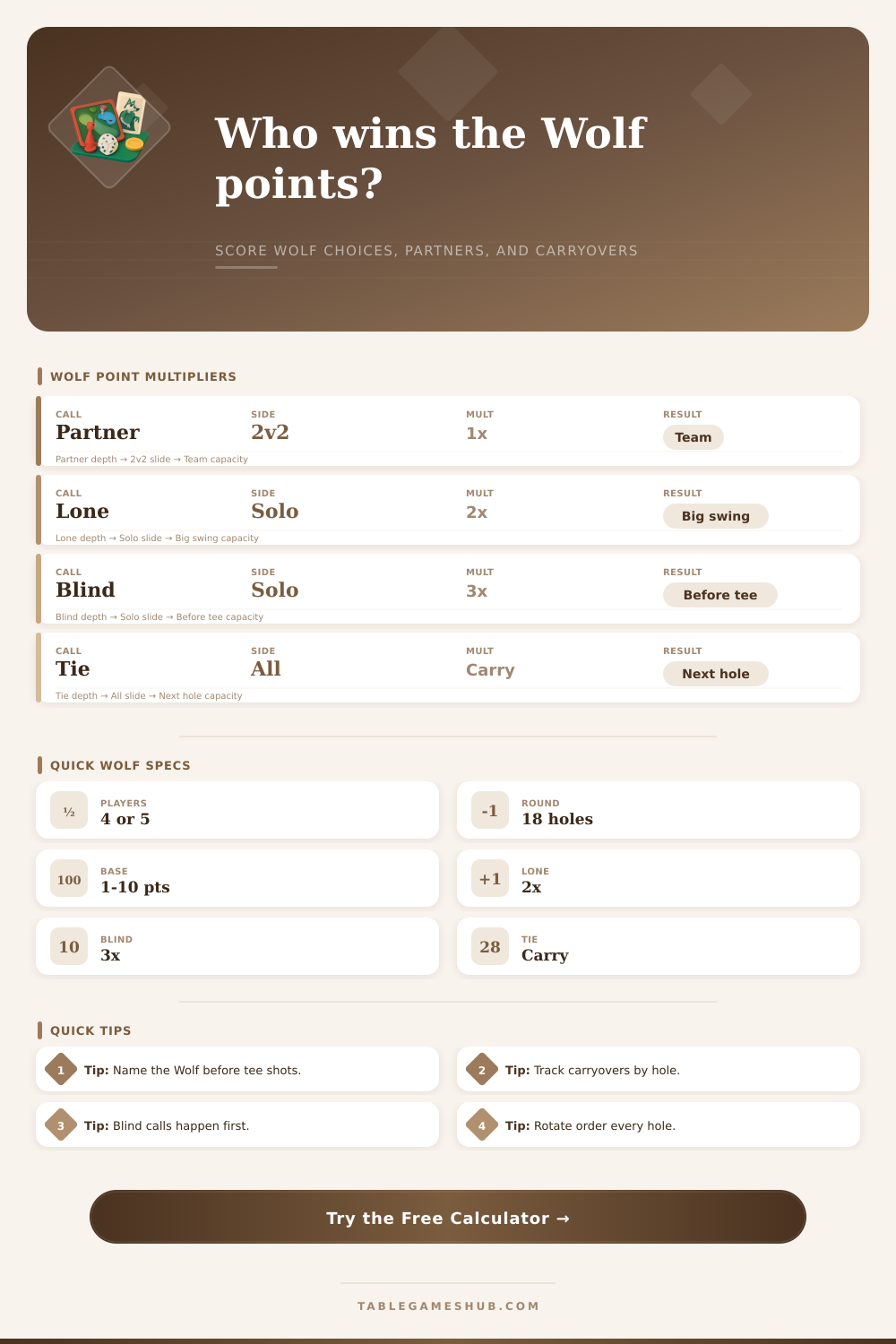
| Partner Wolf | Wolf plus one chosen partner versus field | 1x active stake | Winners gain stake each; others lose stake each. |
| Lone Wolf | Wolf alone versus all non-Wolf players | 2x or 3x | Wolf result is multiplied by every opponent in the field. |
| Blind Wolf | Wolf alone before tee shots are seen | 3x to 5x | Highest swing because the commitment is made before information arrives. |
| Tie or Split | No side fully wins | Carry or zero | Tie adds a carryover; high-low split can wash the hole. |
| Player Count | Wolf Rotation | Hole 18 Pattern | Fairness Note |
|---|---|---|---|
| 3 players | 1, 2, 3 repeat | Six turns each | Works, but partner choices are limited and solo swings are common. |
| 4 players | 1, 2, 3, 4 repeat | Slots 1 and 2 get five turns | Many groups reverse order on the back nine for balance. |
| 5 players | 1 through 5 repeat | Slots 1-3 get four turns | Use sit-out or field scoring if pace needs a lighter format. |
| Back-nine start | Continue from front nine | Do not restart unless agreed | Keeping the same rotation protects the extra-turn pattern. |
| Hole Format | Wolf Side Score | Field Side Score | Best Use |
|---|---|---|---|
| Best ball side result | Lowest gross ball on Wolf side | Lowest gross ball among field players | Fast four-player Wolf with simple scoring. |
| Net best ball with strokes | Lowest adjusted score after handicap strokes | Lowest adjusted field score after strokes | Mixed-skill groups that still want every tee shot to matter. |
| Aggregate side score | Sum of Wolf side balls | Sum or average of field balls | Partner choices matter more because both scores count. |
| High-low split point | One point for low ball, one for high ball | Same comparison across the field | Useful when groups want fewer big swings. |
| Scenario | Base | Carryovers | Active Stake |
|---|---|---|---|
| Clean partner hole | 2 points | 0 | 2 points before multiplier. |
| One tied hole carried | 2 points | 1 | 4 points before multiplier. |
| Lone Wolf after carry | 3 points | 2 | 9 points, then lone multiplier. |
| Blind Wolf with stack | 1 point | 3 | 4 points, then blind multiplier. |
| Spec | Partner Wolf | Lone Wolf | Blind Wolf |
|---|---|---|---|
| Choice timing | After seeing a tee shot | After seeing tee shots | Before tee shots |
| Team shape | Two-player side | Wolf against field | Wolf against field |
| Risk level | Moderate | High | Highest |
| Calculator focus | Partner and field split | Opponent-count swing | Multiplier pressure |
Lock the Wolf before scoring
The selected Wolf and partner define both sides. Confirm those slots before entering the hole result so the point swing lands on the right players.
Carry ties as points, not guesses
Use the carryover field for tied holes. The calculator adds each carryover to the base stake before applying lone or blind multipliers.
Wolf is a format that involves a series of negotiation between the players during a game of golf. The game begins when a player is placed into the Wolf slot. The player in the Wolf slot will have three options: they can play alone, they can pick a partner for the hole, or they can make a commitment regarding the hole before any of the other players have hit their tee shot.
The decision of the player in the Wolf slot will determine the stakes for that hole for all of the remaining player in that group until the next rotation of players to the Wolf slot. Wolf operates with the concept of a rotation of players. Each player has an opportunity to take the Wolf slot for a period of time.
How to Play Wolf Golf
Each player that is in the Wolf slot have different options for calling the hole, and each call will result in a change to the multiplier for the points that can be earned on that hole. For example, if the player in the Wolf slot selects a partner, the multiplier for that hole will remain at one. However, if they select a lone Wolf call after the tee shots have landed, the multiplier will be increased.
Finally, if the player in the Wolf slot chooses a blind Wolf call before any of the tee shots have been hit with the balls, the multiplier will be increased more than for a lone Wolf call. If the players tie on a hole, the carryover rule is triggered for that hole. In this case, the points that are earned on the hole that is tied will be carried over to the next active point value for the players in that group.
For example, if one hole is tied, the points on that hole will be carried over to the next hole, potentially turning a two-point hole into a four-point hole for that group of players. Many groups tend to find large swings in the score for each group when ties occurs on holes. These swings happen because the points from the previous hole are added to the score for the current hole.
Calculators can be used to track the carries for each group because the calculator will handle the carries and prevent the errors that could occur from manually adding those carries to the score. There are a variety of different scoring format for the game of Wolf. For example, best-ball use the lowest score from each group to determine the winner of each hole.
Alternatively, net scoring use the strokes that each player takes to determine the winner of each hole, which allows for players of different skills to compete against each other. In the aggregate format, the scores from each player in a group are combined, and the total score for each group is used to determine the winner of each hole. Furthermore, high-low splits use the best score and the worst score from a group to determine the winner of a hole.
Fairness in the rotation of the players in the Wolf slot is an important factor to consider when playing Wolf. However, the rotation isnt always perfectly even. For instance, in a four-player game, the players who rotate in the first two spots will have one extra turn in the Wolf slot compared to the players who play in the last two spots during a full round of golf.
Some groups will rotate the players in the back nine to even out the number of times that each player has the Wolf slot. However, other groups will accept that the first two players will have one extra chance to be the player in the Wolf slot. For five-player games, the player who is sitting out will change each hole.
In this case, the player in the Wolf slot will have to decide whether the fifth player will be on the Wolfs side, or playing in the field. Each of the players must make a decision of when to take the higher number for the points for that hole, and when to take the lower number for the points on the hole. For instance, a player who has a high score may take the partner call to avoid losing too many points.
In contrast, a player with a low score may take the lone wolf call or the blind wolf call to earn as many points as possible for their group. These decisions are based off the player’s score in the game, the weather, and the number of holes remaining in the round. Many groups make mistake when they play Wolf.
For instance, some groups will not increase the multiplier for the players if there is a carryover of points. In this case, the carryover of points will not have any effect on the score for the players. Other groups may not adjust the rotation of players after a carryover.
In this case, the player who should of had the Wolf slot may end up getting it during their turn. Furthermore, some groups may allow the player in the Wolf slot to change a blind wolf call after the tee shots have been hit with the golf balls. However, allowing a change to the blind wolf call removes the risk element of the call that will result in the increased points for the players in that group.
To avoid these mistakes, the player in the Wolf slot should lock in the call before the first ball is hit with the golf ball.