Kite Area Calculator
Estimate sail area, cut allowance, and layout waste before you cut fabric.
| Shape | Factor | Feel | Best Use |
|---|---|---|---|
| Diamond | 0.50 | Classic | Light air |
| Delta | 0.56 | Stable | General use |
| Box | 0.62 | Lifted | Brisk wind |
| Sled | 0.48 | Simple | Soft wind |
| Wind | Multiplier | Buffer | Note |
|---|---|---|---|
| Light | 0.96 | 5% | Soft pull |
| Steady | 1.00 | 10% | Balanced |
| Brisk | 1.05 | 12% | Keep margin |
| Gusty | 1.12 | 18% | Trim extra |
| Material | Stretch | Weight | Cutting Note |
|---|---|---|---|
| Ripstop | Low | Light | Sharp cuts |
| Poly | Medium | Mid | Allow seam |
| Silk | High | Very light | Test scraps |
| Tyvek | Low | Light | Crisp fold |
| Preset | Span | Height | Area |
|---|---|---|---|
| Classic Diamond | 28 in | 20 in | 280 sq in |
| Stable Delta | 55 in | 42 in | 1155 sq in |
| Box Kite | 34 in | 30 in | 510 sq in |
| Kids Kite | 18 in | 14 in | 126 sq in |
To build a kite that will fly well, you must understand the relationship between the sail area of the kite and the wind. The sail area is the total area of the fabric that the kite will use to catch the wind. The sail area will determine the amount of lift that the kite will have.
If the sail area is too small for the size of the kite, the kite may not be able to catch enough of the wind to remain in the air. Additionally, if the sail area is of an wrong shape, the kite may not fly in a stable manner. The dimensions of the kite will determine the way that it move in the air.
Kite size, shape and fabric
The span of the kite is the width of the kite, and the span determines how much air the kite can catch from the sides of the kite. If the span is too narrow for the other dimensions of the kite, the kite may stall in the air. The height of the kite is the vertical measurement of the kite, and the height determines the amount of lift that the kite will experience.
Because both the span and the height of the kite will impact the way that the kite moves in the air, it is important that these two measurements is balanced in relation to one another to provide a stable shape to the kite. The depth of the kite is the amount of curve in the center of the sail, and this depth add to the amount of volume of air that the kite will move. You may use the span and the height of the kite in different ways within different shapes of kites.
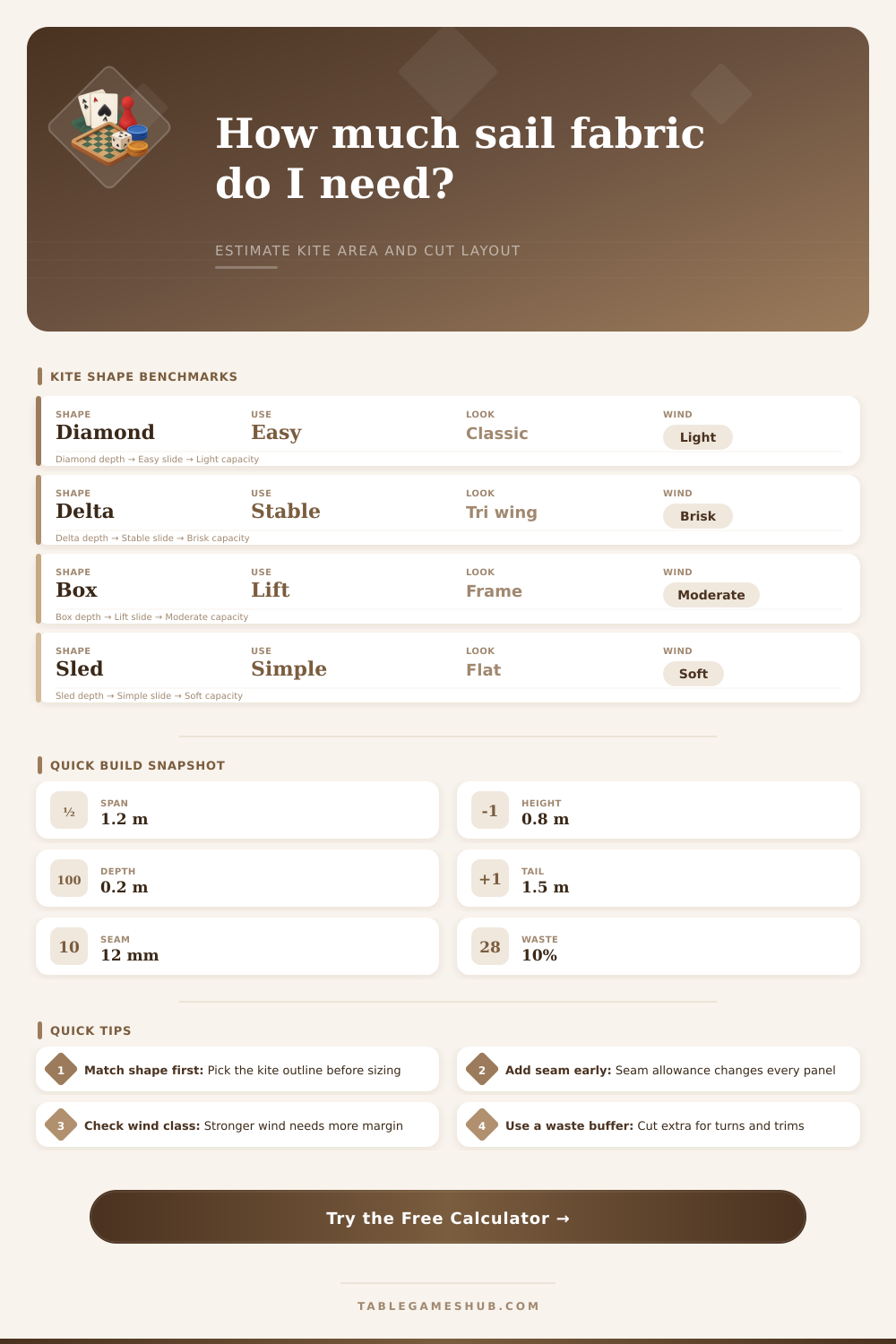
For instance, a diamond kite is a simple shape that is typically used in soft winds, and tends to create a stable lift for the kite. Delta kites are wider than most other shapes, and the high stability of the delta kite allow it to remain in place on windy days. Box kites are made up of a series of cells that increase the depth of the kite, and the depth of a box kite is one of the reasons that it can create significant lift.
Lastly, sled kites are flat shapes, and tend to be easy to fly when the winds is light. In order to cut the fabric for the kite, it is necessary to include extra material for the seams of the kite. If you simply cut the fabric according to the dimensions of the kite, the lack of extra material will cause the kite to rip apart during flight.
To avoid this issue, you must include an allowance for the seams in the dimensions of the kite. An allowance of one-half inch is typically used for these seams. Additionally, while using more panels for the kite will allow the kite to have smoother curves, there will be more seams that need to be sewn.
Thus, more fabric will be necessary to allow for the extra seams. In addition to the fabric for the kite, some fabric waste will be created during the building of the kite. Because the shapes of the kites are curved, the amount of fabric that is cut from the sheets will not be the same as the amount of fabric required for the kite.
Thus, you will have to purchase the amount of fabric for the kite in excess of the amount that is calculated for the size of the kite. For instance, the amount of fabric that is wasted when cutting out the curves of the kite may be around ten percent of the amount of fabric that is needed. Additionally, the tails that are attached to the kites will use up additional yardage of fabric.
The tails of the kites, especially the long tails, will help to stabilize the kite in flight; however, they will use up more of the fabric roll that is purchased. Some types of fabric may be used for kites instead of others. For instance, ripstop nylon is one of the most common fabrics used for kites; the reason for its popularity is that ripstop nylon does not stretch much when the kite is in flight.
Fabrics like polyester are also used for kites, though it permits for the movement of the seams when they are being sewn. Tyvek is another fabric that is used to make kites. Tyvek is a fabric that folds sharply, thus allowing it to maintain the structure of the frame of box kites.
The different types of fabric has different weights. Thus, the weight of the material will impact how the kite reacts to both light wind and heavy wind. Finally, to ensure that the kite will fly correctly, there are some proportions to kites that should of been followed.
One of the most important proportions is the width of the kite (span) to the height of the kite. The span should be approximately one-point-four times the height of the kite. Additionally, the depth of the kite should be approximately eighteen percent of the width of the kite.
If the dimensions of the kite are set incorrectly, the kite may not remain in flight in a stable manner, but may instead dive into the ground. Thus, by setting the dimensions, the height, the depth, the allowance for the seams of the kite, and accounting for fabric waste, it is possible to build a kite that will effectively capture the wind.