Opposed Dice Roll Calculator
Compare attacker and defender dice expressions, modifiers, tie rules, advantage modes, and margin targets with exact enumerated odds.
| Dice expression | Possible totals | Shape | Typical opposed use |
|---|---|---|---|
| 1d20 | 20 | Flat | Skill checks, saves, attacks |
| 2d6 | 11 | Bell curve | Reaction rolls, risk checks |
| 3d6 | 16 | Strong bell | Low-swing attribute contests |
| 1d100 | 100 | Flat percentile | Large-scale resolution |
| 4d3-8 | 9 | Centered curve | Fudge-like contested rolls |
| Tie rule | Attacker total equals defender | Win/tie/loss effect | Best for |
|---|---|---|---|
| Tie favors defender | Attacker fails to exceed | Ties become losses | Armor class, resistance, static defense |
| Tie favors attacker | Attacker meets or beats | Ties become wins | Meet-target systems |
| Tie remains tie | No side wins | Ties stay separate | Duels, reroll-later contests |
| Tie splits half win | Shared result | Half to each side | Expected value comparisons |
| Margin band | Chance | Interpretation | Math checked |
|---|---|---|---|
| Attacker wins | -- | Attacker total is higher before tie rule | A > D |
| Natural tie | -- | Equal final totals before tie rule | A = D |
| Defender wins | -- | Defender total is higher before tie rule | A < D |
| Margin target | -- | Attacker reaches selected margin | A - D >= M |
| Preset | Attacker | Defender | Tie rule | Use case |
|---|---|---|---|---|
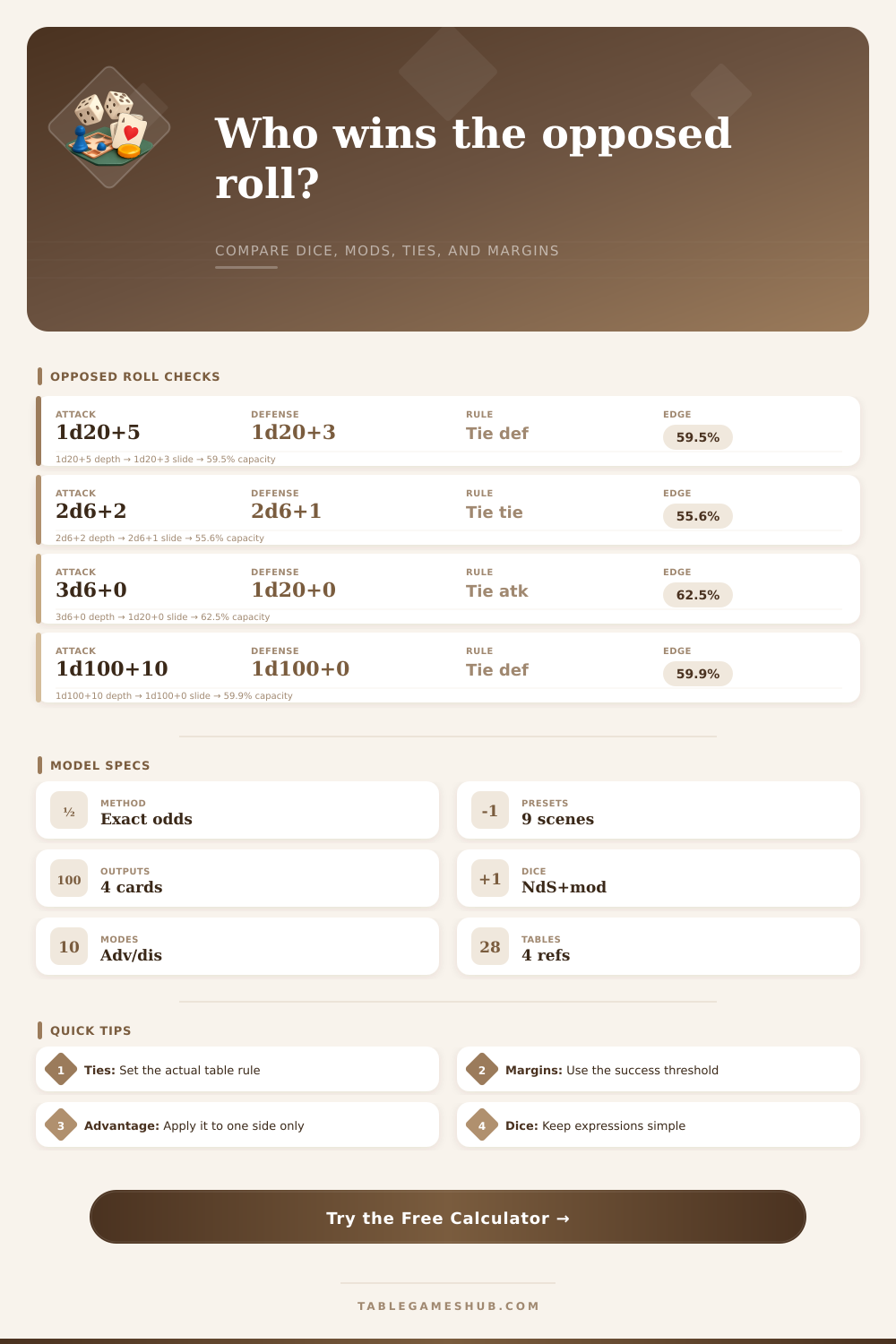
| d20 skill contest | 1d20+5 | 1d20+3 | Tie defender | Opposed ability checks |
| 2d6 risk check | 2d6+1 | 2d6+0 | Tie tie | Curved small-dice contests |
| Percentile duel | 1d100+10 | 1d100+0 | Tie defender | Flat large-range checks |
| Attacker advantage | 1d20+4 adv | 1d20+4 | Tie defender | Buffed offensive roll |
An opposed dice roll calculator is a tool that calculates the mathematical probability of the outcome of an opposed dice roll. An opposed dice rolls is used in scenarios in which one side is attempting to perform some action while another side is attempting to prevent that action from succeeding. The outcome of that opposed dice roll determine whether or not that action is successful.
In general, the opposed dice roll calculator is useful in that it takes for input the various element of that opposed dice roll (such as the types of dice that are used, the modifiers for each side, the rules for ties, and whether any advantage is applied to either side), and calculates the chance of each side winning the opposed dice roll. The type of dice that is used can alter the distribution of the results of that dice roll. For instance, if a 20-sided die (a d20) is used, each of the possible values that can be rolled has the same chance of being rolled as each other.
How to Use an Opposed Dice Roll Calculator
However, if more than one die is used (such as two six-sided dice, or 2d6), the result tend to create a distribution in which middling value of the dice are more likely to be rolled than values that are high or low relative to the other possible values. Each of these different types of dice can be tested within the opposed dice roll calculator, as the opposed dice roll calculator enumerates each of the possible outcomes of the dice rolls. The opposed dice roll calculator can count the number of instance in which attacker rolls beat defender rolls, and can use that count to determine the probability that the attacker will win the opposed dice roll against the defender.
In addition, the opposed dice roll calculator can apply a tie rule; different game system use different rules regarding ties between the attacker and the defender. For instance, some game systems use a rule that the defender wins ties, others indicate that the attacker wins ties, some systems use a rule that ties result in a reroll of the dice, and others use a rule that ties result in some shared outcome between the attacker and the defender. Each of these different tie rules can be evaluated within the opposed dice roll calculator, as the opposed dice roll calculator will calculate the results of each of those different tie rules.
In cases in which the modifiers for the attacker and the defender are similar to each other, each of the different tie rules will have a significant impact upon the win percentage of each of the opposing players. Advantage is another factor that can be included in an opposed dice roll. Advantage isnt the same as applying a modifier to the rolls of the dice, but instead advantage can be applied to the attacker or the defender in an opposed dice roll.
For instance, advantage can increase the chance that a high total is rolled relative to the chance of rolling a low total. Advantage can be applied to each of the two players in the opposed dice roll (or to neither), and the opposed dice roll calculator will provide updated result for each of those applications of advantage. Advantage can have a major impact upon the outcome of a series of opposed dice rolls; it is often more impactful then a flat bonus to each roll.
Another element of an opposed dice roll that can be evaluated with the opposed dice roll calculator is margin thresholds. Margin thresholds can be used to determine how much the winner of an opposed dice roll won by. For instance, the opposed dice roll calculator can calculate the number of instances in which the attacker wins the opposed dice roll by five or more points (for instance), or by ten or more points.
These margin thresholds can help to determine the narrowness or the overwhelm of the victory of the winning player. Some game systems use margin thresholds to produce other outcome for the winner of an opposed dice roll, thus the opposed dice roll calculator can be used to calculate how often those other outcomes will be achieved. In addition to calculating the outcomes of opposed dice rolls according to the elements described above, the opposed dice roll calculator also provides reference tables for those dice rolls.
These reference table can be used to compare the outcomes of a roll using only a 20-sided die to those outcomes of a roll using three six-sided dice (for instance). Each of these distributions of outcomes will have a different spread of outcomes, even if the average totals for each type of die are similar. These reference tables help to explain the reason for the tie rules in each of the different types of games, as games like those with armor class often use a tie rule that permits the defender to win in the case of ties, while games like those using meet-or-beat rules tend to have tie rules that permit the attacker to win in the case of ties between the attacker and the defender.
A person may believe that adding more dice to an opposed dice roll will lead to the outcome of a roll having less variance in its possible results than if fewer dice were used. However, the opposed dice roll calculator provides information regarding the variance of the outcomes of opposed dice rolls. For instance, the opposed dice roll calculator can calculate both the chance that the attacker will win the opposed dice roll (the raw win rate) and the percentage of those instances in which the attacker wins by a certain number of points (the margin success rate).
These two values can be used to determine the true level of variance in the outcomes for the opposed dice rolls. For instance, if the opposed dice roll calculator determines that the attacker wins an opposed dice roll with a high rate of probability but with a low margin success rate, the attacker will win an opposed dice roll with high frequency but with a more comparatively small margin of victory for each of those wins. This type of outcome is common in games that use small dice rolls in conjunction with large modifiers applied to the rolls.
Finally, the opposed dice roll calculator can be used to plan the probability of certain scenes within the games that utilize opposed dice rolls. The opposed dice roll calculator allows each player to determine the impact of small changes in the modifiers of the players actions. Additionally, the opposed dice roll calculator can be used to determine the outcome of changing the tie rule in the games that use opposed dice rolls.
Because the opposed dice roll calculator enumerates the outcomes of each opposed dice roll, the probability calculations that is provided are exact. Thus, the opposed dice roll calculator allows the players to adjust the chance of each player of winning the opposed dice rolls by adjusting each players modifiers and applying a tie rule prior to the beginning of the game.