Trekking the National Parks Calculator
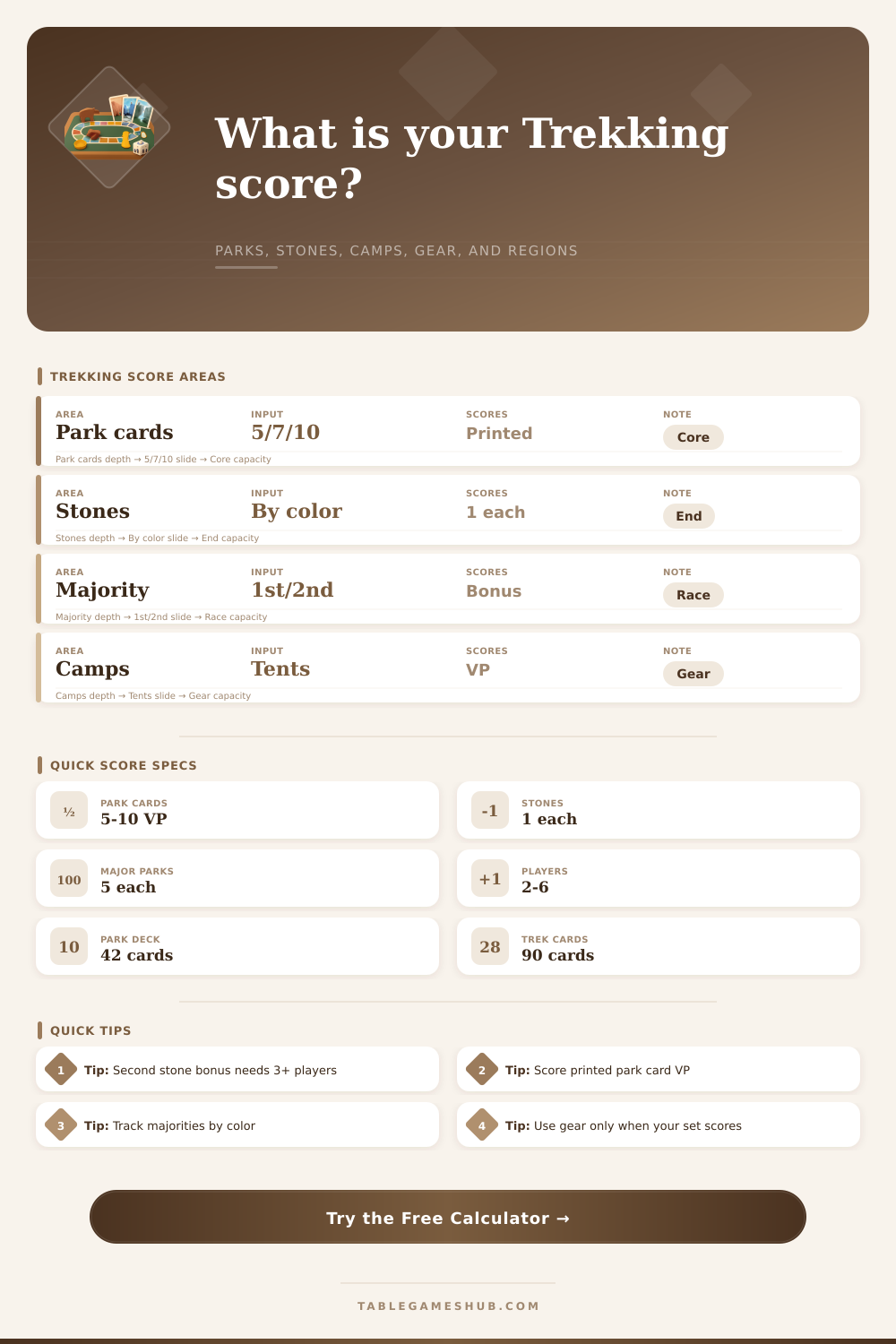
Total park cards, trail stones, color-majority bonuses, major park camps, region routes, camp gear, movement pressure, and final end-game scoring for Trekking the National Parks.
Choose a common end state, then adjust the park cards, stones, camps, region bonuses, gear, and trail movement details to match your table.
Claimed Park Cards
Enter the stones this player collected. Each stone scores 1 VP, then optional first/second majority bonus cards can be added by color.
Major Parks and Camps
Region Bonuses
Camp Gear and End Adjustments
These fields estimate route tempo and card pressure. They are shown separately unless you add a manual bonus above.
| Category | Formula | Input | VP |
|---|
| Stone Color | Collected | Majority Rank | Bonus VP |
|---|
| Score Item | Calculator Field | Formula Used | Common Check |
|---|---|---|---|
| Claimed park cards | 5 VP, 7 VP, 10 VP, other VP | Printed values added directly | Major parks do not count as regular park cards |
| Trail stones | Stone count by color | 1 VP per collected stone | Count only stones in the player supply |
| Stone majorities | Rank dropdown by color | First or second bonus value | Tied awards should be cancelled before entry |
| Major parks and camps | Occupied tents and camp tokens | Count x VP value | Use table edition values or custom entries |
| Regions and gear | Region sets, cards, gear cards | Count x selected VP value | Set values to 0 when playing classic rules |
| Situation | Calculator Entry | VP Handling | Why It Matters |
|---|---|---|---|
| Clear first place in a color | Most stones | Add first majority bonus | Color races can swing the final score |
| Clear second place with 3+ players | Second most | Add second majority bonus | Useful when first is out of reach |
| Two-player game | Second most ignored | Calculator scores 0 second bonus | Second bonus cards are not used in many 2-player tables |
| Tie for a bonus | No bonus, or tie review | Enter cancelled award as no bonus | Tie handling should be settled before totals |
| Tempo Band | Steps per Turn | Exact Landings | Calculator Read |
|---|---|---|---|
| Careful route | Under 2.0 | Low to medium | May favor card draw and targeted parks |
| Balanced trek | 2.0 to 3.4 | Medium | Usually blends stones, parks, and camps |
| Fast loop | 3.5 to 4.9 | High | Strong for stone pickup and reach |
| Cross-country push | 5.0 or more | High | Check whether cards were spent efficiently |
Park cards: Add the printed values from claimed regular park cards; keep major park tent points in the camp section.
Stones: Count every collected trail stone for 1 VP, then add only color bonuses the player actually qualified for.
Regions: For third-edition or house scoring, enter completed region sets and region cards separately so the table can audit them.
Trail moves: Use the tempo card as a route-quality check; movement efficiency is not added to VP unless your table awards it manually.
Endgame Scoring is a form of math that makes a person uneasy. At least, it does when you’re playing Trekking the National Parks. It’s like you’ve set out your tent, rounded up your stones, earned your park cards; but now the numbers is squishy. Did I count those victory points right? Was I supposed to get five points for this park or did I misread the card? Do I really have more red stones than anyone else? What about the bonus points from getting second in yellow?
The End Game Calculator takes all that stress away, because it do the boring part of figuring out how many points everyone gets at end. So you don’t have to fight over point values as you put the game away; you can just celebrate winning. This will spit out a handy chart (see above) showing exactly how much of your total comes from each category: Gear Bonuses, Trail Stones, Park Cards, etc. It’s useful if you’re trying to determine if pushing for the camps would of been better than that stone-heavy strategy or not.
Why You Need This Game Calculator
The game looks like scoring on paper: put down some tokens, add up values on cards. Simple right? Except it’s not. The details occur when multiple people compete for a colored path of trail stones. You gain a point for every stone you possess and the kicker is having most stones of any single color. If you have highest number of stones of a color, you get the bonus card value printed on its track. There may also be a second place bonus depending on player count.
A lot of folks miss out on these bonuses because no one was paying attention well enough to the bonus requirements; they were busy thinking about being first in one color without checking if they also qualified for a second-place bonus. The calculator prompts you to say how many of each color you have and that serves as helpful nudge to review the entire board prior to declaring yourself the winner.
Park cards is simple ways to score some VP. All you have to do is pay some resources or meet certain criteria and they’re yours. No hidden math, simply accumulate. On the front each card tells you how much it’s worth, making it easy to add up. But it’s tempting to reach for those higher value cards first, not necessarily taking into account ability to keep up that resource cost.
There are fields to enter the number of 5, 7 and 10 point cards as well as a custom field for any variant/promo cards. So you don’t need to worry about which expansion or version your friends want to play; it will treat all your different ways to get points equally in the total. Not only does it tell you what your final tally was, but it breaks it down so you can see if you won big because you had lots of stones, or because you made a ton of park claims.
That all adds another level of complexity to camps and regions. This is especially true for house variants and 3rd edition rules. Regions and camps tend to give you steadier, smaller gains while majorities tend to swing big. While you may not feel like you’re doing anything by spending two points on a minor site camp, those points adds up across twelve rounds. To make things even easier to audit, the calculator breaks this out in separate areas and lets you see what exactly was contributing to your scores.
If you spend half of the game chasing gear cards which take sets to score, you need to know if those sets actualy contributed meaningfully to your total. More than likely they did, but you might feel cheated if someone else has a big claim from a park card that steals the spotlight.
You don’t normally score movement efficiency directly for victory points, but it does tell a story of how well you played the engine. The calculator can tracks your card draw versus your spending. It also tracks your moves as a tempo metric. There is no winning or losing here. This is about understanding your playstyle, as having a high step count alongside low card spending might indicate you were efficient (or maybe you were just aimlessly bouncing around). Reviewing these numbers post-game can help you refine your strategy for next time, as you might find you drew too many cards only to sit on them, slowing you down. Or you could have found yourself taking precise moves that allowed you to hit certain spaces exactly when needed to pick up a bonus.
So the thing about this tool is that it takes the friction out of the final tally. Board games are social experiences. There’s not much that kills the mood like a five-minute argument over whether a tie in blue stones means no one gets the bonus or if it should be split between everyone. By default, the calculator treats ties as being cancelled. It will print out a clear breakdown of exactly what happened, which makes things fast and fair since everyone sees the same thing.
This allows you to make adjustments based off house rules. Even then, it doesn’t take long before the points are laid out in front of you and it becomes very clear who won. And that’s where it turns a potential point of conflict into a quiet moment of confirmation.
So you don’t have to be an accountant to play the game anymore. You get to keep the cards in your hand, the stones stay put, and the score is correct. And if that doesn’t satisfy, the losers can begin plotting their revenge right away; provided of course, you first learn the rules.