Double Twelve Dominoes Calculator
Reconcile a 91-tile double-twelve set by player count, starting hand, boneyard, train length, exposed pips, highest double, and live draw odds.
Double-twelve results
| Zone | Tiles | Estimated pips | How it is calculated |
|---|---|---|---|
| Boneyard | 31 tiles | 363.0 pips | Hidden average times boneyard tiles |
| Your hand | 15 tiles | 118 pips | Entered hand pip total |
| Opponent pool | 33 tiles | 386.4 pips | Hidden players after your hand estimate |
| Train layout | 12 tiles | 168 pips | Entered exposed train length and pips |
| Open-train state | Rank matches in set | Single draw | Boneyard window |
|---|---|---|---|
| One open train | 13 of 91 | 14.3% | Recalculate after inputs |
| Two open trains | 25 of 91 | 27.5% | Recalculate after inputs |
| Three train ends | 36 of 91 | 39.6% | Recalculate after inputs |
| Four-way branch | 46 of 91 | 50.5% | Recalculate after inputs |
| Players | Common hand | Opening boneyard | Opening note |
|---|---|---|---|
| 2 players | 16-20 each | 51-59 tiles | Longer hands keep the stock useful. |
| 3 players | 15 each | 46 tiles | Large boneyard, wide draw margin. |
| 4 players | 15 each | 31 tiles | Common double-twelve train setup. |
| 5-6 players | 12 each | 19-31 tiles | Lower hand keeps everyone supplied. |
| 7-8 players | 10 each | 11-21 tiles | Watch the boneyard shrink quickly. |
| 9-10 players | 8 each | 11-19 tiles | Best modeled as a crowded table. |
| Double tracked | Tile pips | Rank tiles | Set impact |
|---|---|---|---|
| 12-12 | 24 pips | 13 tiles include rank 12 | Highest pip double and common engine marker. |
| 10-10 | 20 pips | 13 tiles include rank 10 | High double still changes pip pressure heavily. |
| 6-6 | 12 pips | 13 tiles include rank 6 | Middle double with average-ish pip load. |
| 0-0 | 0 pips | 13 tiles include blank | No pip value, but still a double location concern. |
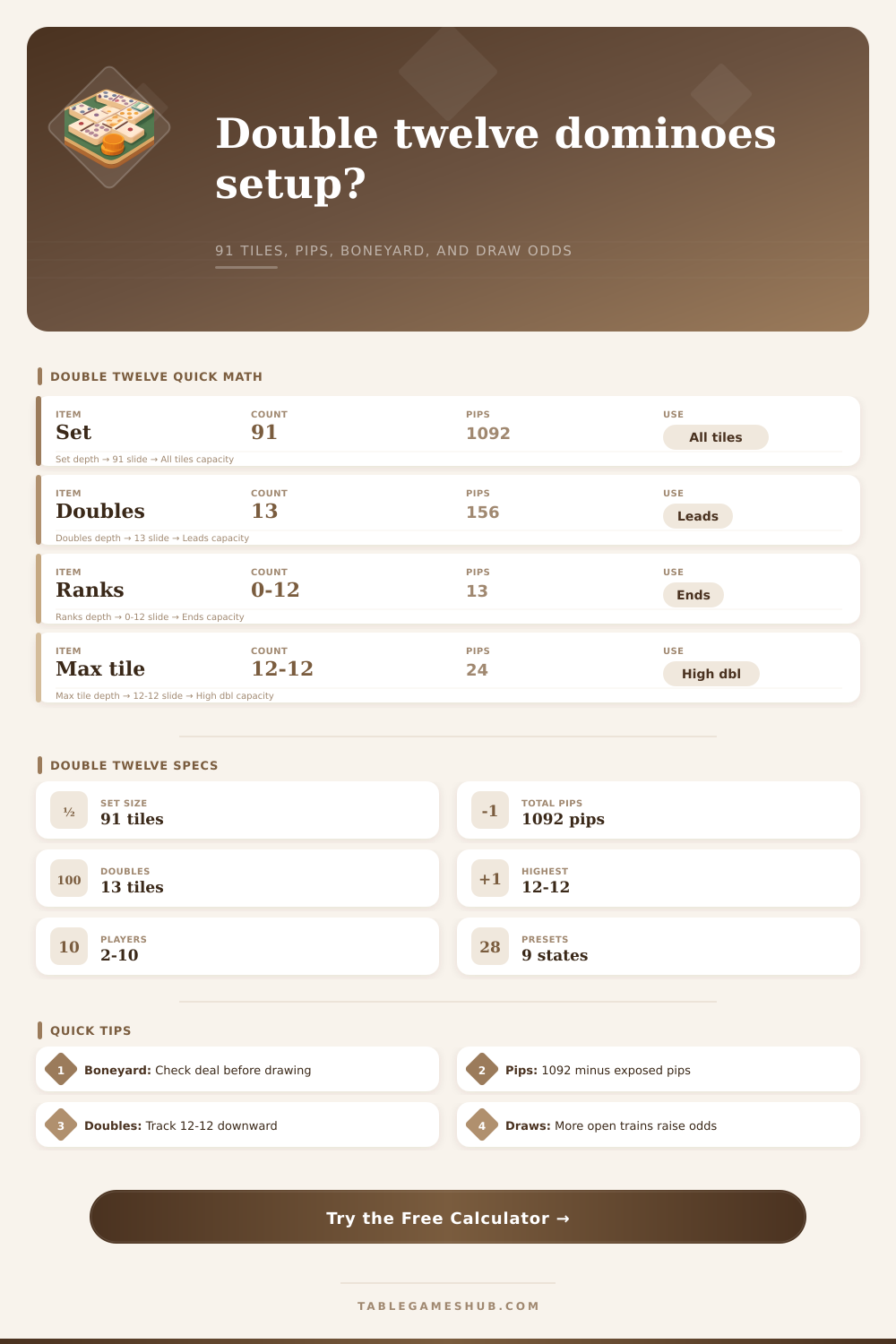
When you bring out the double twelve set instead of the standard double-six set, suddenly there are many more pieces (ninety-one), rather than typical twenty-eight, which makes for a completely different flow to the game. You is no longer just matching numbers; instead, probability takes over. It’s more about having to deal with a complex system of pips, in which remembering what has been played matter less and probability begins to come into play.
Because there are so many combinations available, it is rarely in your best interest to hold onto a certain tile, hoping to block someone else from playing it. Rather, knowing what’s left in the boneyard and reading it well are key. When you input the current state of your board into calculator above, it will crunch the numbers and let you know if a draw is possible, without having to wonder “hmm… could I get there?”. This compares fixed amount of 1,092 pips against the pips you have already seen and those you haven’t.
How to Play Double Twelve Dominoes Using Math
By knowing this, you can estimate how many pips are left to be drawn. You can also estimate how much value your opponents might have and whether they’ve already discarded their high value tiles. If the boneyard is full, then there’s still a lot of variance to go, and anyone’s got a chance of turning things around. However, if it’s bare, game becomes all about who has matching tiles in their hands.
There’s one key thing I track… The double that hasn’t been seen yet. In a normal set you’ll recall having seen the six-six and then think it’s out of play. When there are ninety-one tiles, the doubles stretches as high as twelve-twelve (with twenty-four pips all by itself). If that highest double hasn’t come up on any train, there has to be a single tile somewhere, either in the boneyard or in some player’s hands. The calculator will work out what the probability would of be that said tile would be found in either location, depending on how many tiles haven’t accounted for themselves. That can influence your decision-making, such as whether to go aggressive or save lower-pip tiles for later.
The number of open trains also affects your likelihood of drawing a good tile. If you have a lot of public branches and make it look like a Mexican train then it has more ends compared to a private train only scenario. That means there are more rank to play. Therefore, it is more likely that the next tile you draw from the boneyard is one you can use right away. This is where the reference table on the page comes into play. It shows the odds for single end vs multi-branch draws. As you can see, the more blocks you have on the board (blocked lines), then your chance of pulling an immediate hit decrease a lot. That’s why skilled players tend to lean toward starting with layouts that leave several paths open so they don’t get stuck waiting to see what happens.
The size dynamics change drastically depending off how many people are at the table. At a two-player table, hands will be large, the boneyard will be deep and you’ll have time to make long strategic plays, waiting for the right match to fall into your lap. In games with eight or ten players, hands gets tiny and you’re forced to play faster with less control over the pace. The calculator factors this in and adjusts to match. This gives you a realistic idea of what sits quietly in center stack versus what your opponent might have hidden away in his grip. Knowing this gives you insight into how much control you do-or don’t-have over direction of the game.
So how does one play double-twelve? It’s not so much about memory as it is understanding how the odds change over time. This means that whatever your chosen strategy might be, the tiles don’t give a damn. They’re only reacting to the mathematics behind the remaining options. When you use these devices to follow the absent doubles and expose the buried pips, you cease to play against blind chance. Instead, you begin to view each draw as an exercise in measured risk. And that mindset is naturaly the difference between consistent success and crossing your fingers and hoping for the best. Sure, the jumble of ninety-one tiles might appear confusing when looked at. But when you plot out their probabilities, the picture begins to reveal itself, actualy making it easier.