D8 Probability Calculator
Calculate exact d8 odds for single checks, dice pools, sum targets, exact totals, rerolls, exploding 8s, keep-highest rolls, and opposed contests.
Choose the roll structure first, then set the target, dice pool, modifier, and optional d8 mechanics.
| Single d8 event | Favorable faces | Probability | Decimal |
|---|---|---|---|
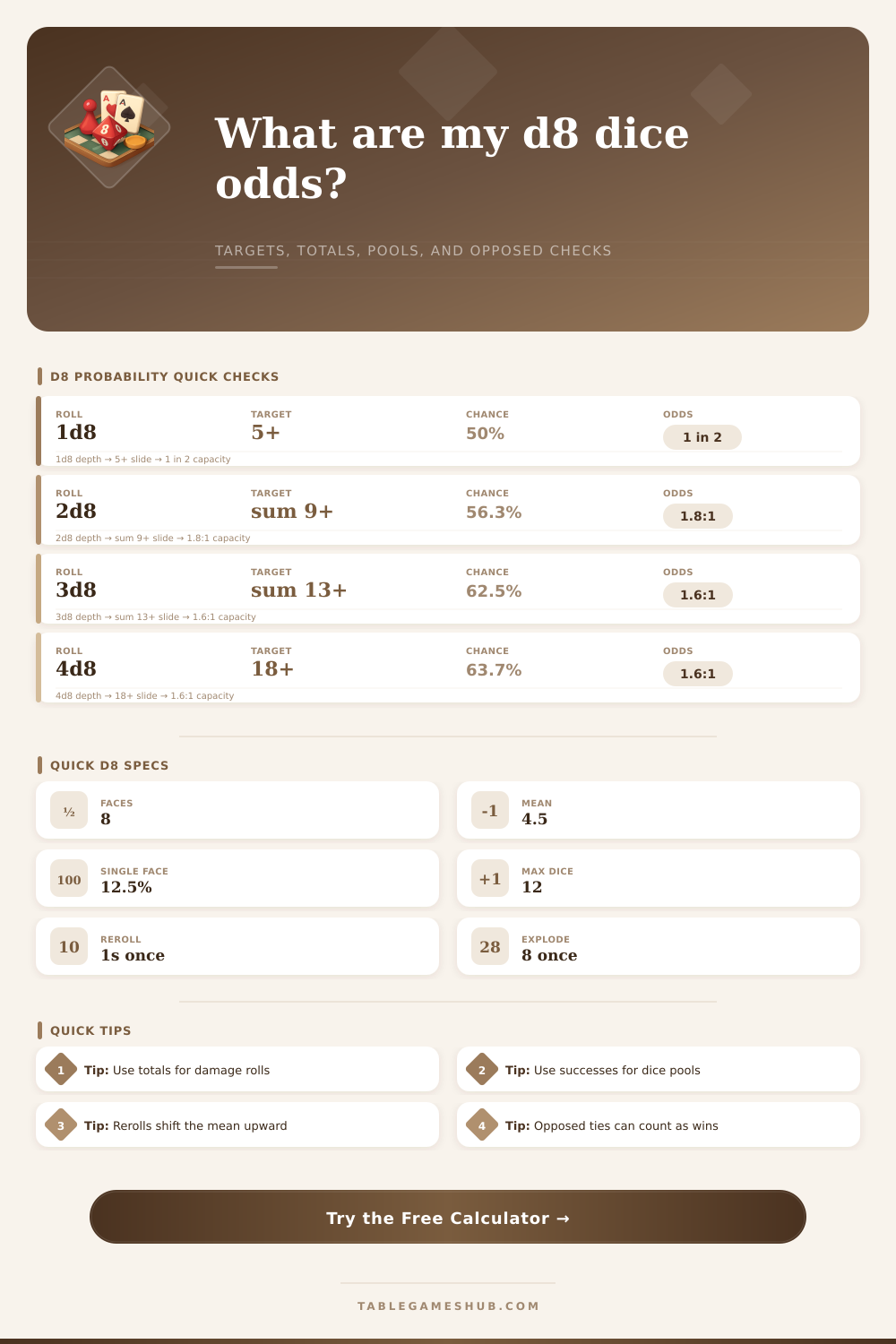
| Roll 2 or higher | 7 of 8 | 87.5% | 0.875 |
| Roll 4 or higher | 5 of 8 | 62.5% | 0.625 |
| Roll 5 or higher | 4 of 8 | 50.0% | 0.500 |
| Roll 6 or higher | 3 of 8 | 37.5% | 0.375 |
| Roll 7 or higher | 2 of 8 | 25.0% | 0.250 |
| Roll exactly 8 | 1 of 8 | 12.5% | 0.125 |
| Roll | Minimum | Average | Maximum |
|---|---|---|---|
| 1d8 | 1 | 4.5 | 8 |
| 2d8 | 2 | 9.0 | 16 |
| 3d8 | 3 | 13.5 | 24 |
| 4d8 | 4 | 18.0 | 32 |
| 5d8 | 5 | 22.5 | 40 |
| 6d8 | 6 | 27.0 | 48 |
| Dice pool | Need 6+ | At least one | At least two |
|---|---|---|---|
| 2d8 | 37.5% per die | 60.9% | 14.1% |
| 3d8 | 37.5% per die | 75.6% | 31.6% |
| 4d8 | 37.5% per die | 84.7% | 48.3% |
| 5d8 | 37.5% per die | 90.5% | 62.8% |
| 6d8 | 37.5% per die | 94.0% | 73.8% |
| Mechanic | Best use | Math model | Effect |
|---|---|---|---|
| Keep highest | Advantage checks | State distribution | Raises the top result |
| Reroll 1s once | Quality dice | Weighted face table | Mean becomes 4.9375 |
| Exploding 8 once | Open-ended damage | Extended face table | Mean becomes 5.0625 |
| Success count | Dice pools | Binomial probability | Counts faces at threshold |
| Opposed roll | Contests | Distribution compare | Checks every matchup |
Total rolls: Use sum modes when every pip matters, such as damage, resource output, or random-event strength. The expected total is helpful, but the probability card tells you how often the stated target actually lands.
Dice pools: Use success-count mode when each d8 is a separate attempt. A threshold like 6+ gives each die a 37.5% success chance before rerolls, keeps, or explosions change the distribution.
Tabletop games has their own type of die: the eight-sided one. It isn’t the heroic twenty-sider, and it isn’t the boring workhorse known as the six-sided cube. No, d8 hits a sweet spot. It provide a reliable baseline for skill checks or damage rolls but has just enough variance to prevent things from getting stale.
For the most part, gamers looks at dice like mere random number generators. You roll ‘em, you tally up the results, and you’re done. But knowing what’s actualy happening with those eight-sided dice makes for a whole new way of viewing your combat strategy and even your character building.
Understanding Your D8 Dice Rolls
You input your specific circumstances, and calculator does the math for you. It spares you from needing to guess complicated distributions. First, select your calculation mode, this describes how the tool understands success. Are you trying to roll a specific amount (e.g., 12 damage)? Then pick “exact” or “target total.” The tool calculates the chance that you’ll achieve it given size of your dice pool.
Or maybe your game has you roll a dice pool where the result is determined by how many times you rolled a certain face? Switch to the “success-count pool” mode. This is common with moddern narrative games. Set a threshold for a “hit” (such as a “six or higher”) and define how many successes is required. The tool tells you the odds through binomial probability.
People often misinterpret what happens when you add a modifier to a dice pool. For example, a flat +1 to the pool doesn’t have the same effect as adding an extra die. Adding a die shift the curve more broadly and increases the variance. Instead, a modifier just moves the whole curve upward or downward unchanged. It doesn’t change shape of the curve. This is laid out nicely in the reference table on the page where it shows how the mean scales for each new d8.
Take some time to think about the explosion and reroll mechanics. Many system allow you to reroll ones or explode eights for extra damage. While these rules might not look like much at a glance, they do have a big effect on expected value of your roll. By exploding dice, you add an open ended potential which shifts the distribution towards higher values. By rerolling ones, you remove worst case scenario from consideration which nudges average slightly upwards. Select any of these options in the die rule adjustment menu and calculator will take care of these adjustments for you.
This is helpful if you’re trying to compare two character builds where one offers unpredictable high values and the other provides a more consistent bonus. The complication come when opposed checks enter the picture. Now, you’re not only trying to beat a number. You’re trying to outpace the odds. Depending on how closely your possible outcomes align with opponents’, you’ll have a certain likelihood of success or failure.
In general, if both sides has equal dice pool sizes and similar modifiers, the odds will be roughly even. If one party has significantly more resources than the other they’ll start to dominate the math. The tool can break this down for you, because it compares each potential outcome in any given match-up. Instead of leaving you with a feeling that “you’ve got this” or “this is going to be close,” it presents you with a specific win percentage.
When planning, keep in mind the core column of results. More dice combinations falls into average range. Extreme high/low dice combination are always far less probable then middling results. In other words: Moderate, consistent bonuses are frequently better than explosive-but-rarely-seen bonuses.
Remember… The dice calculator tells you the central band (the most probable rolls) and the expected total. It also tells you where the heck most of your dice rolls will be. Adjust your campaign expectations accordingly. Unless the game mechanics reward outrageous results, you should of don’t plan on building a strategy around outliers.
The thing about probability is it doesn’t take any fun out of rolling dice. It only puts it in context. With knowledge comes power. Knowing why you won or lost. And if you have good odds but still lose? Sometimes that happens anyway. Randomness is random. But knowing that you have worse odds then you felt at the moment you rolled them makes you a better player.
A d8 isn’t just a piece of plastic with some numbers on it. It’s a decision making tool. Treat it as such.