Kakuro Combination Calculator
Enumerate valid clue combinations using sum, cell count, no-repeat digits, required digits, excluded digits, and crossing-cell intersections.
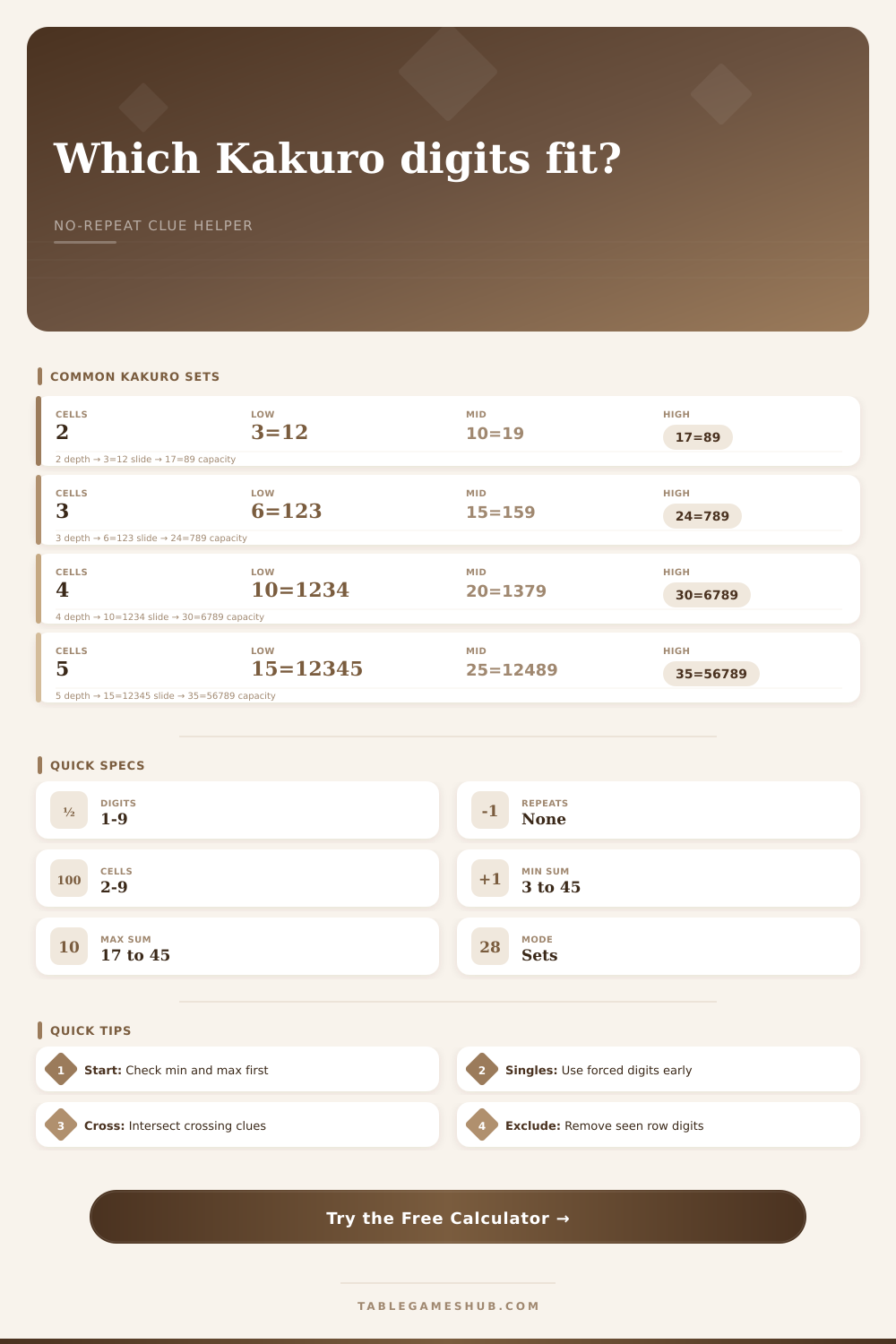
| Cell count | Minimum set | Minimum sum | Maximum set | Maximum sum |
|---|---|---|---|---|
| 2 cells | 1 + 2 | 3 | 8 + 9 | 17 |
| 3 cells | 1 + 2 + 3 | 6 | 7 + 8 + 9 | 24 |
| 4 cells | 1 + 2 + 3 + 4 | 10 | 6 + 7 + 8 + 9 | 30 |
| 5 cells | 1 + 2 + 3 + 4 + 5 | 15 | 5 + 6 + 7 + 8 + 9 | 35 |
| 6 cells | 1 + 2 + 3 + 4 + 5 + 6 | 21 | 4 + 5 + 6 + 7 + 8 + 9 | 39 |
| 7 cells | 1 + 2 + 3 + 4 + 5 + 6 + 7 | 28 | 3 + 4 + 5 + 6 + 7 + 8 + 9 | 42 |
| 8 cells | 1 + 2 + 3 + 4 + 5 + 6 + 7 + 8 | 36 | 2 + 3 + 4 + 5 + 6 + 7 + 8 + 9 | 44 |
| 9 cells | 1 + 2 + 3 + 4 + 5 + 6 + 7 + 8 + 9 | 45 | 1 + 2 + 3 + 4 + 5 + 6 + 7 + 8 + 9 | 45 |
| Clue | Cells | Only or common sets | Useful deduction |
|---|---|---|---|
| 3 | 2 | 1 + 2 | Both digits are forced |
| 4 | 2 | 1 + 3 | Both digits are forced |
| 16 | 2 | 7 + 9 | Both digits are forced |
| 17 | 2 | 8 + 9 | Both digits are forced |
| 6 | 3 | 1 + 2 + 3 | All three are forced |
| 7 | 3 | 1 + 2 + 4 | All three are forced |
| 23 | 3 | 6 + 8 + 9 | All three are forced |
| 24 | 3 | 7 + 8 + 9 | All three are forced |
| Filter | What it does | Best use | Example |
|---|---|---|---|
| Required digits | Keeps sets containing every listed digit | Locked crossing cells | Required 7 in 17/3 |
| Excluded digits | Removes sets containing any listed digit | Digits already impossible in a run | No 1 or 2 in 23/4 |
| Must contain | Shows sets that include the tested digit | Testing one crossing candidate | Can 8 fit in 35/5? |
| Cannot contain | Shows sets that avoid the tested digit | Testing eliminations | What remains if 5 is out? |
| Only forced digits | Summarizes digits present in every candidate set | Finding guaranteed entries | Look for common digits |
For many people, there’s a particular category of frustration reserved for those who love the logic behind solving puzzles like Kakuro, but abhor the mental arithmetic required to make it happen: “I look at an eighteen split out over three cells, my brain fires off all sorts of combinations, seven plus eight plus three, six plus nine plus three, and I’m stuck in this messy web of possibilities that clogs up my working memory before I’ve written down one digit.” That’s where the calculator above come in. It runs the numbers for you, removes the noise, and lets you get back to business of focusing on logic itself. From there it becomes a process of elimination instead of a guessing game.
Kakuro’s basic rule is easy to grasp. You have number 1-9, and you can’t repeat a number in a single run. This restriction sets a limit on what can be true. The largest possible value for a pair of cells? Seventeen: 8+9. Anything more higher than that means you’ve got a problem. What this tool does are help draw those lines. Give it a number of cell and a sum, and it returns all valid unordered combinations. Unordered is key there; the calculator doesn’t care about order, just digits themselves. So it’ll tell you that it’s seven and nine, not which is which. And why is that relevant? Because usually position is determined by other clue (crossing), not by actual sum.
Why Use a Calculator for Kakuro Puzzles
First, eliminate the impossible. Most folks gets tripped up here: They see a clue and attempt to memorize every combination of possible answer until one feels right. No! Cross off what isn’t there. If there’s an existing number in a crossing cell, put that number in your exclusion field. Bam! Your list get smaller immediately. Not only are you saving time, but also reducing mental effort for yourself. Each digit you cross off is another variable that you don’t need to hold in your head.
The intersection helper goes one better. By using it, you can plug in a single digit and let it run through the remaining set. Say you think a particular cell could be a four. You can pose this hypothesis to the tool, and it will tell you if that holds water. If it doesn’t find any valid set with that four in them, bam! You just made a deduction without using pen and paper.
The required digits field will become your anchor here. If you get one cell in a group, often the whole thing falls right into place. If you know you have a seven somewhere in a three cell twelve then you must of had a two and a three elsewhere. The calculator filters through all these sets until it finds one that contains the number you are sure of.
And it does more than spit back options. It shows the way. That’s why the reference table on the page make it so clear how to solve short clues. Clues with low sums (three/four) in two cell can only go one way. Ones with high sums (sixteen/seventeen) lock in fast too. Where the problem becomes ambiguous is in the middle ranges. And that’s when the tool pay off.
Most times in puzzle solving the solution isn’t what you’re looking for; it’s the process of eliminating options until the solution screams out as the only possibility. But rather than eliminate across the entire grid, you want to narrow down to a single forced move. That’s where the calculator help. Instead of freezing yourself with choices, it shows you what you can use and what you should never have considered. Eliminate the impossible possibilities and suddenly remaining combinations become clear. Then you know, instead of having to guess.
When the puzzle is thick with numbers, and the clock is ticking, it’s all too easy to go down a rabbit hole of math. Take a step back and remind yourself what the minimum sum would be for a particular cell count, and what the maximum sum could be. If your working guess falls outside these limits, you’re barking up the wrong tree. Catch yourself there and save a few minutes’ worth of dead-end paths.
It’s not about completing the puzzle, but about the satisfaction of moving through it logicaly and cleanly. Let the machine do the heavy lifting. You do the thinking. That’s what separates a pleasant solve from a slog.