Nerf Dart Range Calculator
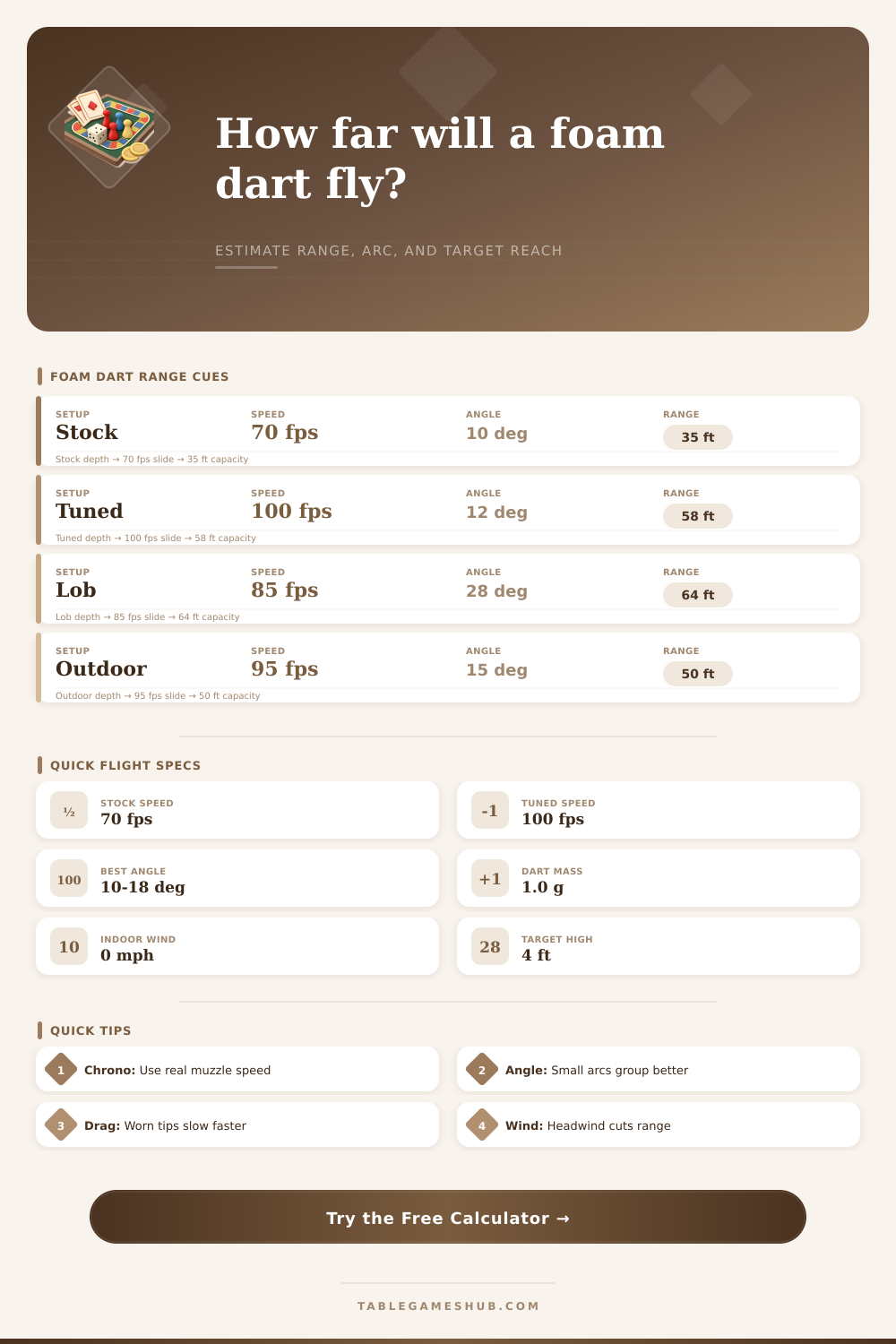
Estimate foam dart carry distance, target reach, flight time, and arc height from launch speed, angle, mass, drag, wind, mode, and target height.
| Preset | Launch speed | Angle | Dart profile | Best use |
|---|---|---|---|---|
| Stock indoor | 70 fps | 10° | Elite full-length | Living room or garage range checks |
| Tuned elite | 95 fps | 12° | Waffle or elite tip | Repeatable target lane testing |
| Half-length pro | 130 fps | 8° | Short stable dart | Flat shots at longer indoor targets |
| Mega lob | 75 fps | 25° | Mega foam dart | Big foam darts with visible arc |
| Profile | Relative drag | Stability | Mass cue | Range effect |
|---|---|---|---|---|
| Elite full-length | Medium | Medium | 0.9-1.1 g | Baseline foam dart estimate |
| Waffle tip | Medium-high | High | 1.0-1.2 g | Shorter carry but better consistency |
| Half-length pro | Lower | High | 0.9-1.1 g | Better flat range at high speed |
| Worn or bent | High | Low | Varies | Noticeably shorter and less repeatable |
| Angle band | Trajectory feel | Target height fit | Range tradeoff | Practical note |
|---|---|---|---|---|
| 0-6° | Very flat | Same-height targets | Fast drop | Best for close accuracy lanes |
| 7-15° | Flat arc | Waist to chest height | Strong useful range | Most repeatable for foam darts |
| 16-30° | Visible lob | Higher or distant targets | Longer hang time | More sensitive to wind and spin |
| 31°+ | High arc | Over obstacles | Less predictable | Useful for fun, not tight groups |
| Mode | Air cue | Wind setting | Expected effect | Setup check |
|---|---|---|---|---|
| Indoor still air | Stable | 0 mph | Most repeatable estimate | Watch vents and ceiling fans |
| Indoor hallway | Channelled air | 0-2 mph | May carry slightly cleaner | Measure from muzzle to wall target |
| Outdoor open air | Turbulent | 2-10 mph | Shorter practical range | Repeat shots in both directions |
| Long test lane | Controlled | 0-3 mph | Good for comparing darts | Keep launch height consistent |
Range is another important factor to consider when using a foam dart blaster. Range is actualy more important than speed for foam darts because there are many variable that influence the distance that the foam dart will travel. A calculator can help to account for these different variable to set up a test lane or game for the foam darts.
Using the calculator will remove the guesswork from the aiming process because the calculator use mathematical equations to find the variables that influence range. While many people feel that the speed of a foam dart is the most important factor in its performance, speed isnt the only important factor. Although higher velocities will propel the foam dart further in an environment without air resistance, the light weight and blunt end of a foam dart will cause it to lose it’s initial velocity quick due to air resistance.
Find Foam Dart Range Using a Calculator
The loss of velocity will be even greater once the foam dart begins to arc away from the blaster. By entering the velocity and angle at which the foam dart is to be launched into the calculator, the calculator will compute the drag penalty for the foam dart. The range that the foam dart will travel is the distance from the blaster to the point at which the foam dart slows to the velocity that is calculated after the drag penalty is apply to the initial velocity.
The angle at which the foam dart is launched is one of the variables that will impact the distance that it will travel. The launch angle may be surprising for many people. Many envision launching the foam dart as flatly as possible from the blaster.
However, when launched at such an angle, the foam dart will drop towards the ground almost immediately after it leave the blaster. Increasing the angle of the launch by a few degrees will cause the foam dart to remain in the air for a longer period of time. The calculator will display the ground distance that the foam dart will travel.
Additionally, the calculator will also display the distance at which the foam dart will cross a set height of the target. This is important in that the target might be of chest height or must be cleared by the foam dart. The mass of the foam dart and the shape of the tip of the dart will have an impact upon the distance that it will travel.
Due to the momentum created by a heavier foam dart, it will travel further once it slows to an end. However, the speed at which it must leave the blaster to reach a certain height will be greater with the additional mass of the foam dart. If the tip of the foam dart is bent or the tip is worn, it will create additional drag that will reduce the range at which the foam dart will travel.
A condition selector on the calculator will allow for these variables of condition of the foam dart to be account for. Not all foam darts are created equally. Wind will impact the distance that the foam dart will travel.
Indoor players often do not consider the effect of the wind on the range of the foam dart. If the wind is moving towards the player, it will reduce the range at which the foam dart will travel. However, if the wind is pushing in the same direction as the foam dart it will travel at a greater distance.
However, the increased distance caused by a tailwind will make it more difficult for a player to group their shot. The crosswind will not impact the distance that the foam dart will travel. However, it can push the foam dart sideways.
The setting for the wind direction on the calculator will apply a modifier to the distance calculation to ensure it is honest with the player. Both the height from which it is launched and the height of the target will determine if the shot is to be use. If the foam dart is launched from chest height and aimed at a low angle, the foam dart may hit the floor prior to reaching the target.
The target height in the calculator will allow the player to adjust for this variable. This is important for players who must achieve a certain height of the target for the game. The setting for environment in the calculator will allow for the user to adjust for different environments in which they may be playing.
While indoor air is generally the same throughout a given area, there may be breezes created by ceiling fans or vents. Outdoor air may be more turbulent so the setting will apply a penalty to the range calculation so that it does not overpromise the distance that the foam dart will travel. While the range calculator provides an excellent estimate of the distance at which a foam dart will land, the only way to be certain is to perform the shots themselves.
Place a marker at the spot at which the foam dart makes contact with its target. Foam darts can bounce off of their targets. Take the average distance of several shots with the same type of foam dart.
The figure provided by the calculator is more accurate than intuitions of range. While the range calculator is a helpful tool for players of all levels, the most common mistake by inexperienced players is to treat the calculated distance as a guarantee. Because there are numerous variables in play, the range that is calculated is only an estimation.
Additionally, there are natural variations among foam darts, as well as in the skill with which the estimation is executed. The calculator removes the variables that can be account for so that individuals become aware of the variations in the other factors. Using these numbers allows for a better understanding of how each of the variables impact the range of the foam dart.