⛳ Golf Best Ball Calculator
Build a team scorecard from player gross scores, handicap strokes, low-net selection, tie-breakers, and a scramble comparison.
| Measure | Value | Formula | Read |
|---|
| Format | Typical team | Handicap allowance | Calculator handling |
|---|---|---|---|
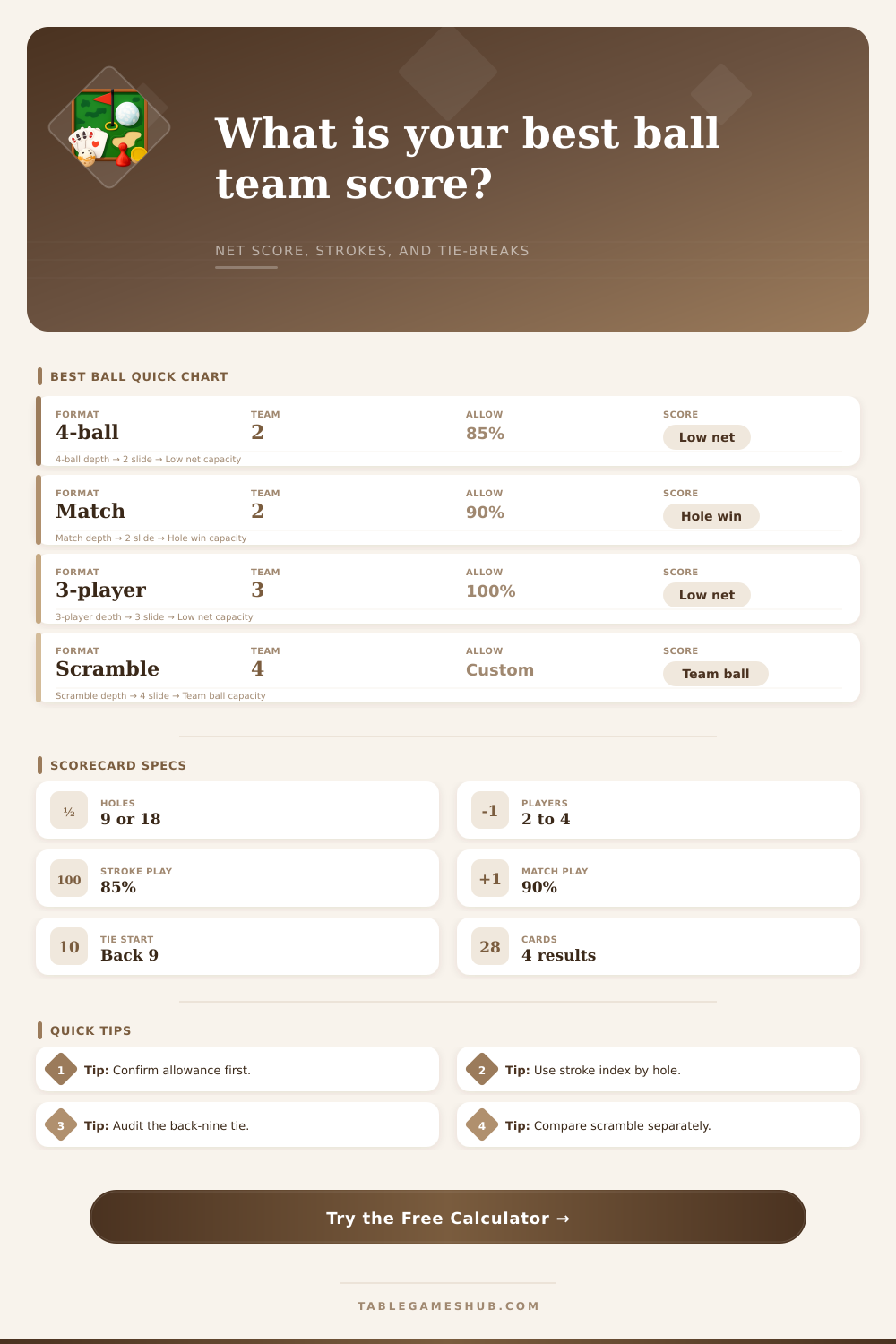
| Four-ball stroke play | Two partners, each plays their own ball | 85 percent recommended allowance | Playing handicap equals course handicap times allowance, rounded to whole strokes. |
| Four-ball match play | Two partners against another side | 90 percent from the lowest player | Lowest playing handicap is zeroed, then others receive the rounded difference. |
| Team best ball | Three or four players on one side | Often full course handicap by committee | Every active player is allocated strokes by their playing handicap. |
| Custom allowance | Club event or mixed field | Committee selected percentage | The entered percentage is applied before stroke allocation. |
| Stroke allocation case | Example playing handicap | Stroke-index effect | Net score handling |
|---|---|---|---|
| Playing handicap 5 | Receives one stroke on SI 1 through 5 | Five hardest holes only | Gross score minus one on those five holes. |
| Playing handicap 18 | Receives one stroke on every hole | All 18 holes | Gross score minus one on each hole. |
| Playing handicap 24 | Receives one on every hole, plus SI 1 through 6 | Six hardest holes get two | Gross score minus two on SI 1 through 6. |
| Plus playing handicap -2 | Gives back strokes on SI 18 and 17 | Two easiest holes add one | Gross score plus one on those holes. |
| Tie-break method | First read | Second read | Best use |
|---|---|---|---|
| Back-nine countback | Holes 10 through 18 | Back 6, back 3, final hole | Common 18-hole scorecard tie-break. |
| Front-nine countback | Holes 1 through 9 | Front 6, front 3, ninth hole | Useful for shotgun starts or front-nine events. |
| Hardest holes | Lowest stroke-index holes | Next hardest holes | Highlights scoring on the most stroke-relevant holes. |
| Contributor count | Number of players who won a hole | Shared-low holes as support | Shows whether one player carried the whole card. |
| Best ball vs scramble | Ball in play | Scorecard source | Comparison note |
|---|---|---|---|
| Best ball | Each player keeps their own ball | Lowest eligible player score by hole | Shows who contributed each scoring hole. |
| Scramble | Team selects one preferred ball after each shot | One team score per hole | No individual gross line is preserved for best-ball selection. |
| Gross best ball | Each player ball | Lowest raw score per hole | Best for scratch events and gross awards. |
| Net best ball | Each player ball with strokes | Lowest score after handicap strokes | Best for handicap events with mixed abilities. |
Apply the allowance before allocating strokes
Playing handicap is calculated first, then strokes are placed onto holes by stroke index. That order keeps low-net hole selection consistent.
Compare scramble as a separate format
A scramble score can be lower because the team plays one selected ball. Use the comparison card as context, not as a replacement for best-ball scoring.
Golf best ball is a format in which each player on a team play they’re own ball on each hole, and the team score is based on the lowest score for each hole by the players on that team. Unlike scramble golf, in which each team move the ball of the best player on the hole, in best ball, each player must play through the course with their ball. In calculating the best ball score for each team, the calculator must account for the handicaps for each player.
Each player may have a different handicap, and as a result, there is different strokes to add to each player score for each hole on the course. To account for this, a calculator can be used to determine the best ball total for each team. For the calculator, the team may use an 85 percent score for four ball events.
How Best Ball Golf Works and How to Score It
The reasoning behind the 85 percent score is that two players can beat one player on a golf course. For match-play events, however, the percentage may be 90 percent. In this case, the player with the lowest handicap on the team will have a score of zero for the round, and each of the other players on the team will recieve the number of strokes that the difference in the players scores.
It is also possible to use the players full handicaps in this situation. If the event is changed to team best ball, each player will receive 100 percent of their handicap for each round of golf. The percentage allowance will be used before the strokes is allotted to each player to each hole.
With each round of golf, a player will earn strokes on some holes over others. The player with the highest handicap will earn strokes on the players hardest holes, and the player with the lowest handicap will earn strokes on the easiest holes for each player. By entering the handicap of each player and the strokes that each player receives on each hole, the calculator can determine which holes will receive a stroke for each player.
When comparing two teams with the same total score, a tie-break will occur. Many golf teams use a back-nine method to resolve ties. The scores for the last nine holes will be compared first, and then the calculator will compare the scores for the last six holes.
The scores for the last three holes will then be compared, and the 18th hole. Some teams use a front-nine tie method instead, or a tie that only counts the six hardest holes on the course to score for the round of golf. The tie method can be toggled in the calculator to determine each teams score using different methods.
In addition to calculating the best ball score for a round, a calculator may also compare that score to the score that would be recieved in a scramble game. In scramble games, each player for a team will play one ball after each shot for each hole. Thus, each teams score in scramble will be lower than each teams score for best ball.
By comparing the scramble score to the best ball total score, the difference in scoring can be observed for each team. The total score for each team calculated on the calculator may not be accurate if the weather or course conditions on that day differed from the usual conditions for that course. If one of the players on a team had a poor score due to the weather, for instance, that players score on each team will change the total score for that team.
Thus, the scores for each player and the data for each course must be entered correctly to recieve an accurate total score for the best ball competition. The tables referenced within the calculator include the common rules for different types of best ball games. The tables show various handicap strokes that a player will give to a player field when they have a plus-handicap on a round of golf.
The tables also show strokes that are given to high-handicap players. These tables can help a player to ensure that their chosen score for each type of competition is in accordance with the rules of that competition. The total number of strokes for each player and the stroke indexes for each hole must be entered into the calculator.
Additionally, each players score for each hole must also be entered. Once these scores are entered, the calculator can display the competition total, the gross total score, the number of strokes needed to reach a target score, and the tie-break method. This calculator can save players the arithmetic calculations for computing the best ball competition total.
Additionally, it can show which player scribed the lowest score on each hole for the competition. By providing this view of the competition, players can understand the result of the competition, and the decision of team scores for each player.