French Tarot Score Calculator
Total a hand from contract type, oudler count, card points, petit au bout, poignee, slam, and the player-count settlement.
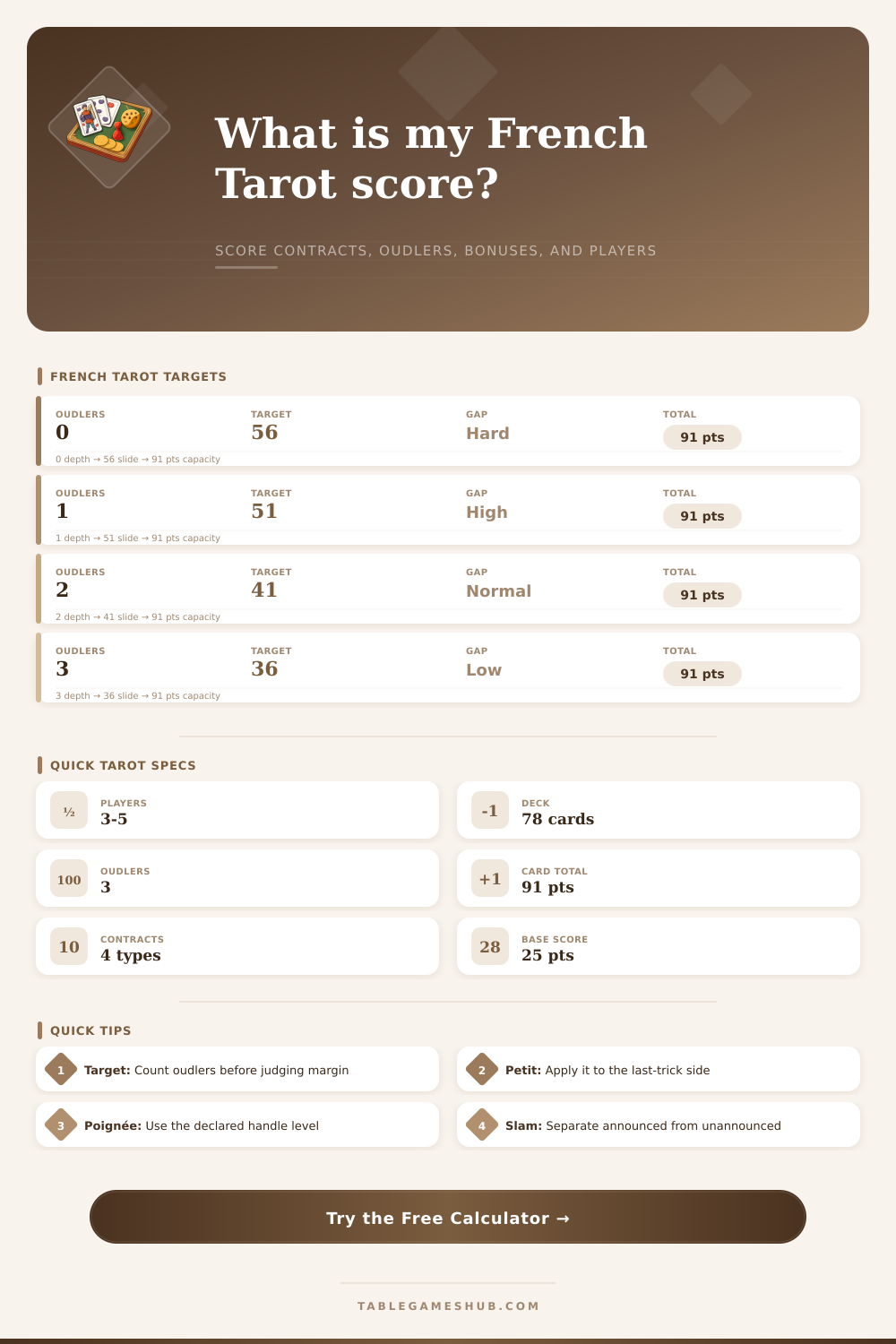
| Oudlers won by attack | Target card points | Practical meaning | Common pressure point |
|---|---|---|---|
| 0 oudlers | 56 points | Highest target | Needs many court cards and trumps |
| 1 oudler | 51 points | Demanding but normal | Often decided by a few half-points |
| 2 oudlers | 41 points | Flexible target | Petit au bout may swing the score |
| 3 oudlers | 36 points | Lowest target | Usually supports higher contracts |
| Contract | Coefficient | Core formula | Use case |
|---|---|---|---|
| Petite / Prise | x1 | (25 + margin) x 1 | Smallest accepted attack |
| Garde | x2 | (25 + margin) x 2 | Standard confident attack |
| Garde Sans | x4 | (25 + margin) x 4 | Attack without taking the chien |
| Garde Contre | x6 | (25 + margin) x 6 | Chien left to the defense |
| Bonus | Value | Multiplier | Calculator treatment |
|---|---|---|---|
| Petit au bout | 10 points | Contract coefficient | Added to the side winning the last trick with the petit |
| Single poignée | 20 points | Not multiplied | Credited to the declaring side |
| Double / triple poignée | 30 / 40 points | Not multiplied | Credited to the declaring side |
| Slam | +200, +400, or -200 | Not multiplied | Entered from the attack team's perspective |
| Players | Attackers | Defender multiplier | Attack total shown |
|---|---|---|---|
| 3 players | 1 attacker | 2 defenders | Per-defender score x 2 |
| 4 players | 1 attacker | 3 defenders | Per-defender score x 3 |
| 5 players | 1 attacker | 4 defenders | Per-defender score x 4 |
| 5 players | 2 attackers | 3 defenders | Per-defender score x 3 |
To play the game of French Tarot, the players must calculate the score for each round using a mathematical process. A single half-point in the score for each player can significanly impact the score for every player at the table. Due to the complexity of the game and the various mathematical elements involved in calculating the score for each round of game, players typicaly use a calculator to determine the values of each score component before entering the values into the scorebook that is used to record the scores of each players.
The first step in using a calculator to score a game of French Tarot is to enter the contract that each player played. Each type of contract utilizes a different multiplier for the score; contracts like a petite use a small multiplier, while contracts like a garde sans or a garde contre use much larger multiplier. These different values of the multipliers impact the total value of the score that is obtained by each player by the number of tricks that are taken.
Scoring French Tarot with a Calculator
By entering the contract into the calculator, the program automatically applies the correct coefficient to the game score, eliminating the need for the players to remember these different coefficients. After entering the contract into the calculator, the next step is entering the oudler count for the round of game. The oudler count for a round is comprised of three different values: the three oudlers, the 1 of trumps, the 21 of trumps, and the Excuse card.
Each of these cards have a specific point value for the round. If any of the attacking team should miss an oudler, the target score for that game is incremented by either five or ten point. The calculator automatically compares the entered values of each player’s card points to the oudler count to ensure that there are no errors in the calculation of each players score.
The next step in using the calculator to score a game of Tarot involves entering the total number of points for all of the players’ cards. Each player’s total number of card points is counted in half-point values, and the total number of points for all of the players’ cards within a complete deck of Tarot is always ninety-one point. The margin of the score is one of the most important elements within the game.
If the taker finishes three points above the target score with a garde contract, they will score twice the value of the margin. However, if the taker finishes three points below the target score with a garde contract, the taker will score the same number of points then the margin. The calculator will show the signed margin of the score for each player to indicate the success of each players contract.
The next scoring component includes the value of the petit au bout. Petit au bout awards the side of the game that won the 1 of trumps a ten point bonus to their score. This bonus is multiplied by the coefficient of the contract that each player executed.
Because the bonus belongs to the side of the game that played the 1 of trumps last in the game, the players must enter that information into the calculator. If the bonus is not entered correctly for the game, it is possible to provide the bonus to the taker instead of the defense, which will score the points. The next component of the score is the poignée declarations, which is different than the value of the petit au bout.
The bonus awarded for poignée is never multiplied by the contract coefficient. Instead, a poignée bonus is a fixed number of twenty, thirty, or forty points for the game. This bonus can be awarded to either the attacking player or the defenses.
The bonus can be awarded to the defense even if the defense loses the game. The next component of the score is slam bonuses, which are separate from the game scoring structure. Each slam bonus value is constant with the size of the contract that the players play.
An unannounced slam scores two hundred points for each player, while an announced slam scores four hundred point. Additionally, if a player announces a slam that is not achieved, they lose two hundred points. Because an unannounced slam scores two hundred points less than an announced slam, it is easy for players to forget the difference between the two types of slam.
Slam bonuses are included as a separate line in the calculator to reflect the scoring structure of slam bonuses for the game. The number of players in the game determines the value of the per defender score. For games with four players and one taker, the score is multiplied by three.
For games with five players and a called king, the number of players on the attack side is only two player, so the score is also multiplied by three. The calculator automatically calculates the correct number to multiply the score by after each player enters the number of players in the game and the number of attackers. The calculator calculates the raw score for each player; however, the players still must calculate the social importance of the score.
For example, a game that features a successful garde contre may still leave the players feeling like there was a loss due to the small margin of victory. Similarly, if a player takes a petite but loses by a small margin, it may not impacts the players. The reference tables included in the calculator allow the players to verify certain rules of the game without having to calculate the scores of each round of game.
These tables are helpful for the players in reviewing the rules of the game prior to beginning the deal. Some of the most common arguments that occur between the players during a round of game are regarding the petit au bout, the poignée declarations of the game, or the slam announcements. Calculators have no opinion on whether the poignée was correctly declared at the correct time during the game; it can only calculate the points after the players have agreed on the facts of the game.
If the players use different methods to score the game, the errors will accumulates throughout the evening of play. Therefore, the calculator ensures that players have a clear record of the game.