Golf Yardage Calculator for Carry and Roll
Blend wind, slope, turf, and strike quality into one clean shot number.
| Club | Carry | Total | Anchor | Use Case |
|---|
| Direction | Speed Band | Carry Shift | Roll Shift | Notes |
|---|
| Surface | Lie | Carry Effect | Roll Effect | Shot Feel |
|---|
| Condition | Band | Carry Shift | Roll Shift | Notes |
|---|
Golfers must understands that the total distances that the ball will travel is equal to the carry distance and rollout distances. Carry distance is the distance that the ball will travel through an air before it makes contact with the ground. Rollout distance is the distance that the ball will travel on the ground after it makes contact with the ground.
To calculate the total distance the ball will travel, you can add the carry distance to a rollout distance. Golfers often makes mistakes in calculating distances because they only calculate the carry distance of the ball, but they must also take into consideration rollout distance and how rollout distance can change based off the conditions of the terrain. For instance, if the turf is firm the rollout distance will be large, but if the turf is soft, the rollout distance will be small.
How to Find the Total Distance of a Golf Ball
Thus, firm golf course will cause the ball to roll a long distance after it makes contact with the ground, but soft golf courses will cause the ball to stop shortly after it makes contact with the ground. Therefore, carry distance is not a factor that golfers should rely on when selecting club to use when hitting the ball. Beyond the conditions of the terrain, there are also environmental conditions that may impact the way that the ball travels.
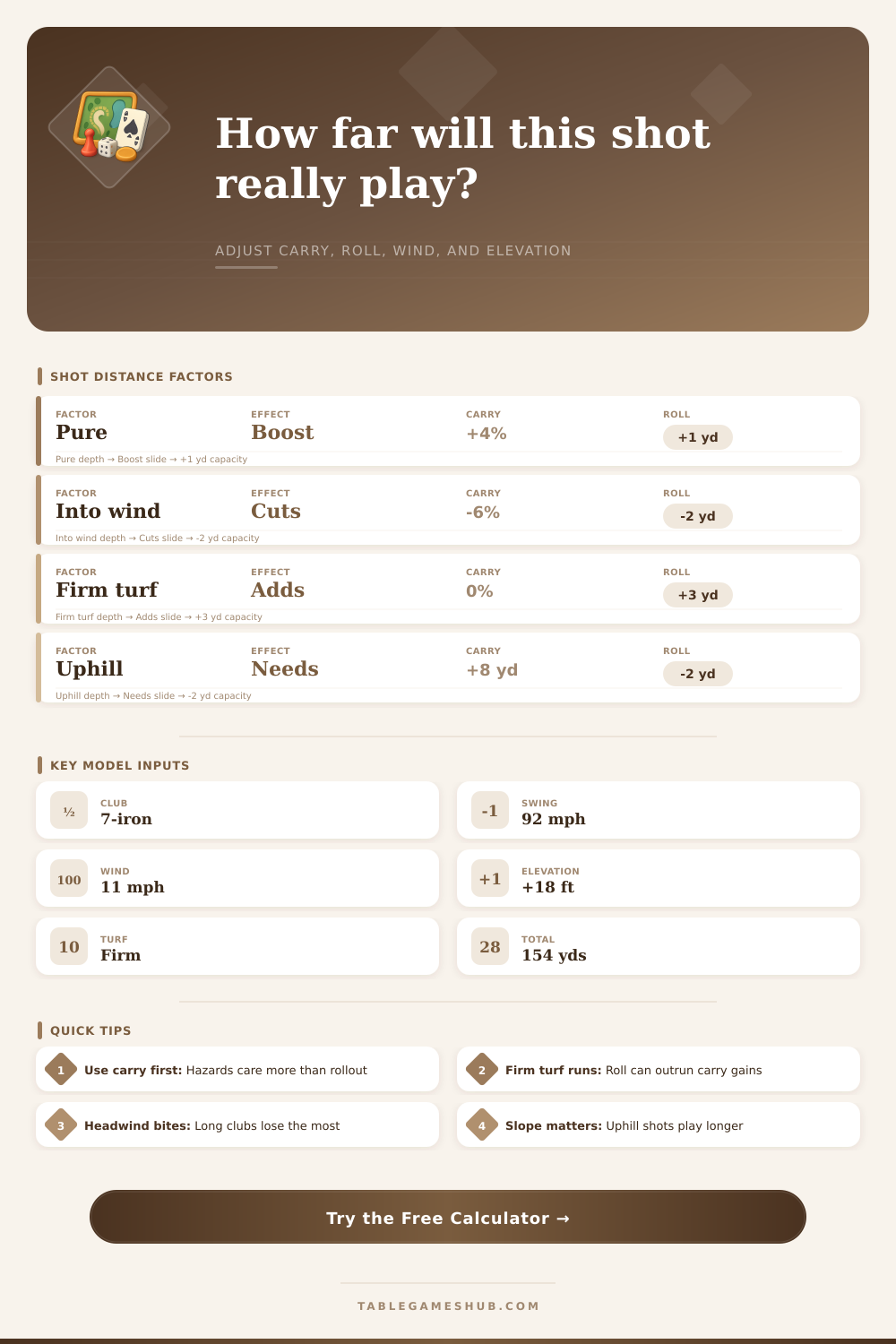
For instance, wind can have different effects on carry distance and rollout distance, but in different directions. Headwinds will decrease carry distance of the ball and rollout distance, while tailwinds will increase both of those distances. Additionally, elevation will also decrease the distance that the ball will travel, as uphill slopes will decrease carry distance and rollout distance of the ball, while downhill slopes will increase both distances.
Other factors includes the temperature and the altitude of the course. Cold weather contains more denser air than warm weather. This density in the air will create more resistance for the ball as it travels through teh air.
Thus, cold weather will decrease carry distance of the ball, while warm weather will allow the ball to travel a greaterer distance. Altitude will also impact the density of the air. Air is thin at high altitudes.
Thus, high altitudes will allow the ball to travel a greater distance. Other factors that may impact the total distance that the ball will travel are the quality of the strike of the ball and the lie of the ball. For instance, if the ball is hit in the center of the club face, the carry distance will be higher then if the ball is hit on the toe of the club face.
Additionally, if the ball is located in the rough, the grass will grab it and it will travel a shorter distance than if it is located on the fairway. Calculators can help you to determine these distances. Distance calculators allow for the carry distance and rollout distance to be blended into total distance calculations.
By plugging in factors like clubs used to hit the ball, the speed with which the ball is hit, the direction of the wind, the slope of the golf course, and the firmness of the turf on which the ball is to be hit, the calculator will provide calculations of the carry distance and rollout distance that will likely occur. Using these calculations, the player can determine the total distance that the ball will travel, allowing the player to select the correct clubs. Thus, using a distance calculator allows the player to both avoid guessing at distances, and to account for how various environmental factor will impact the distance of the player’s shot.