Golf Net Score Calculator
Convert gross strokes into a clear net score, net-to-par, and stroke allocation for any round.
| Handicap Index | Allowance | Base Strokes | Rounded Strokes |
|---|---|---|---|
| 0-5.0 | 95% | 4.8 | 5 |
| 5.1-10.0 | 95% | 9.5 | 10 |
| 10.1-18.0 | 95% | 17.1 | 17 |
| 18.1-28.0 | 95% | 26.6 | 27 |
| Course Rating | Slope | Par | Use Case |
|---|---|---|---|
| 68.4 | 113 | 72 | Easy tees |
| 72.4 | 128 | 72 | Club tees |
| 74.0 | 140 | 72 | Hard tees |
| 70.2 | 118 | 70 | Short course |
| Net Score | Par | Net to Par | Status |
|---|---|---|---|
| 68 | 72 | -4 | Excellent |
| 70 | 72 | -2 | Under par |
| 72 | 72 | E | Level |
| 76 | 72 | +4 | Net over |
A net score are calculated from the gross score of a player in golf based on the player’s handicap index. A gross score is the total numbers of strokes that a person takes to complete a round of golf. However, the golfer calculates a net score for each player as a modify version of that total.
Net scores allow for many different types of golfers of different skill levels to compete against each other. A handicap index is the numerical value that represent a person’s skill in playing golf. This number can then be used to calculate a course handicap.
How to Calculate a Net Score in Golf
A course handicap is the number of strokes that a person receive on a particular golf course. The course handicap can be calculated using the person’s handicap index, the course rating, and the slope rating for that particular golf course. The course rating is a value that represents the difficulty of a golf course for a scratch golfer.
The slope rating is a value that represents the difficulty of a golf course for a person who is not a scratch golfer. Since different golf course have different levels of difficulty for the average golfer, each person must use the course rating and the slope rating to determine there course handicap for that particular round of golf. The slope rating is a value that is used to scale the handicap index for a person to the number of strokes that they will receive on the golf course.
If the slope rating for a golf course is 113 or higher, then the golf course is considered to be more difficultly for the majority of golfers. To calculate a course handicap for a person using this slope rating, the person’s handicap index is multiplied by the slope rating for the golf course. The resulting product are divided by 113.
After calculating the course handicap for a person for a round of golf, it is also possible to calculate the course handicap allowance. A course handicap allowance is a percentage of the course handicap that is applied in a particular types of golf tournaments. For instance, some golf tournaments use a 95 percent course handicap allowance while others use an 85 percent course handicap allowance.
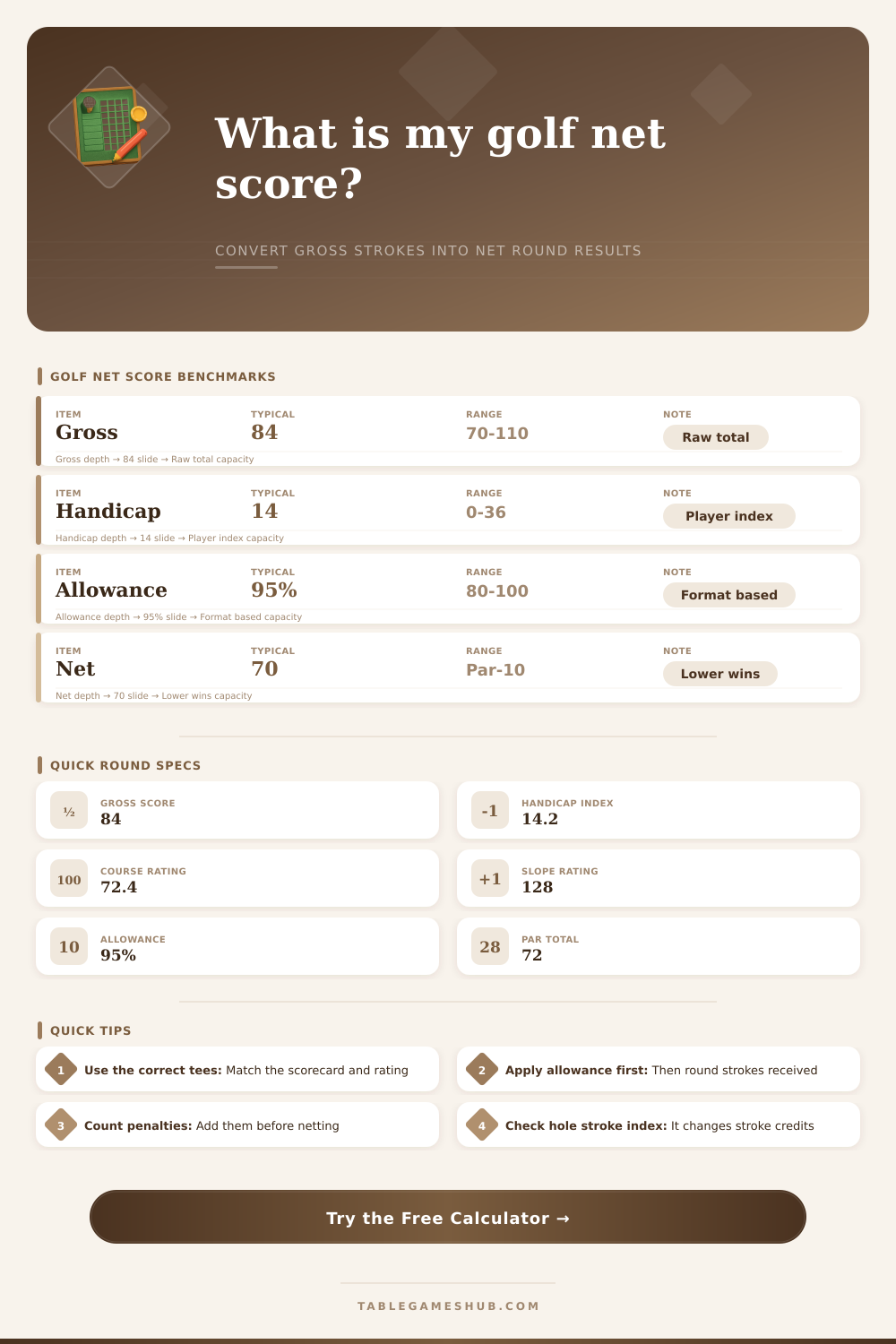
To calculate the net score for a round of golf, the player subtracts the allowance from the players gross score for that round of golf. All penalty strokes must be included in a player’s gross score to accurately calculate their net score. If a player hits their ball out of bounds, they will be required to add penalty strokes to their gross score.
Similarly, if a player hits their ball into a water hazard on the golf course, they will also be required to adding penalty strokes to their gross score. These penalty strokes will increase the gross score for the player. Such an increased gross score will have an impact upon the final net score for the player.
In addition to penalty strokes, a player must also have a gross score that accurately reflect the number of strokes that they took to complete a round of golf. All players must take into account the number of strokes that they took to complete each round of golf from the correct tee on the course because the difficulty of each tee determines the course rating and slope rating for that course. The stroke index for a round of golf is a system for determining which holes on a golf course will receive the strokes calculated from a player’s handicap index.
The stroke index system provide strokes for each hole in a round of golf according to the level of difficulty of each hole on the course. The harder holes on a course are given strokes for players’ handicap index first. For instance, if a player have a handicap index of two, the player will receive one stroke each on the two hardest hole on the course according to the stroke index for that round of golf.
This system provides for a player’s handicap strokes to be distributed systematic throughout each round of golf. A person’s net score can be used to measure there progress in improving there game of golf. While the gross score for each round of golf can be used to determine the total number of strokes that a player took for each round, a net score can indicate how a player performed relative to their golfing skill.
For instance, if a player’s net score is lower than par for a number of rounds of golf, this could indicate that the player is experiencing improvement in their golfing skill. If, however, a player’s net score is more higher than par for a number of rounds of golf, that player may need to practice their game of golf more often to improve their skills. Additionally, using net scores for a number of rounds of golf allow for many different types of golfers to identify any patterns in their game of golf since the net score more accurately measure the performance of each player compared to the gross score.
You’ll find that net scores are much more helpfull than gross scores. It would of been better to know this sooner.