🪓 Ax Throwing Rotation Calculator
Estimate ax rotation count from release distance, speed, spin rate, handle length, grip style, and target center path.
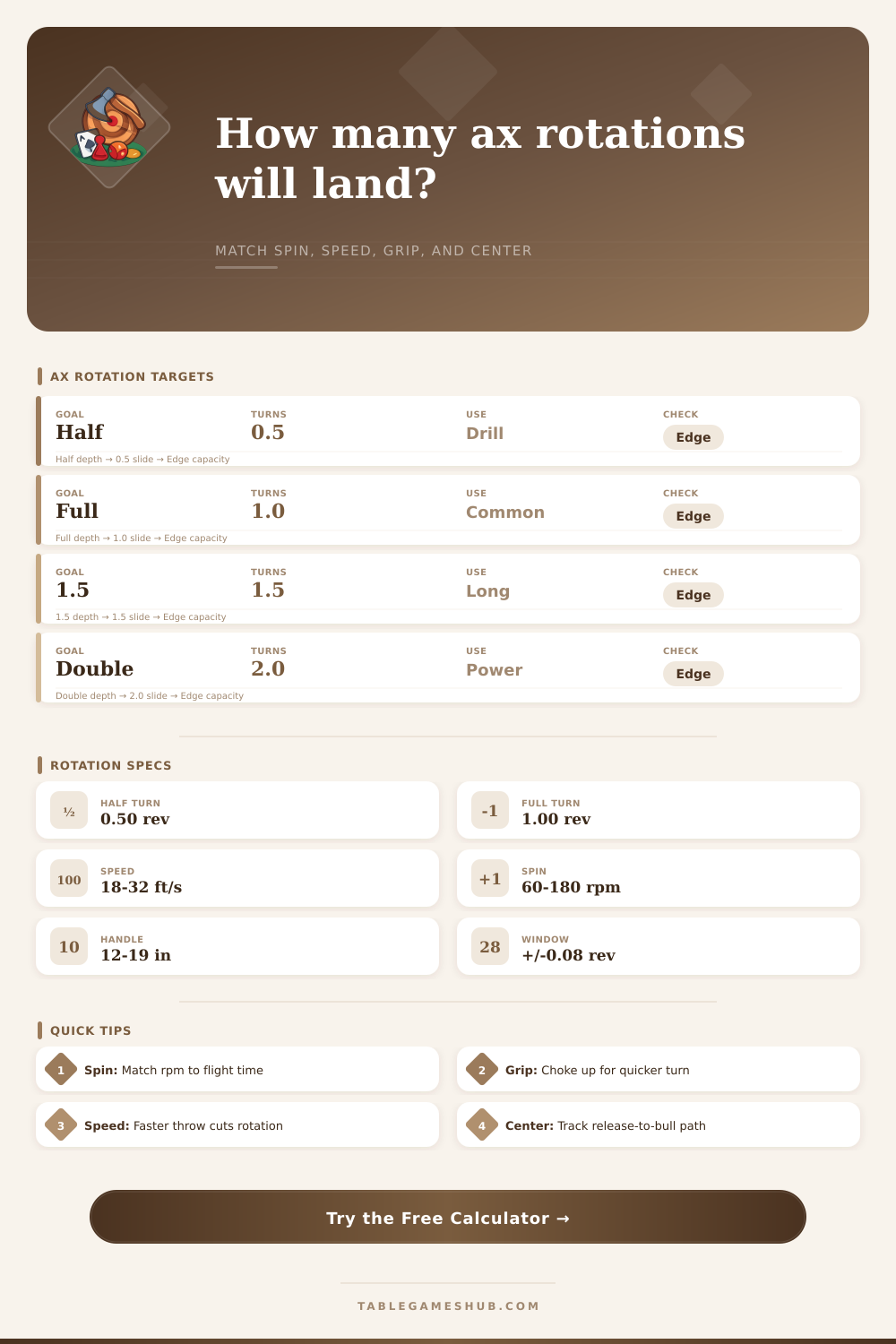
| Rotation Goal | Target Turns | Blade Orientation Check | Best Use |
|---|---|---|---|
| Half rotation | 0.50 rev | Head changes from rear-facing to front-facing | Short release drills and close practice marks |
| Full rotation | 1.00 rev | Blade returns to the release orientation | Common one-turn timing check |
| One and a half rotations | 1.50 rev | Blade flips past a full turn | Longer release distance or quicker spin throws |
| Double rotation | 2.00 rev | Blade completes two full cycles | Power timing tests with enough flight time |
| Release Speed | Flight Time at 11 ft | Spin for 1 Turn | Rotation Tendency |
|---|---|---|---|
| 18 ft/s | 0.61 s | 98 rpm | More time in air, easier to over-rotate |
| 22 ft/s | 0.50 s | 120 rpm | Balanced one-turn timing for many throws |
| 26 ft/s | 0.42 s | 142 rpm | Needs more spin or more distance |
| 30 ft/s | 0.37 s | 164 rpm | Fast throw, usually under-rotates if spin is low |
| Grip or Handle Factor | Typical Effect | Rotation Meaning | Adjustment Cue |
|---|---|---|---|
| Choked grip | About 6% quicker spin | More turns during the same flight time | Useful when the blade arrives short of a full turn |
| Neutral grip | Baseline spin | Best for comparing distance, speed, and rpm | Start here before changing grip position |
| Butt-end grip | About 5% slower spin | Fewer turns during the same flight time | Useful when the ax over-rotates |
| Long handle | Narrows tolerance | Small timing errors feel larger at the blade | Use smaller speed or spin changes per test |
| Center Path Angle | Height Difference | Rotation Read | Target Center Note |
|---|---|---|---|
| 0 to 3 degrees | Nearly level | Rotation count is mostly speed and spin driven | Good baseline for comparing throws |
| 3 to 7 degrees | Moderate drop or rise | Center path may change release feel slightly | Keep release height consistent |
| 7 to 12 degrees | Steep path | Rotation timing can look different at the board | Recheck target center and release height |
| Over 12 degrees | Very steep | Use results as a rough timing estimate only | Flatten the path before fine tuning spin |
Tip 1: Change only one timing variable
Use the same release distance while testing speed, spin, or grip. If every variable moves at once, the rotation count stops being useful.
Tip 2: Read rotation at the target center
Judge whether the blade is early or late at the bullseye height, not at the board edge or after a bounce.
To achieve a succesful ax throw with any degree of consistency, it is first important to understand how the ax rotate while it is in flight from your hand to the target. The ax throw are successful if the blade of the ax lands on the target in the required manner, but can be cancelled if the ax rotates either too much or too little on its flight to the target. Several different factor can determine the rotation of the ax, each of which an individual can manage in order to achieve the desired rotation of the ax.
Many individual that strive to improve their ax throwing skill tend to change several of these different factors at once. However, changing several of these factors will make it impossible for the individual to determine which of those changed factors contributed to the achieved result. For example, if an individual changes their distance from the target, their throwing speed, and their grip on the ax all at once, it will be impossible to determine if their changed distance to the target contributed to their changed ax rotation, or if it was instead their changed grip that led to that change.
How an Ax Spins When You Throw It
By changing only one of these variable at a time, though, an individual can determine the effect that each individual changed variable has upon the rotation of the ax. Thus, when changing the grip with which one holds the ax, for instance, the distance from which one throws the ax should be held steady. The distance from which the individual stand from the target will impact the rotation of the ax due to the relationship between distance and flight time of the ax.
For instance, if an individual stands closer to the target from which they aim to throw the ax, the flight time of the ax will decrease; the ax will take less time to reach the target. Conversely, if an individual stands further from the target, the flight time of the ax will increase. Throwing speed will also impact flight time; if an individual throws the ax at a faster speed, the flight time will decrease, and if they throw the ax at a slower speed, flight time will increase.
The grip with which an individual hold the ax also impacts the rotation of the ax. If an individual use a neutral grip of the ax, the ax will rotate at a standard rate. If an individual “choke’s” up on the ax handle to the head of the ax, the spin rate at which the ax rotates will increase.
However, if an individual holds the ax with their grip near the butt end of the ax handle, the spin rate will decrease. Additionally, using a wrist snap to add additional rotation to the ax before an individual releases it from an individuals hand will also impact the rotation of the ax; however, using a wrist snap may make it difficult to consistently release the ax in the same manner. The length of the ax handle impact the rotation of the ax; longer handle allows for the ax to be spun at a higher rate.
Thus, increasing the length of the handle will make it easier to increase the rotation of the ax. However, an increased length of the handle also means that even small inaccuracy in the timing of the throw can drastically impact the accuracy of the ax in reaching the target. A shorter handle for the ax is more forgiving in an individual that is just beginning to learn how to properly throw the ax, but allows for less rotation of the ax overall.
The height from which the ax is released can have a major impact upon the rotation of the ax. If an individual releases the ax from a height that is either higher or lower than the center of the target, the ax will travel along an angled path to the target. As a result, the rotation of the ax will appear to change along its flight to the target.
An individual must pay attention to the height of the center of the target and the height from which the ax is to be released in order to understand the rotation of the ax. For instance, if an individual judge the rotation of the ax based off the top or bottom of the target rather than the center of the target, the individual may expect a certain rotation, but instead recieve an incorrect indication of the rotation of the ax. The rotation that should of been considered is the rotation of the ax in which the blade of the ax reaches the same height as the center of the target.
In ax throwing, there are different types of rotation that can occur for the ax. A half rotation is thrown where the ax only rotates halfway during its flight to the target. Half rotations are mostly used for individuals that is practicing with the ax at close distances.
Full rotations are those where the ax rotates 360 degree during flight, and are the most common for those who are throwing the ax at standard distances. One and a half rotation and double rotation are rotations used when the distance to which the ax must travel to the target is increased, or when the spin rate of the ax is increased to ensure that it will hit the target at the desired angle and with the desired power.