🪓 Ax Throwing Distance Calculator
Size the throw line to the target plane, target center height, lane depth, player reach, handle length, and safety buffer.
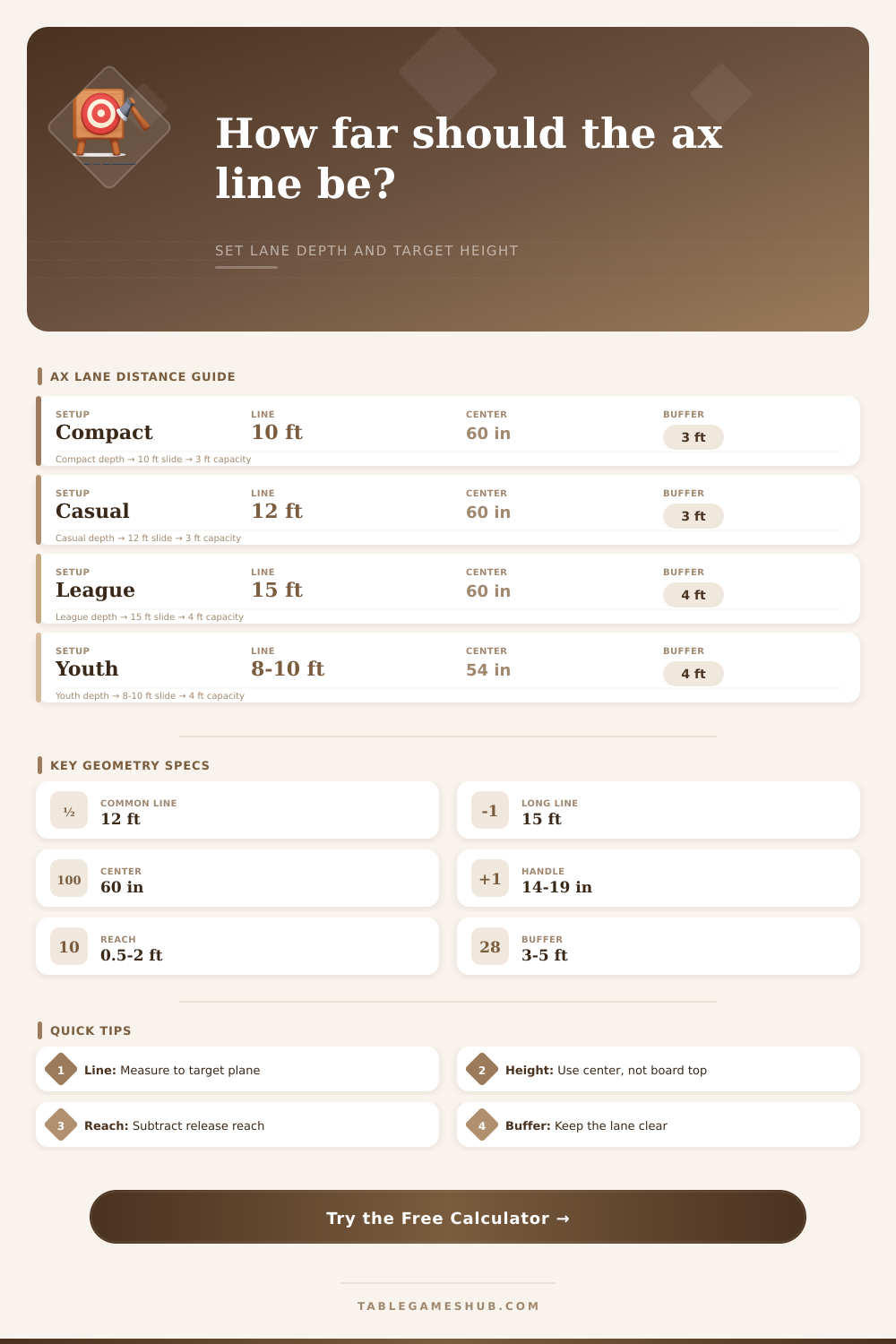
| Lane Setup | Throw Line to Plane | Target Center Height | Best Use |
|---|---|---|---|
| Compact practice bay | 9 to 11 ft | 54 to 60 in | Short depth, controlled practice, and limited indoor space |
| Casual recreational lane | 11.5 to 12.5 ft | 60 in | Most backyard and party layouts where lane depth is moderate |
| Long fault line check | 14 to 15 ft | 60 in | Players checking a longer throw line against a fixed target plane |
| Youth or short-reach layout | 8 to 10.5 ft | 48 to 56 in | Smaller players, lower target centers, and supervised practice |
| Height Relationship | What to Measure | Distance Effect | Calculator Use |
|---|---|---|---|
| Release above center | Hand height minus center height | Slight downward path | Path card combines horizontal distance and vertical drop |
| Release near center | Hand height close to target center | Flatter path | Line recommendation changes mostly by reach and handle |
| Lower target center | Center from floor, not board size | Shorter visual window | Youth preset lowers center and line together |
| Higher target center | Bullseye or chosen scoring center | Longer diagonal path | Warning appears if the path angle becomes steep |
| Lane Depth | Back Buffer | Target Clearance | Layout Result |
|---|---|---|---|
| 14 to 16 ft | 2 to 3 ft | 1 to 2 ft | Only compact or youth lines usually fit cleanly |
| 17 to 21 ft | 3 ft | 2 ft | Casual 12 ft line has usable spare depth |
| 22 to 26 ft | 3 to 4 ft | 2 to 3 ft | Comfortable for 12 ft lines and some longer checks |
| 27 ft or more | 4 to 5 ft | 3 ft or more | Deep venue lane with room for longer throw lines |
| Player or Ax Factor | Typical Range | Geometry Meaning | Adjustment Direction |
|---|---|---|---|
| Player reach past line | 0.5 to 2 ft | Release point is closer than the marked line | More reach can move the marked line farther back |
| Handle length | 14 to 19 in | Longer handle changes the geometry window | Long handles add a small line allowance |
| Restricted stance | 0 to 0.5 ft reach loss | Release stays closer to the throw line | Recommended marked line can shorten slightly |
| Forward lean or step | 0.2 to 0.8 ft reach gain | Release is farther beyond the line | Marked line may move back if lane depth allows |
Tip 1: Measure to the target plane
Keep the main distance measurement perpendicular to the target face. Do not include frame depth, wall space, or the lane behind the thrower in that line number.
Tip 2: Keep reach separate from line distance
The painted throw line and the actual release point are different. Enter reach separately so the calculator can show the true flight path to the center.
When you begins axe throwing, the distance between you and the targets is one of the first thing that you will notice. This distance is referred to as the throw line and it is the line that dictate how far the axe will travel before it hits the target. The distance of the throw line is important in that it dictates the flight of the axe.
A calculator can help to determine the distance that the throw line should be based off specific measurement of the axe throwing lane. These measurements include the depth of the lane, the height of the target center, and the reach of the release hand. Based upon these measurements, the calculator can provide the distance of the throw line and whether or not the lane have enough space to accommodate the throw line according to these calculation.
How to Use an Axe Throw Line Calculator
Many people will attempt to replicate the axe throwing line up of a commercial axe throwing venue. These commercial venues often has different dimension than those within the home. The commercial venue will often include extra depth behind the target and extra space behind the axe thrower.
Home lanes or garage bay axe throwing venues may not include this extra space. As a result, the throw line may need to be move forward or the target center may need to be lowered. These alternatives the calculator can show to the axe thrower.
Axe throwers may also adjust the release height of the axe. The height of the axe relative to the target will impact the distance that it travel. If an axe is released from a height above the center of the target, the axe will travel in an arc that descends toward the target.
An individual that is taller than others will be able to release the axe from a higher starting position than an individual that is shorter. This extra height will allow the axe to travel a shorter distance from the thrower to the target. An axe will often travel in a downward arc that permit the blade to bite into the target.
The axe thrower can calculate the axe height relative to the target so that the throw line can be calculated accordingly. Another factor that may impact axe throwing is the length of the handle of the axe. A longer handle will impact the geometry of the axe throw.
An axe with a longer handle will require an adjustment to the throw line so that the axe can travel to the target. The same adjustment will be required if the axe is being used within a tight space. A short handle to the axe will have the opposite effect on the geometry of the axe.
Player reach is a variable that many axe throwers may incorrectly measure. The point where the thrower’s feet lands on the floor is not the same as the reach of the player. The hand will extend forward of the throw line when the axe is being thrown.
The distance that the hand extends forward can range from six inches to nearly two feet. This distance will impact the placement of the throw line. Lane depth is a measurement that must be accounted for in any axe throwing lane.
The depth of the lane will account for the throw line, the safety buffer behind the axe thrower, and the space required behind the target. If the depth of the lane is insufficient to account for these three measurements, the throw line will need to be shorten or the target will need to be moved. The axe thrower performs this calculation using the axe throw line calculator.
The calculator also includes an estimation of the number of rotation that the axe will make during the throw. A full rotation of the axe is used in most commercial axe throwing venues. The number of rotations will change based upon the speed at which the axe is thrown, the weight of the handle of the axe, and the cleanliness of the axe.
The axe will often travel in a path that allows for these variable to be accounted for by the axe thrower. The calculator provides an estimation based upon the depth of the lane and the length of the axe handle. This calculation is not meant to replace the ability of the axe thrower to account for the rotations of the axe.
A youth setup will use the same calculations as the adult throw line but with smaller measurements. For youth axe throwing setups, the target will be lower and the throw line will be closer to the target. There will also be a generous safety buffer around the youth axe thrower.
The calculator can pre-set these variables to automatically adjust the height of the target and the throw line for youth axe throwers. Using an axe throw line calculator prior to establishing the throw line on the floor will help the axe thrower to avoid the problem of a drifting throw line. The throw line that feels good for an axe thrower on the first day may shift from use or from becoming accustomed to the floor.
If the throw line appears to shift, the axe thrower may not understand the reason for the movement of the throw line. Using the calculator again to calculate the measurements for the axe thrower will help to realign the throw line with the axe thrower. The geometry of the axe throwing lane may account for the struggles of an axe thrower to move from one venue to another.
The first venue may have a twelve-foot throw line and a sixty-inch target center. The second venue may have the same throw line but with a lower target center. The flight of the axe will change based upon the different target center.
An understanding of the variables that impact the flight of the axe can help to account for the difference between venues. A calculator will never be able to measure the feel of the floor or the balance of a specific axe. These variables can only be accounted for through practice with throwing the axe.
The axe throw line calculator removes the guesswork of the thrower regarding the layout of the axe throwing lane. Using the calculator, the axe thrower can ensure that the throw line is appropriately placed for the individual and that the lane will fit within the space provided.