Knife Throwing Rotation Calculator
Estimate knife rotation count from throw distance, knife length, release speed, spin rate, mode target, release phase, and target-center height.
This calculator focuses on sport knife rotation timing, not ax rotation. It treats the knife as a slim rotating body and compares the measured flight rotations with no-spin, half-spin, or full-spin target phases.
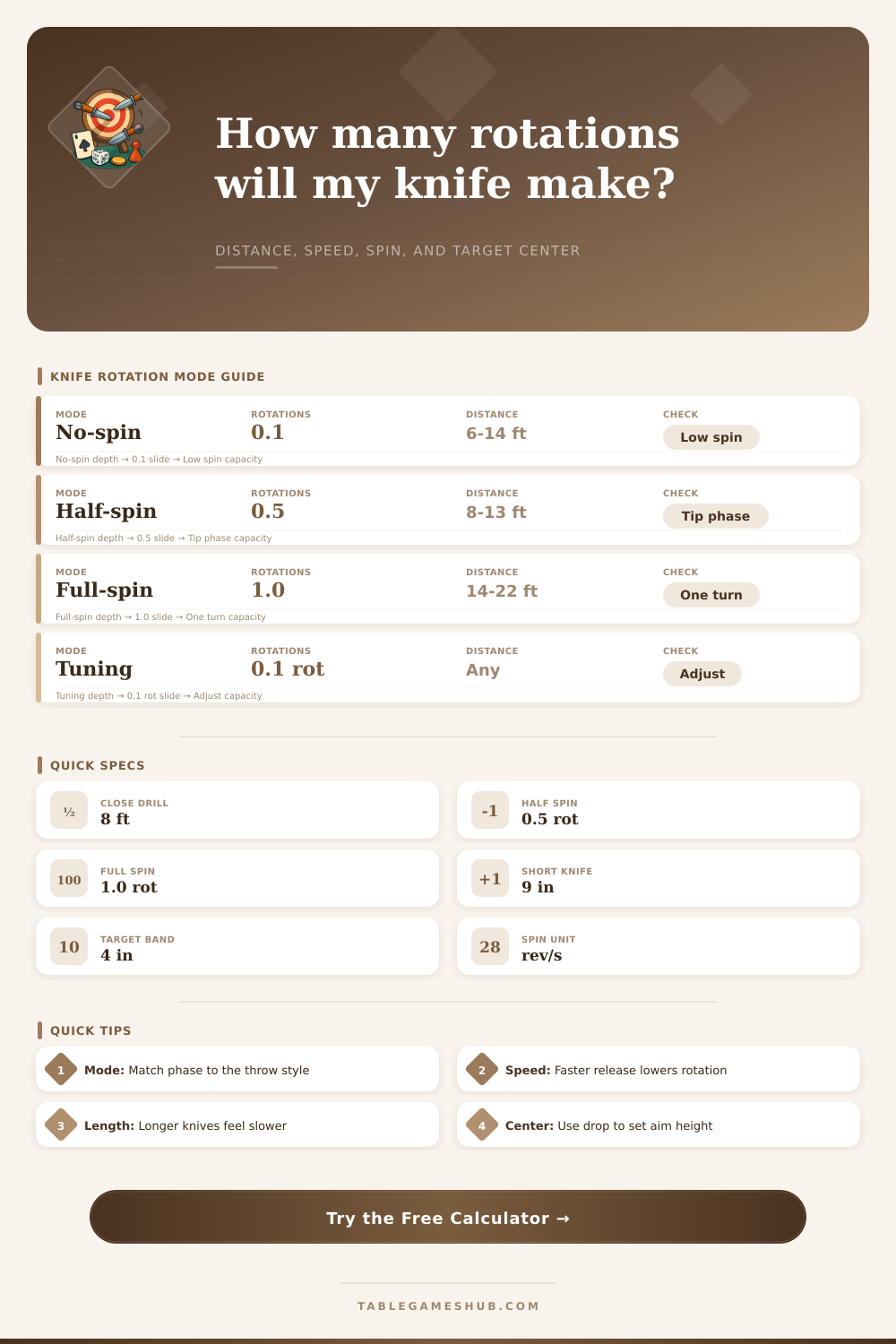
| Mode | Target Rotation Count | Typical Use | Calculator Signal |
|---|---|---|---|
| No-spin mode | About 0.10 to 0.20 rotations | Close controlled throws where the knife stays nearly tip-forward. | Phase error should stay small and total rotation should remain below one quarter turn. |
| Half-spin mode | 0.50 rotation | Handle-forward release that arrives tip-forward after a half turn. | Required spin rate equals 0.50 divided by flight time. |
| Full-spin mode | 1.00 rotation | One complete rotation before arrival at the target center plane. | Actual rotations should land close to a full integer turn. |
| Fine tuning | 0.05 to 0.15 rotation changes | Small release speed or spin-rate changes after observing impact phase. | Use the mode error value to see how much phase needs correction. |
| Release Speed | Spin Rate | Distance Example | Expected Rotation |
|---|---|---|---|
| 18 mph | 1.8 rev/s | 8 ft close target | About 0.55 rotations before phase bias. |
| 22 mph | 2.2 rev/s | 10 ft half-spin line | About 0.68 rotations before tuning. |
| 26 mph | 2.4 rev/s | 16 ft full-spin line | About 1.01 rotations, often near full-spin timing. |
| 30 mph | 2.6 rev/s | 20 ft longer line | About 1.18 rotations, requiring phase adjustment. |
| Knife Length | Balance Note | Rotation Feel | Calculator Use |
|---|---|---|---|
| 8 to 9 in | Short sport knife | Can feel quick in the hand and sensitive to phase. | Use a smaller center window and check rotations per knife length. |
| 10 to 11 in | Balanced common length | Good baseline for comparing half-spin and full-spin timing. | Default presets use this range for the knife scale. |
| 12 to 13 in | Longer sport knife | Often feels slower and easier to read during rotation. | Check length scale before changing distance too much. |
| Offset balance | Tip or handle bias | Large offset narrows the clean timing window. | The calculator reduces tolerance when balance offset is large. |
| Target Center Check | Flight Time | Drop Estimate | Adjustment Meaning |
|---|---|---|---|
| Very fast close line | 0.18 s | About 1.6 in | Center hold is small but still visible on tight targets. |
| Common half-spin line | 0.30 s | About 5.3 in | Release height and target center height matter. |
| Long full-spin line | 0.42 s | About 10.7 in | Vertical hold can be larger than the center window. |
| Slow release line | 0.55 s | About 17.9 in | Use the hold result before judging rotation timing alone. |
Change distance, release speed, or spin rate separately so the rotation count tells you what actually moved the phase.
A knife can have the right rotation but still miss low; use the target-center hold result before changing mode.
Knife throwing involve several different variable that can be measured. The outcome of a knife throw is based off the rotation that the knife makes between the hand and the target. The number of rotation that the knife makes in flight is dependent on the distance between the hand and the target, the speed at which the knife is thrown, the spin rate at which the knife spin, and the length of the knife blade.
All of these variables relate to the phase of the knife’s rotation when the point of the knife touch the target board. If a person understand each of these variables, and how they relate to each other, then a person can make the knife throw a repeatable process. The rotation of the knife occur while the knife is in flight.
How Knife Rotation Affects Your Throw
While in flight, the knife can be considered a rigid body that turns at a constant rate. The total rotation that the knife make in flight can be calculated by multiplying the length of time that the knife is in flight by the number of turns that the knife makes each second. The length of time that the knife is in flight can be calculated by dividing the distance that the knife travel by the forward speed at which the knife travels.
If a person change either the speed at which the knife travels or the distance that it is thrown, then the phase of the knife when it land on the target will change. Thus, two knife throws that are similar in the knife’s movement while in flight may land different than the target. Many knife thrower use one of three different throwing patterns.
One type of thrower release the knife in such a way that the knife remains tip-forward while in flight, and those knife throwers use very little spin on the knife. Another type of thrower release the knife handle-first so that the knife makes a half turn before it lands on the target. The third type of knife thrower make one complete rotation of the knife before it lands on the target.
Each of these throwing pattern requires a specific speed of the knife and spin rate so that the knife travel the distance required to reach the target. If a person does not use the proper spin rate and speed for the distance between the thrower and the target, then the phase of the knife will be incorrect when the knife reach the target. One of the variables that many knife throwers underappreciate is the speed at which they release the knife.
The speed at which they release the knife is important because it change the length of time that the knife will be in flight. For instance, if a person increase the speed at which they release the knife, then the knife will be in flight for less time. Consequently, there will be fewer rotation of the knife while in flight.
Such a change can affect the number of rotations that the knife makes while traveling from the thrower to the target. For instance, a spin rate that provides the knife with a half-turn will travel to a target at a distance of ten feet. However, the same spin rate at a distance of sixteen feet may not make the knife rotate a full turn.
A knife rotation calculator allow a person to enter these variable to determine how many rotation will occur in flight. The calculator can then show the drop of the knife’s center when it reach the target. The length of the knife blade impact the knife throw in that the length of the blade change the balance point of the knife, and the amount of time that it can rotate.
Shorter knife blade will rotate at a faster rate than longer knife blades. Additionally, errors in the rotation of shorter blades will be more noticeable than errors with longer knife blades. Longer knife blades will rotate at a slower rate than shorter knife blades.
Furthermore, the balance offset of the knife change the time in which the knife can rotate. A larger balance offset will lead to a smaller time in which the knife can rotate. The knife rotation calculator is also able to factor in this variable to reflect the specific knife to be thrown.
The height of the target and the height from which the knife is released are two factor that will impact whether the knife lands high on or low on the target. The effect of gravity will cause the knife to drop in relation to the time that it is in flight. Consequently, if the distance between the knife and the target is greater, the knife will be dropped from a higher point to allow for the knife to land on the target.
The angle of the target will affect where the knife land on the target, but it will not impact the number of rotations that the knife will make in flight. Many knife throwers make mistake due to not considering some of the variables with which the knife’s rotation is impacted. For instance, a thrower may change the distance at which the knife is thrown or the speed at which it is thrown without considering the impact that those variables have upon the phase of the knife when it land on the target.
Additionally, a thrower may only focus on the spin rate at which the knife is thrown which is another mistake in knife throwing. The reference table within the knife rotation calculator include various speed and spin rates for each distance at which the knife can be thrown. This table allow a person to easily understand the relationship between each of the variables.
Small changes in speed and spin rates are more impactful for knives that are thrown at short distance. For instance, at a distance of eight or nine feet from the target, even the slightest change in the speed at which the knife is thrown will have a much more greater impact upon the phase of the knife than the same change in speed at a distance of ten feet or more. Thus, many knife throwers find it easier to use the half-spin pattern of throwing at distance that are in the middle of the range of distance at which the knives are thrown.
Weather and fatigue is two variable that the knife rotation calculator cannot measure. However, both of these variables do have an impact upon the variables that are to be measured. For instance, if a person is fatigued, they may release the knife at a slower rate, or with less precision in the spin rate at which the knife is released.
Additionally, humidity and temperature in the air may impact how the knife’s handle feel when the knife is gripped, and may even impact the way in which the thrower release the knife with their fingers. The purpose of the knife rotation calculator is not to perform the math that is required to calculate each of the variable. Instead, the calculator allow a person to diagnose the issue with the knife throw.
For instance, if the rotation of the knife is correct but the knife lands low on the target, the issue with the height from which the knife is released or the aim at which the knife is thrown can be assessed. If the phase of the knife is incorrect, the table allow a person to determine if the speed or spin rate of the knife should be changed. Thus, by using this calculator regularly, a person will be able to quickly make adjustment to their knife throw.
Additionally, the calculator will allow a person to more precisely and quickly measure the rotation of the knife than if the person used video to measure the knife’s rotation. Consequently, once a person understand the relationship between each of the variable, this calculator can be used as a quick check to ensure that a person’s knife throw is properly performed.