Golf Handicap Slope Calculator
Convert index, slope rating, course rating, and PCC into a clear course handicap, differential, and target score.
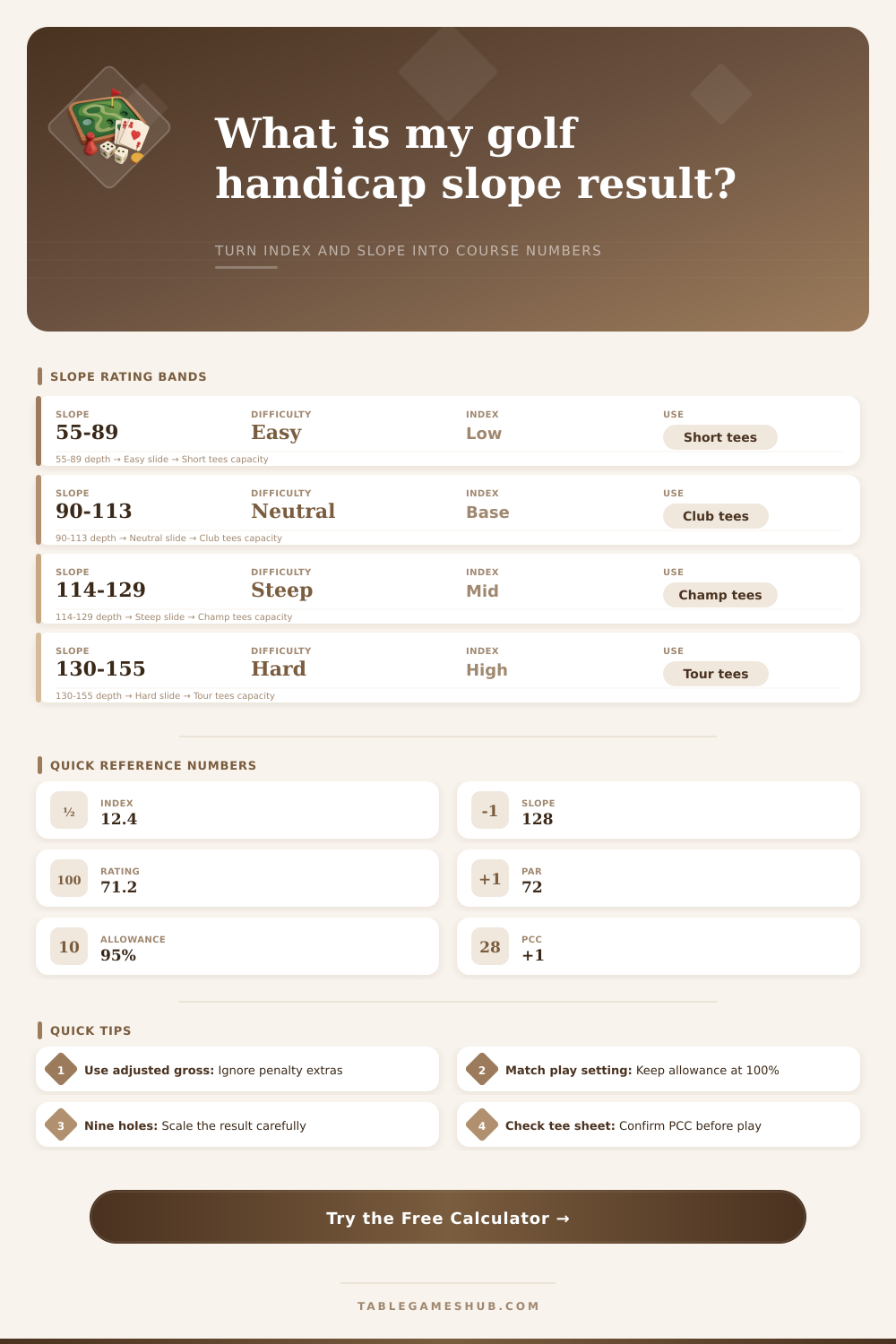
| Slope | Band | Player Feel | Typical Tee |
|---|---|---|---|
| 55-89 | Easy | Soft | Forward |
| 90-113 | Neutral | Even | Club |
| 114-129 | Steep | Testy | Blue |
| 130-155 | Hard | Strong | Champ |
| Index | Slope | Course Hdcp | Notes |
|---|---|---|---|
| 8.0 | 113 | 8 | Baseline |
| 12.4 | 128 | 14 | Club tees |
| 18.2 | 135 | 22 | Steeper set |
| 24.7 | 145 | 32 | Champ tees |
| Differential | Label | Use | Story |
|---|---|---|---|
| 0-5 | Low | Stable | Smooth |
| 5-10 | Mid | Typical | Normal |
| 10-15 | High | Challenging | Steep |
| 15+ | Very High | Big round | Rusty |
| Allowance | Stroke Play | Match Play | Team |
|---|---|---|---|
| 100% | Full | Full | Yes |
| 95% | Common | Common | Yes |
| 90% | Light | Light | Yes |
| 85% | Extra light | Extra light | Yes |
Slope rating is a measurement of how much more difficult a golf course is for a bogey golfer as compared to a scratch golfer. The neutral scale for the slope rating are 113; any slope rating of 113 indicates that the course is of neutral difficulty for all golfers. Any slope rating higher than 113 indicates that the course is more difficult for average golfers; however, any slope rating lower than 113 indicates that the course is easier for average golfers.
Course rating is another measurement that indicates the score that a scratch golfer is expected to shoot on a specific course. By knowing the slope rating and course rating for a course, it is possible to calculate a course handicap for a golfer. Course handicap can be calculated by knowing four number for the golfer: their handicap index, the slope rating for the course, the course rating for the course, and the par for that course.
What Slope Rating and Course Rating Mean for Your Golf Handicap
To calculate course handicap, the golfer must multiply their handicap index by the slope rating for the course. The golfer divides that product by 113. To that result, the golfer must add the difference between the course rating and the par for the course.
The course rating and par are incorporated into the calculation for some courses are more difficult than others. After these steps are taken, the result will be the course handicap for that golfer on that specific course. Playing Conditions Calculation (PCC) is used to adjust the handicap for conditions for the course; these conditions include both weather and the placement of the golf balls on the course.
For instance, courses with head-winds are more difficult to play than courses without head-winds; the same is true for courses on which the golf balls are located on the edges of the green rather than in the center. These conditions may change the difficulty of the course, thus the need to adjust handicap scores to ensure the scores for all golfers is accurate. In addition to PCC, you must consider the allowance percentages for each round of golf.
For instance, stroke play uses a 95% allowance percentage, while match play use a 100% percentage. For each round of golf, a golfer can calculate their differential to determine how well they played relative to their handicap. To determine differential, subtract the course rating for the course and the PCC from the golfer’s gross score.
The golfer multiplies the result of that subtraction by 113 and divided by the slope rating. The result will be the golfers differential for that round. A low differential indicates that the player played well relative to their handicap; a high differential, however, indicates that the player did not play as well as they should of relative to their handicap.
By calculating the differential for each round, a golfer can understand how many times they played well to their handicap, and how many times they played poorly relative to their handicap. There are different tee boxes on a course for golfers of all abilities. Each of these tee boxes has a different slope rating and length.
Some tee boxes are labeled as “easy” to play for new golfers or those with high handicap index because they have a slope rating under 90. Some tee boxes, however, are labeled as “championship” tees because they have slope ratings that is higher than 130; these tees are more difficult because they are longer. Thus, if a golfer chooses a tee box with a high slope rating, the course will be more difficult to play; the more difficult the slope rating, the more difficult the course will be for that player.
When recording a score, it is necessary to ensure the gross score is adjusted according to the rules for that course; some courses require the capping of bad holes. In this case, using the raw gross score will create an inaccurate differential. Additionally, it is important to use the correct percentage for allowances for that type of game; failing to use the proper PCC value will lead to an inaccurate score for the player.
Thus, to ensure that the differential is accurate for the player, it is important to use the proper allowances, the proper gross score (adjusted), and the proper PCC. Both the length of the course and the slope rating provide context for the type of golf course that is being played. For instance, courses shorter than 6000 yards may be considered more relaxed courses; courses longer than 7000 yards may test a player’s driving ability.
The slope rating determines the difficulty of the course relative to each type of player. Thus, if a golfer understands the slope rating, the course rating, and the PCC for a course, the player will understand how to use the course handicap for that round of golf. By using these various measurements, a golfer can understand their true performance for any given course.