Golf Handicap Match Play Calculator
Compare course handicaps, allowance, and stroke allocation before the first tee shot.
Breakdown
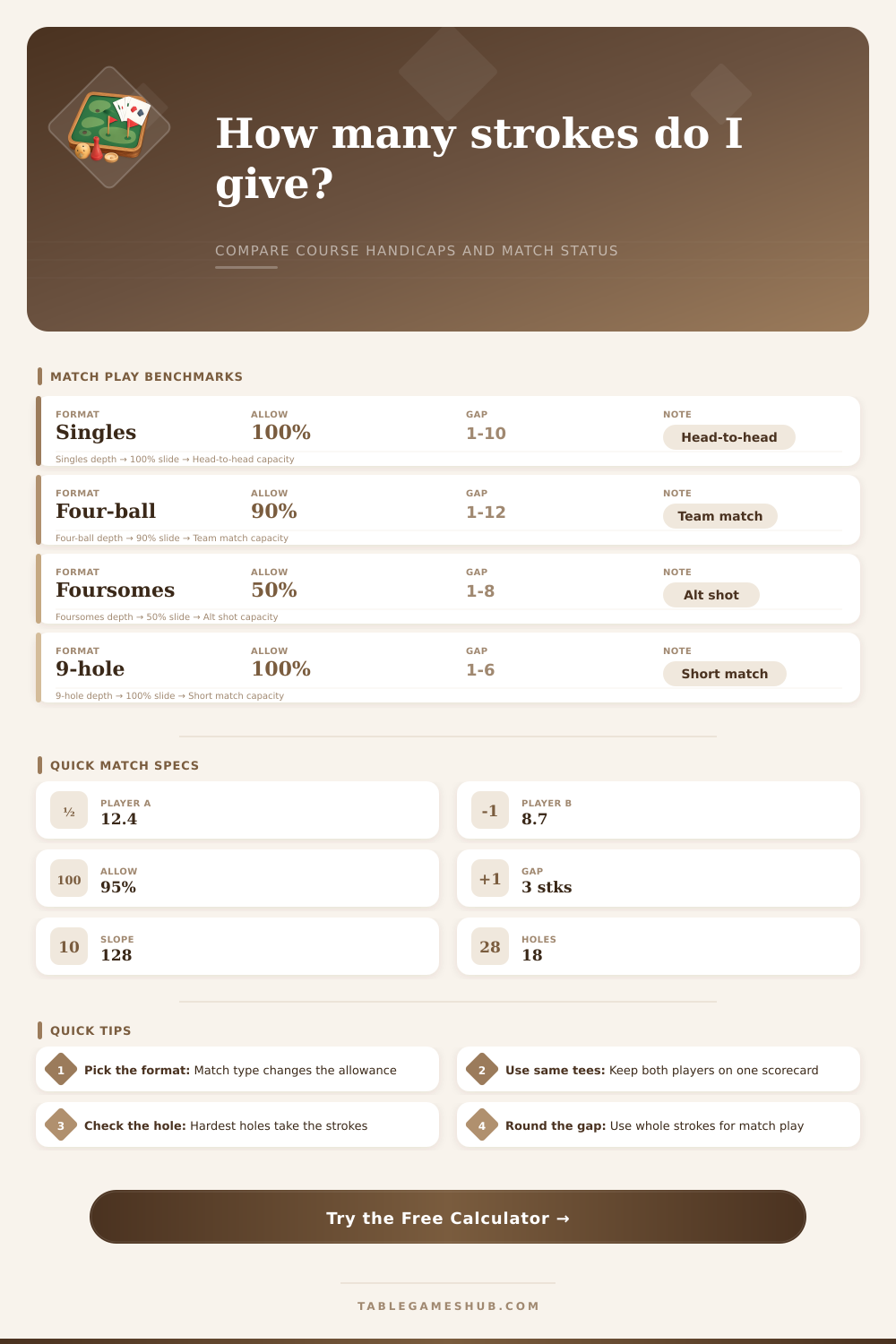
| Format | Allowance | Example Gap | Notes |
|---|---|---|---|
| Singles | 100% | 1 to 18 | Head to head |
| Four-ball | 90% | 1 to 12 | Best ball |
| Foursomes | 50% | 1 to 8 | Alternate shot |
| Skins | 100% | 1 to 18 | Stakes vary |
| Gap | Stroke Rule | Use Case | Result |
|---|---|---|---|
| 0 | All square | Same net score | Even match |
| 1 to 5 | One hole | Small edge | Single stroke |
| 6 to 10 | Two holes | Clear edge | Two strokes |
| 11+ | More holes | Wide gap | Multiple strokes |
| Index | Derived CH | Allowance | Play CH |
|---|---|---|---|
| 4.5 | 5 | 95% | 5 |
| 8.7 | 10 | 95% | 10 |
| 12.4 | 14 | 90% | 13 |
| 18.2 | 21 | 100% | 21 |
| Hole | Stroke Call | Player | Note |
|---|---|---|---|
| 1 | Yes | Higher CH | Hardest hole |
| 7 | Yes | Higher CH | Typical call |
| 13 | No | None | Gap exhausted |
| 18 | Maybe | Depends | Final hole |
Match play handicaps is used to ensure that golf matches between players are fair, regardless of the skill of those players. Each player have a handicap index that expresses there skill in the game of golf. This handicap index is converted into a course handicap, which determines the number of strokes that a player will recieve during there round of golf.
The course handicap is calculated using the slope rating of the golf course and the player’s handicap index. Courses with higher slope ratings provides a greater number of strokes for players of lower skill levels. The course handicap also takes into account the par of the course, which allows players of different skill levels to compete against one another on the course.
How Match Play Handicaps Work
The number of strokes that a player receive during a round of match play depends upon the format of the match that is being played. In match play singles matches, players receive a full allowance of their playing handicap. In four ball matches, however, players receive 90 percent of their playing handicap, since in four-ball matches players use the best ball score of a team of two player.
In foursomes matches, players receive 50 percent of their playing handicap; foursomes matches use an alternate shot format, where players take turns hitting the ball. Strokes are not distributed equally to each of the 18 hole in a round of golf. Instead, strokes are distributed to specific holes according to the stroke index of each hole on the course scorecard.
The stroke index of each hole reflect the difficulty of each hole. Players receive their strokes on the holes with the lowest index numbers. For instance, if a player has a three stroke allowance, they will receive a stroke on each of the three most highest difficulty holes on the course, the holes with stroke index numbers of one, two and three.
Before playing golf, you must check the scorecard to ensure that you are aware of which holes will provide a stroke to the player. To determine the winner of each hole in a match play competition, the official calculates each player’s score. The gross score of a player is the total of the strokes that they took to complete each hole.
A player’s net score is their gross score minus the number of strokes that they received for that hole. The player with the lowest net score on each hole win that hole; if both players have the same score for that hole, the hole is halved. The net margin between players is higher in four-ball than in singles matches, since the players have a partner who can compensate for the bad shot of another player on the course.
Therefore, the four-ball game has a higher handicap for the players; the strokes for foursomes matches are halved due to the precision required to hit an alternate shot. Errors in match play often occur due to a lack of knowledge of the rules of match play. One of the most common error is playing on different tee boxes; different tee boxes have different slope ratings.
Another of the most common error is the use of decimal points when computing course handicap allowances; only whole stroke are used in match play. Players also makes errors if they do not check the course hole stroke index numbers before playing matches with other player. Handicaps allow players of different skill levels to compete against each other.
A scratch player have a handicap of zero. A player with a handicap of 12 receives strokes on their score card on twelve different hole. If a scratch player competes against a player with a 12 handicap in a singles match, the 12 handicap player will receive one stroke each on their twelve hardest hole.
Thus, the handicap system ensure that the skill of each player is tested, but provides a level playing field for players of all skills. Understanding the handicap system allow the player to focus on the game of golf rather than the math behind it.