Giant Checker Board Size Calculator
Plan an oversized checker board by square size, checker diameter, crown stack height, border width, and full play area clearance.
| Checker format | Grid | Total squares | Starting checkers | Use case |
|---|---|---|---|---|
| American checkers | 8 x 8 | 64 | 24 pieces | Most backyard and event boards |
| International draughts | 10 x 10 | 100 | 40 pieces | Large demo boards and club displays |
| Canadian draughts | 12 x 12 | 144 | 60 pieces | Very large show boards with extra space |
| Spare-piece set | Same grid | Same board | +2 to +4 pieces | Useful when pieces are handled by groups |
| Square size | 8 x 8 grid | Suggested checker | Board feel | Minimum walkway |
|---|---|---|---|---|
| 12 in | 8 x 8 ft | 8.5 to 9 in | Indoor mat scale | 18 to 24 in |
| 18 in | 12 x 12 ft | 13 to 14 in | Gym or patio scale | 24 to 30 in |
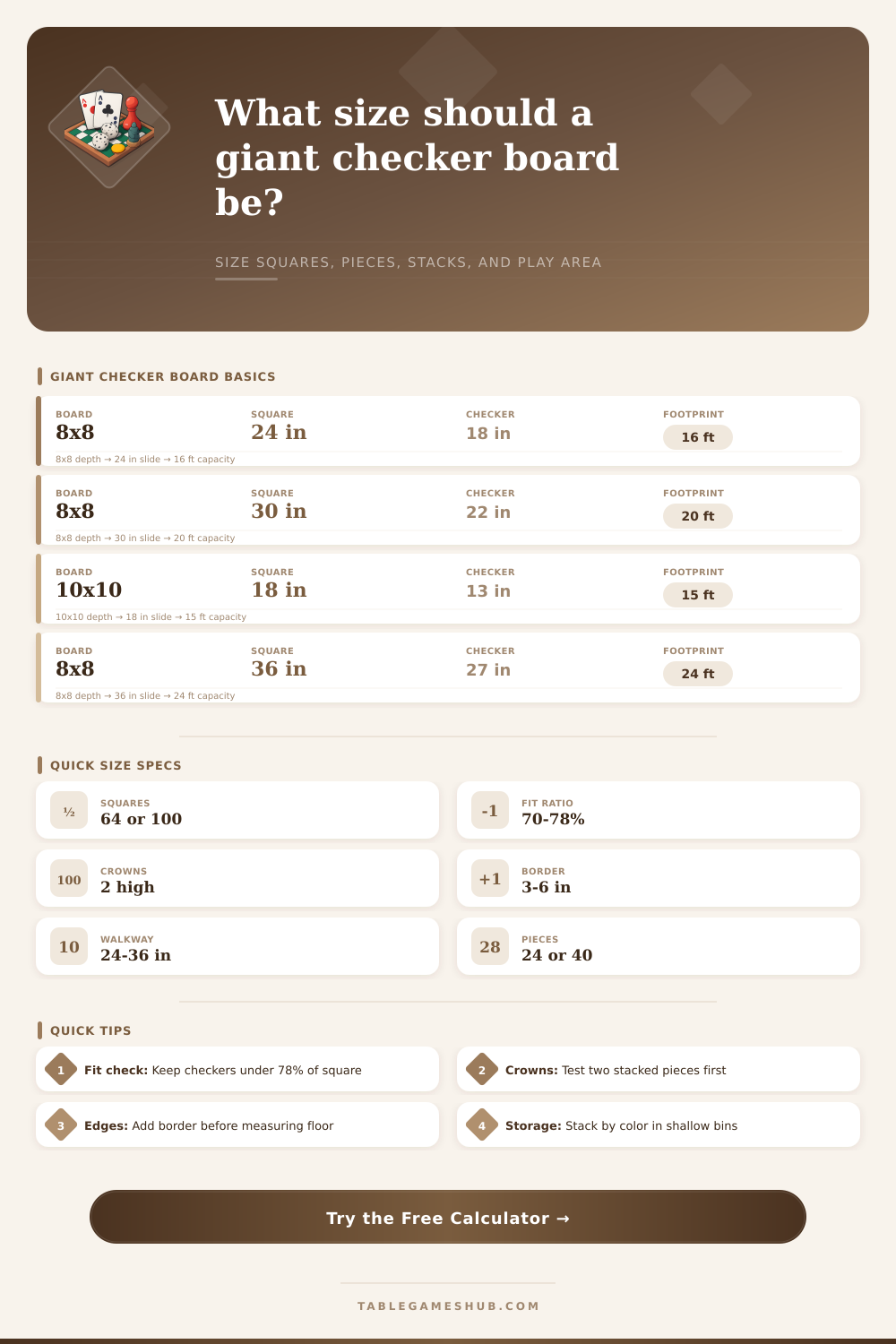
| 24 in | 16 x 16 ft | 17 to 18.5 in | Classic giant scale | 30 to 36 in |
| 36 in | 24 x 24 ft | 25 to 28 in | Festival or park scale | 36 to 48 in |
| Checker diameter ratio | Square clearance | Movement quality | Crowning note |
|---|---|---|---|
| 60% to 68% | Very open | Easy for children to place | Stacks feel small on huge squares |
| 70% to 78% | Balanced | Best giant checker fit | Two-piece crowns stay readable |
| 80% to 86% | Tight | Works for display, less hand room | Crowns can touch square edges |
| Over 86% | Too tight | Pieces crowd diagonals | Use larger squares or smaller pieces |
| Surface type | Border advice | Checker thickness | Play area note |
|---|---|---|---|
| Vinyl mat | 2 to 4 in printed edge | 0.5 to 1.5 in | Keep walkway flat and taped |
| Painted patio | 4 to 6 in sealed edge | 1 to 2 in | Leave room to walk around corners |
| Interlocking tiles | Use full tile border | 1 to 2.5 in | Check seams before stacking crowns |
| Lawn or turf | 6 in visible boundary | 1.5 to 3 in | Add buffer for uneven ground |
Giant checker boards tend to change the ways that a person plays with the game due to the way that the game is scaled up in size. Giant checker boards increase the size of the game boards squares and the size of the checkers that are to be played upon. The giant size of the checkers force players to walk around the checker board rather than lean over a table.
Thus, the game becomes a physical event to play the game. However, scaling up a checker board isnt a simple process. The game requires planning of the width of the squares, the diameter of the checkers, the height of the crown stacks of the checkers, and the space between the checkers and the edge of the board (the border).
How to Plan a Giant Checker Board
If these factor are not carefully planned, there may not be enough space within the lawn or the floor for the giant checker board. A giant checker board calculator can provide mathematical results that indicate the dimension of the giant checker board and the area in which players will be walking. Results from the calculator indicate whether each checker will comfortabley occupy each square within the board, whether two checkers within a crown will fit within each square, and whether the entire game will fit into the space that is planned for the checker board.
The ratio of the size of the checker to the size of the square is another of the primary considerations in creating a giant checker board. The size of the checker should not too large within each square, or the player will struggle to move its checker across the square. However, if the size of the checker is too small relative to the size of the square, the board will appear empty.
The ideal ratio is for the checker to occupy between 70 and 78% of the area of the square. This percentage leave enough room for the player’s fingers to grasp the crown of the checker without undesired contact with the checker next to the crown of the checker. The giant checker board calculator indicates this ratio so that the game designer does not discover this issue after painting or taping the board.
An additional consideration is the size of the crown stacks of the checkers. Standard checkers has kings that are composed of two checkers stacked upon each other. However, giant checkers may have kings that are composed of three or four checkers.
The height of the crown of these checkers will impact the stability of the king when the players reach towards there pieces. If the king is too tall and placed upon a soft surface like a lawn, it may topple if the players take a careless step. The giant checker board calculator can indicate the total height of these crown stacks for the players to consider before adding the checkers to the game.
The type of surface upon which the giant checker will be played will also impact the size of the game. For instance, if the game is to be played on a vinyl mat, then the checkers can be thinner since the vinyl mat can be rolled up for transport. However, if the giant checker board is to be played upon painted concrete or interlocking tiles, there will need to be a wider border to prevent the edges of the checker board from chipping.
Additionally, if the giant checker board is to be placed upon a lawn, there must be a buffer between the lawn and the checkers to account for the ground not being level with the checkers. Finally, there needs to be additional room for the players to place their feet upon the ground while playing upon the giant checker board. The width of the border and the walkways will need to be adjusted according to the type of surface that will be used for playing the game.
The width of the walkways that are to be created around the giant checker board is another of the measurements that the game designer must consider. If the checkers are two or three feet in size, the players may need to move across multiple checkers to move one of their checkers. Thus, there needs to be clear floor space on all sides of the giant checker board.
The walkways may appear to be large in size, but there may be other elements to the party at which the game will be played. The giant checker board calculator accounts for these walkways and adds them to the bordered giant checker board. The result will provide an indication of the total area that will be used by the giant checker board.
the transport of the checkers also needs to be considered.
Standard checker and draughts games contains twenty four checkers on an eight by eight game board. If two sets of checkers are to be used, there will be forty-eight checkers. These checkers will be stacked to transport the game to the playing area.
Thus, the total height of these checkers will increase if they are to be transported in stacks. The giant checker board calculator will provide an estimation of the total height of the checkers in stacks with the buffer for the board. This provides the ability to determine if the checkers will fit within the storage bin for the game.
Finally, the different rule sets that are used for checkers, draughts, and cornhole also change the size of the game and the number of piece that are to be used within the game. For instance, American checkers is played upon an eight by eight game board with twenty four pieces. International draughts is played upon a ten by ten game board with forty pieces.
Canadian draughts uses a twelve by twelve game board. Each game has different physical demands upon the players, based off the size of the game board. If a game designer desires to produce one giant checker board that can be used by multiple groups of players, they must first decide which game to use to determine the number of pieces and the size of the game board.
The largest checker boards are not necessarily the most functional giant checker boards. For instance, a checker board with squares that are twenty four inches in size and checkers that are eighteen inches in diameter is very large, but not overly difficult to use. A checker board that is thirty six inches in size with twenty seven inch checkers may be impressive, but the size of the board may make it difficult for the players to walk across the giant checker board.
The giant checker board calculator allows the designer to test the size of the game and see how it will interact with the walkway and buffer sizes for the game. By planning a giant checker board with such detailed considerations, the designer will ensure that the giant checker board will be appropriate for the intended location and the players that will use the game. For instance, a game designer that plans a giant checker board for a location like a senior center may want to make the squares smaller and the checkers thinner.
However, if the giant checker board is to be played at a park festival, the game may be larger in size to account for the ground that will be used for walking. Thus, if the giant checker board is calculated to have appropriate dimension according to the space that is available for the game and the players, the game can be begun.