Splendor Duel Calculator
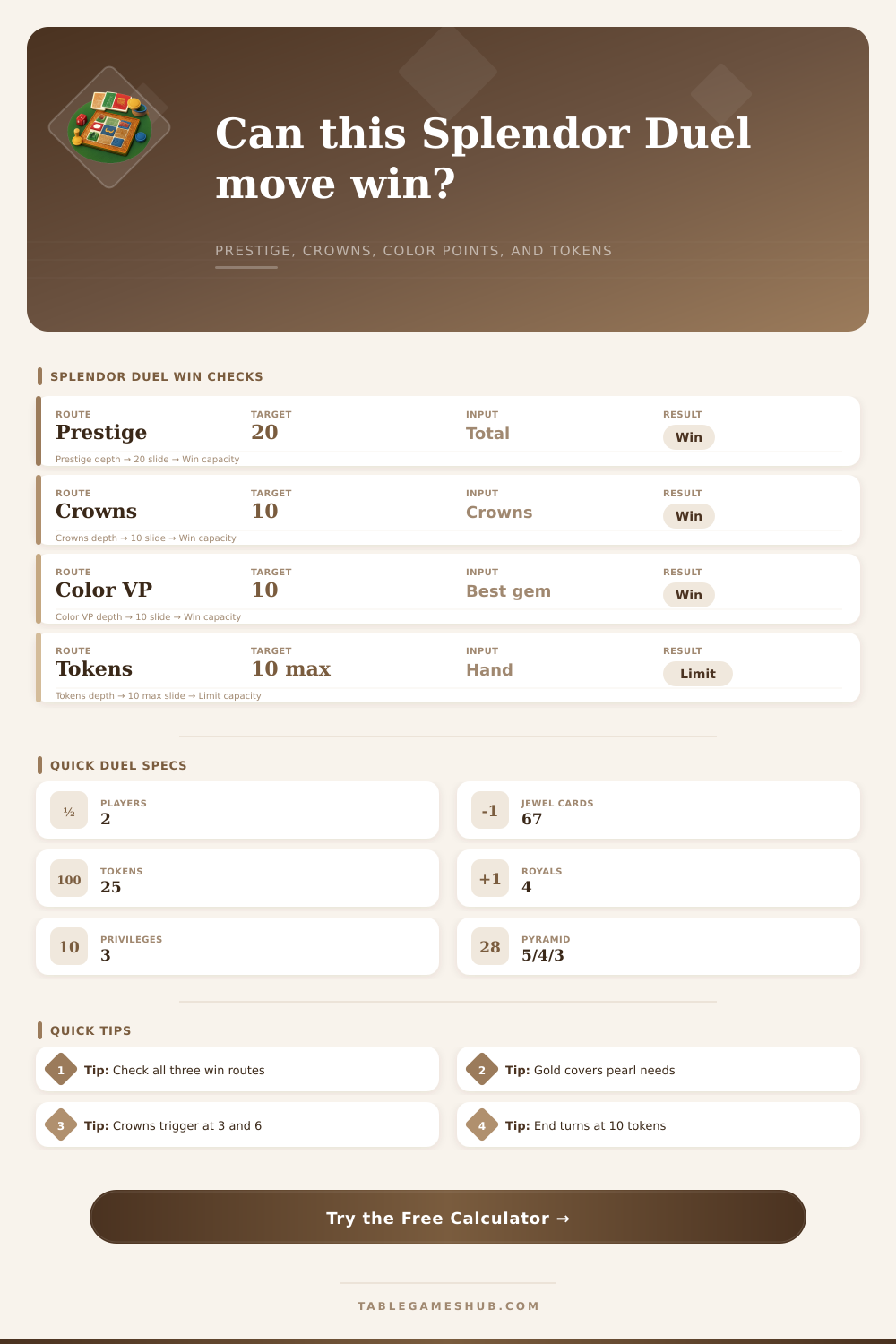
Project whether a purchase, reserve line, or refill plan reaches 20 prestige, 10 crowns, 10 prestige in one gem color, or the exact tokens needed for the next Jewel card.
1Splendor Duel Presets
2Current Victory Track
3Target Jewel Card
4Held Tokens and Bonuses
Enter tokens in hand, then permanent bonuses already showing on your Jewel cards. Gold is treated as wild and can cover any gem or pearl requirement.
5Target Requirement
6Refill and Blind Reserve Odds
7Game Component and Spec Grid
8Splendor Duel Reference Tables
| Victory route | Official threshold | Calculator formula | Important timing |
|---|---|---|---|
| Total prestige | 20 prestige | Current prestige + target prestige + Royal prestige | Checked after mandatory action and any card ability resolves. |
| Crowns | 10 crowns | Current crowns + target crowns | Royal cards are first selected at the 3rd and 6th crown. |
| Same-color prestige | 10 prestige in one color | Maximum color prestige after adding the target card or copy-color card | Gray Royal prestige does not create its own color route. |
| Token limit | 10 tokens between turns | Held tokens + gathered tokens + reserve gold before the purchase | Discard excess only at turn end after the mandatory action. |
| Token type | Total in box | Requirement use | Calculator treatment |
|---|---|---|---|
| Blue, white, green, black, red | 4 each | Match printed Jewel card requirements | Requirement minus permanent bonus, then minus held tokens. |
| Pearl | 2 | Printed pearl requirements and privilege picks | Can be covered by held pearls, privileges, or gold wilds. |
| Gold | 3 | Wild payment after reserving | Applied after color and pearl shortages are totaled. |
| Privilege scroll | 3 | Optional pre-action non-gold token picks | Reduces remaining shortage before estimating take-token actions. |
| Target source | Extra action | Gold impact | Best use in calculator |
|---|---|---|---|
| Visible pyramid card | None before buying | No automatic gold | Use when the card is already public and reachable. |
| Already reserved card | None before buying | Uses any gold already held | Use for secret or protected cards in hand. |
| Reserve first, then buy | Adds one reserve action | Adds one gold if gold is on the board | Use when blocking or securing a card matters. |
| Blind deck reserve | Adds one reserve action | Adds one gold if gold is on the board | Use with deck-hit odds for tier chase estimates. |
| Public setup element | Count | Space or sequence | Calculator note |
|---|---|---|---|
| Visible Jewel pyramid | 12 cards | 5 Tier I, 4 Tier II, 3 Tier III | Use visible source when the target is already in this layout. |
| Token board | 25 spaces | Filled from center along the printed spiral | Refill odds use empty spaces and bag composition. |
| Compact play area | About 24 x 20 in | Card pyramid above board | Shown in selected display units in the breakdown. |
| Reserved cards | 3 maximum | Kept secret from opponent | Reserve lines are blocked when all three slots are used. |
9Calculation Tips
Check the win order: add the card, resolve its ability, take a Royal if the 3rd or 6th crown is crossed, then compare all three victory routes.
Do not undervalue gold: in this calculator, gold covers the final combined shortage after permanent bonuses and held tokens have already reduced the card requirement.
The anxiety I’m describing is a perfect example of what Splendor Duel is all about. It’s a two-player game where every decision feels less like a casual “pick up and play” experience, and more like making a chess move across the table from a person who appears calm but holds enough gems in their hand to buy the card that kills you. What do you do? Your face is neutral, your hand is brimming with gem tokens, and your brain starts running through possible move combinations. You can’t simply buy whatever card sounds cool because your opponent are actively working against your goal of buying that specific card next turn. Before you know it, the tension rise. One wrong move, one careless placement of a token, one ill-timed reserve, may mean giving victory to the other side without ever taking another action.
The rest of the work gets done for you with this handy tool (above), which projects whether any given purchase line results in reaching the wanted twenty prestige points, ten crowns, or ten points in any one gem color. It eliminates the mental math that otherwise induces players to stall or make hasty decisions when pressed for time. Rather than wondering if all your existing blue bonuses and hoarded tokens will add up to pay for that Tier III card, you simply enter your precise stockpile into this spreadsheet and get the answer instantly. Because in a duel, every second count: You don’t have time to waste while your opponent blocks off your reserves.
Why You Should Use This Calculator Tool
Total prestige is what most players looks at when considering their chances at victory. It’s certainly the easiest-to-read score track, so it makes sense that they’d be fixated on it. But the path to a crown victory comes as a surprise to many. Besides tracking your current number of crowns, you also need to consider if a certain card will move you from three to six crowns (or vice versa), because that will add a Royal card to the game. Those Royals can drop five prestige points on you all at once, resulting in a swing turn where you sidestep all the gradual grinding required to collect individual Jewel cards. To compensate for this, the calculator allow you to account for possible Royal drops prior to buying the card.
Things get more complicated with those wildcards (the gold tokens) and extra actions (privilege scrolls), though. The gold in particular is difficult: It’s not permanent; once used, it’s gone. And it’ll fulfill whatever gem cost you need, but it’s a one-time resource that must be spent at the right moment. So it’s a single-use resource that needs to go toward its best possible target. With the privileges, meanwhile, you’re able to take an extra token before your primary move. You can also extend your turn by essentially getting an extra action. Finally, you can make a purchase you otherwise wouldn’t of been able to do in two turns. Knowing when to use them transforms this game from an easy engine-building challenge into a narrow tactical puzzle, as each of those tokens have a purpose to fill.
The other question is one of probability. The thing so many players forget about until they’re looking out at an empty board. You can only buy if you have the right gems, and as those gems drain from the board you’re left estimating your chances of pulling them when the board refills. The refill odds calculator gives you a space where you enter the number of empty spots on the board and the number of tokens still in the bag. This helps you determine whether to go all-in on a risky purchase (and potentially shut down your engine) or to play it safe with something of lesser value that ensures your engine continues chugging along. That’s what makes for good strategy in a competitive game: balancing the immediate reward vs. You keep your options open for later.
In the end, though, Splendor Duel is about seeing two or three turns ahead rather than just reacting to the situation in front of you. Where do they think they’ll be blocked? When will they activate one of their win conditions? What’s going into reserve for a final push at the end? The calculator doesn’t eliminate the skill involved in the game… It merely removes the error from the execution. The strategy selection remains entirely up to you, but you’ll know the numbers are on your side.
Winning isn’t just about winning (it’s about winning confidently), clearly, knowing why your move wins and how much better it is than theirs. As soon as you can stop worrying about having too few blue gems and focus on shutting down their red engine, the game moves from a frantic scramble to a rewarding mental duel. And that change in perspective is well worth the time spent tracking your tokens and projecting your prestige.