Triominoes Score Calculator
Total a Triominoes turn or round from tile values, draw penalties, bridge and hexagon bonuses, rack leftovers, current standings, and the 400-point final-round trigger.
1Named Triominoes Presets
Load a common scoring situation, then edit tile values, bonuses, rack totals, penalties, and match status for your score sheet.
2Turn and Match Inputs
Tile, Bonus, and Penalty Inputs
Rack Totals and End-of-Round Inputs
3Formula Cards
Tile Placement
tile score = A + B + C
Every legal placed Triomino scores the sum of its three printed numbers before shape bonuses or draw penalties are applied.
Shape Bonus
turn = tile + bridge or hex bonus
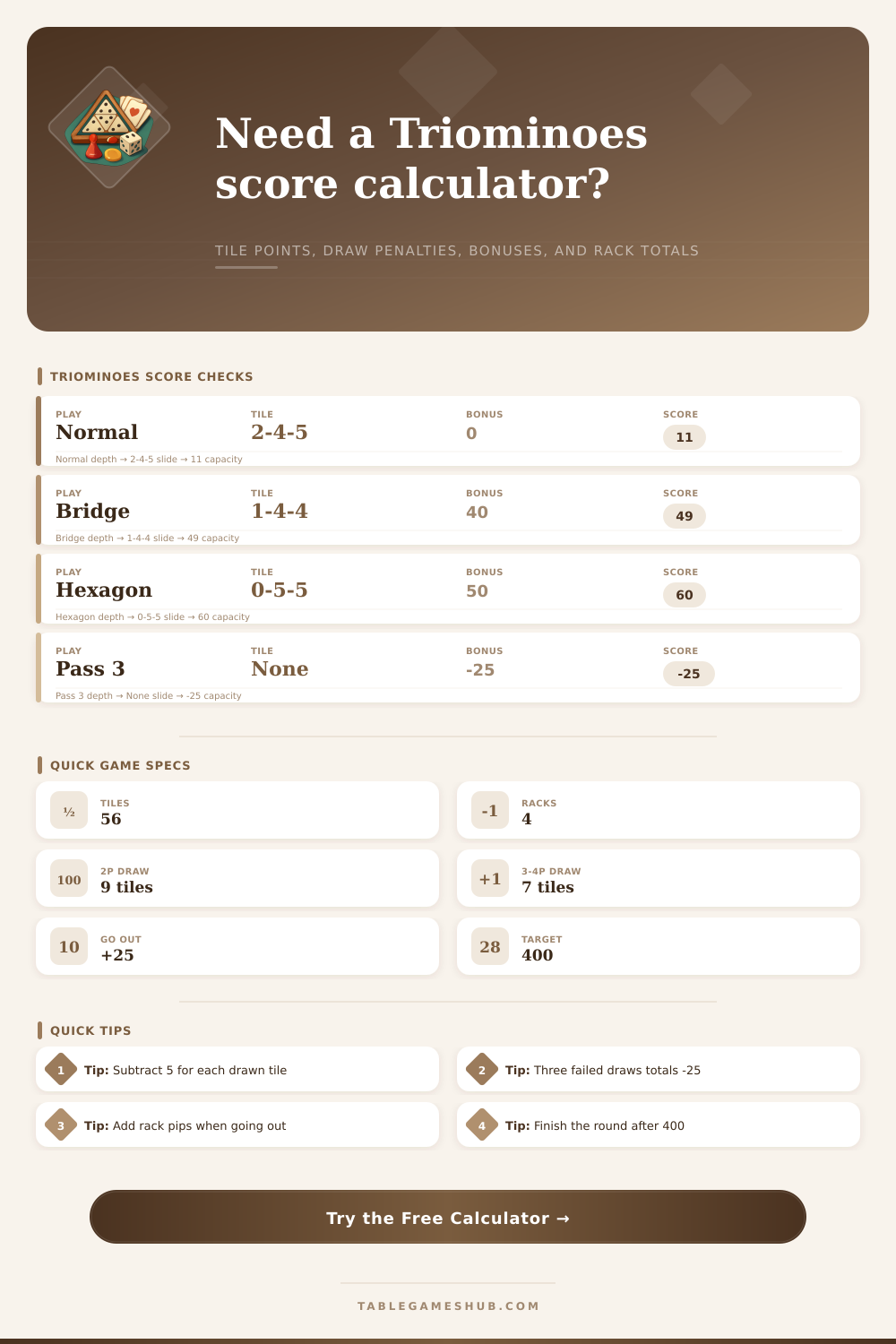
Use +40 for a bridge, +50 for one hexagon, +60 for two hexagons, or +70 for three hexagons from a single placement.
Draw Penalty
penalty = draws x -5, plus -10 if pass
A player who draws up to three tiles loses 5 points each; if the third draw still cannot play, add the extra pass penalty.
Round Ending
end score = turn + 25 + opponent racks
When a player empties their rack, add the last-tile bonus and the total points left on the other players' racks.
4Component and Spec Grid
5Reference Tables
| Event | Input Needed | Score Formula | Calculator Use |
|---|---|---|---|
| Normal placement | Three tile numbers | A + B + C | Use for most legal tile plays. |
| Opening tile | Opening tile numbers | Tile sum, or selected house start rule | Use start mode for first score sheet entry. |
| Bridge | Tile numbers plus bridge shape | Tile sum + 40 | Use when the placement earns the bridge bonus. |
| Hexagon family | Tile numbers plus hex shape | Tile sum + 50, +60, or +70 | Use for single, double, or triple hexagon closes. |
| Draw Result | Drawn Tiles | Penalty | Score Sheet Reading |
|---|---|---|---|
| Draw one, then play | 1 | -5 | Add the tile score and bonus, then subtract 5. |
| Draw two, then play | 2 | -10 | Useful for a delayed playable tile found in spares. |
| Draw three, then play | 3 | -15 | The placement can still score if the third tile plays. |
| Draw three and pass | 3 | -25 | Three draw penalties plus the extra pass penalty. |
| Round End | Primary Bonus | Rack Math | Calculator Mode |
|---|---|---|---|
| Player empties rack | +25 | Add all opponents' rack points | Empty rack |
| No player can move | None | Subtract each player's own rack points | No moves rack adjustment |
| Lowest-rack house scoring | House rule | Compare rack totals before award | Use adjustment field if needed |
| Final-round trigger | Target reached | Finish the current round before winner check | Match state card |
| Setup | Players | Starting Rack | Scorekeeping Note |
|---|---|---|---|
| Classic two-player | 2 | 9 tiles each | Track spares closely because draw penalties matter more. |
| Classic three-player | 3 | 7 tiles each | Use separate columns for draw penalties and turn totals. |
| Classic four-player | 4 | 7 tiles each | Four rack totals make the go-out bonus swing larger. |
| 400-point race | 2 to 4 | By player count | When a player passes the limit, finish the round before declaring the winner. |
6Scorekeeping Tips
Separate columns: Record tile sum, shape bonus, draw penalty, and rack adjustment separately before copying the final entry into the running total.
End checks: When a rack empties or every player is blocked, total all remaining rack points before moving to the next round or final winner check.
What sounds like a game of dominoes plus a geometry class is actualy quite straightforward, except when it comes time to count scores. Because there are bonus points for shapes, penalty points for what’s left in your rack (which no one else can see), and point totals that fluctuate wildly even within rounds as they suddenly end and you have to do some quick math right then and there before anyone starts getting angry at each other about who still owes what. Triominoes seems pretty simple, until you attempt to play without forgetting who owes what to whom.
Once you know how many bonuses your tiles is worth as well as their value, just plug them into the calculator above, which will do the math for you. This frees you from remembering all of the rules during a game (who remembers that drawing tiles is actualy penalized?). Every time you’ve got nowhere else to go and you reach into the spare pile, you’ll suffer a 5-point penalty for each tile you draw.
How to Count Your Score in Triominoes
It’s only a few points on any one turn, so you may think it doesn’t matter. However, if you find yourself having to draw twice or even three times, those penalties adds up fast. They will wipe out a massive bridge bonus in no time at all. Understanding that trade-off is half the battle. You might take the risk of drawing in order to hold out for a particular high-value piece, but don’t hesitate, the penalty system will slap you hard for doing so.
Simple placement becomes strategic geometry thanks to shape bonuses. A bridge is worth forty points. You get fifty or more if you close any hexagon(s) simultaneously, depending on how many sides you close. In a game where a normal turn may garner only ten or fifteen points, these are huge swings. And here’s the trick: knowing which pieces earn these shape bonuses means understanding exactly what triggers them.
It’s not about your rack alone, but rather seeing the entire table. Closing two hexagon with one tile gives you seventy points because of the fifty-point hexagon bonus plus extra value for completing more sides at once. That’s a seventy-point event; changing the lead entirely. Here, the pages’ reference tables lay it all out clearly without having to memorize specific multipliers while playing.
The other wrinkle is the end-of-round scoring, which turns on its head: Whoever clears their rack scores 25 points and all of the points of the tiles still in your possession. So that’s yet another reason to get defensive towards the end, you can be racking up points really nicely during the round, but if you have some big tiles at the end and your opponent clears them cleanly, chances are good that their bonus will outweigh what you’ve accumulated steadily. It is a little thing, but it does matter. And again, the calculator accounts for this.
You can enter the contents of each player’s remaining rack so you’ll know precisely the impact (or lack thereof) that last rush will have on your total. This time pressure on scoring also usually comes from the fact that tournament play typically goes to four hundred points. You don’t want to burn out by saving your good moves, but do you have enough to win this round? Should you of waited? Knowing how far ahead or behind someone else is take the worry out of it.
Do the math. Are you thirty points back now with only a few tiles in the draw pile? You know right then what you need to do. There is no guesswork. Just figure out whether or not you can make up the points without taking one off yourself. But it’s this combination of factors, the risk/reward balance they each create, where the fun of Triominoes truly lies.
Risky bridge versus the potential -5 point penalty from drawing tiles? Or is it the safe move with a guaranteed 10 points? Simulate it in seconds using the tool and leave the math behind to get back to playing the game. No more worrying about keeping track of scores… Just click those tiles together and feel comfortabley about yourself.
A good score means a good strategy. You stop blindly throwing darts at the board when you can identify each penalty or bonus on the scoreboard. Instead of random placement, you begin to view it as a set of strategic moves. It’s the distinction between playing for fun and playing competitive with every point counting. Track those racks. Watch those penalties. Let the numbers be your guide to the next move.