Matador Dominoes Calculator
Check rule-of-seven legal ends, matador outs, draw rescue pressure, block risk, final score swing, and table setup for a double-six Matador hand.
1Matador Dominoes Presets
Choose a named table state, then adjust the open ends, hand outs, boneyard rule, pip totals, and setup dimensions.
2Hand And Rule Inputs
3Scoring And Setup Inputs
4Component And Setup Specs
5Rule-Of-Seven Reference
| Open train end | Regular inward end needed | Why it works | Blank-end note |
|---|---|---|---|
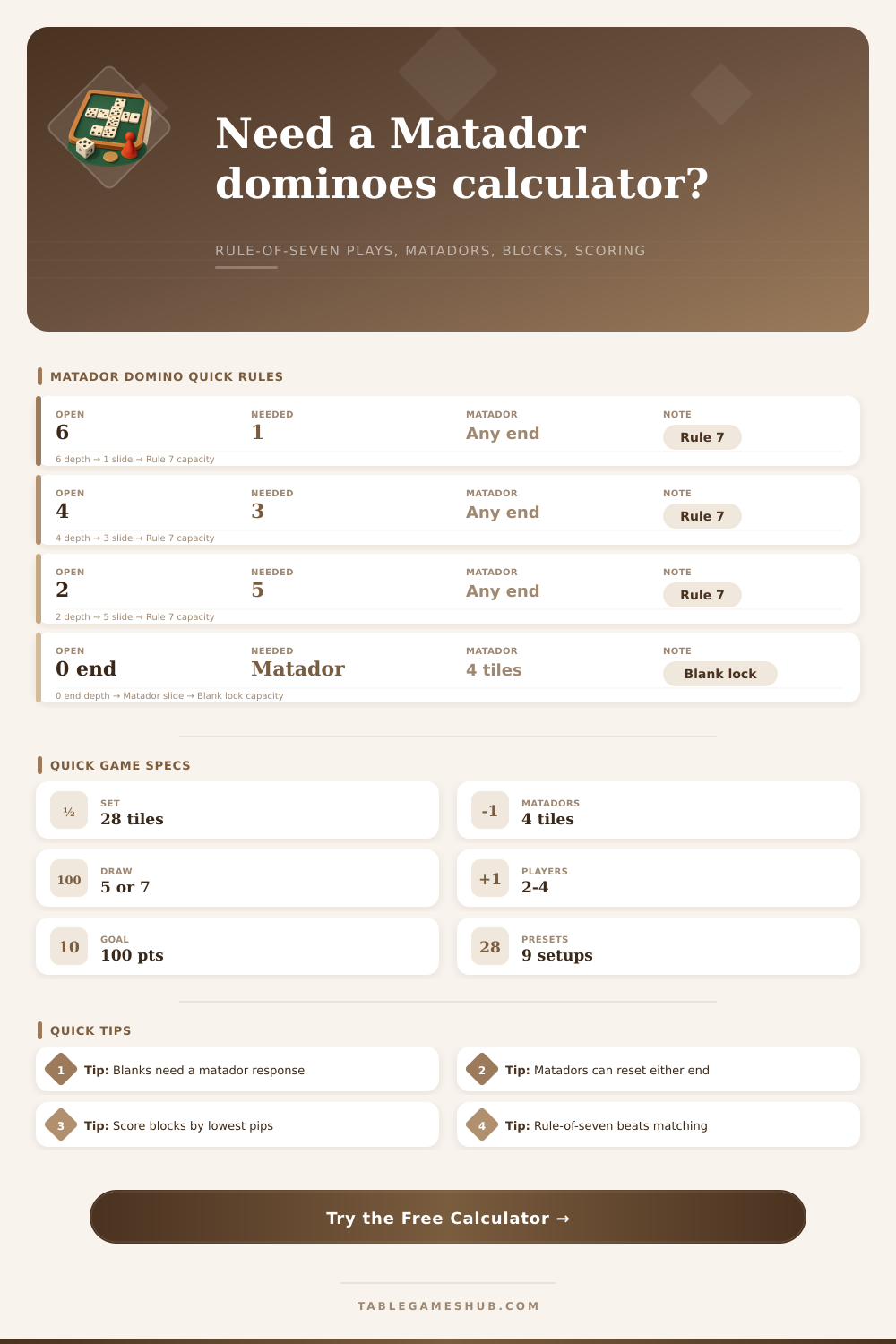
| 6 | 1 | 6 + 1 = 7 for a normal play. | Not a blank, so regular tiles may connect. |
| 5 | 2 | 5 + 2 = 7 for a normal play. | The 2-5 tile is a matador if used. |
| 4 | 3 | 4 + 3 = 7 for a normal play. | The 3-4 tile is a matador if used. |
| 3 | 4 | 3 + 4 = 7 for a normal play. | The same 3-4 matador can reset the end. |
| 2 | 5 | 2 + 5 = 7 for a normal play. | The same 2-5 matador can reset the end. |
| 1 | 6 | 1 + 6 = 7 for a normal play. | The 1-6 tile is a matador if used. |
| 0 | No regular end | A blank cannot total seven with another double-six end. | Only a matador can be played on a blank. |
6Matador Tile Reference
| Matador tile | Total pips | Calculator role | Useful table state |
|---|---|---|---|
| 0-0 | 0 | Universal play and strongest blank-end answer. | Best when an open end is blank. |
| 1-6 | 7 | Can be played without matching the current end. | Can leave either 1 or 6 open. |
| 2-5 | 7 | Counts as a matador even though it also totals seven. | Can convert pressure toward 2 or 5. |
| 3-4 | 7 | Flexible reset tile for middle-number ends. | Can convert pressure toward 3 or 4. |
7Scoring And Block Reference
| Hand ending | Winner check | Score formula | Calculator input to watch |
|---|---|---|---|
| Domino out | A player empties their hand. | Winner gains losers' remaining pips. | Losers combined pip total. |
| Blocked hand | No player can play after passes. | Low pip hand gains losers' pips minus own pips. | Your pips vs lowest opponent pips. |
| Low-pip tie | Two or more players tie for lowest. | Common scoring gives no hand score. | Lowest opponent pip total. |
| Target race | Match score reaches the agreed goal. | Current score plus award compared to target. | Current score and match target. |
8Setup And Component Reference
| Setup | Suggested surface | Player range | Component note |
|---|---|---|---|
| Travel two-player | 24 x 24 in | 2 players | One compact double-six set and small score pad. |
| Classic kitchen table | 60 x 36 in | 2-4 players | Room for boneyard, train, and score sheet. |
| Partnership table | 72 x 36 in | 4 players | Separate team notes and discard visibility. |
| Teaching layout | 84 x 42 in | 3-4 players | Extra room for exposed examples and reference cards. |
| Round card table | 48 in diameter | 3-4 players | Good reach, limited score-sheet space. |
9Component Spec Grid
| Component kit | Piece count | Storage footprint | Best use |
|---|---|---|---|
| Travel double-six set | 28 tiles | 6 x 4 in | Small two-player hands. |
| Standard double-six set | 28 tiles | 8 x 5 in | Most Matador tables. |
| Wood tray and score pad | 31 pieces | 12 x 8 in | Organized boneyard and scoring. |
| Large spinner set | 28 tiles | 10 x 6 in | Readable tile faces for four players. |
| Partnership table kit | 34 pieces | 14 x 9 in | Team notes, pencil, and marker tiles. |
| Tournament score kit | 40 pieces | 16 x 10 in | Score sheets, clock card, and tile tray. |
10Practical Calculation Tips
Blank-end pressure: When an open end is blank, the calculator treats only unused matadors as natural tile-type outs. That is why a blank can create a sharp block even with many tiles still unseen.
Score swing: For blocked hands, compare your pip total to the lowest opponent before trusting the point award. A tie for lowest pip total commonly produces no score.
Now it’s your turn; you’re seated opposite a friend who has just played a double-six tile. A previous player left a blank on one side of the train. Glancing down at your hand, you notice that all of your pips doesn’t match. This is where matador dominoes become more than just a matching game. It becomes a test of your ability to read odds while under pressure.
Success isn’t guaranteed by having good tiles, knowing what matters when the board goes against you is key. It all hinges on the rule of seven. Add your pip count from inside and match it with the exposed end. Make sure the total add up to seven. If you see six on the table, then bring a one. For most hands, it’s just arithmetic.
How to Use the Matador Calculator Tool
This does not apply if you get a blank on the end. A blank can’t add up to seven with any ordinary tile. All of your normal outs go poof. That’s where the calculator does its work. It calculates the math for you. It translates this momentary stalemate into a real-world number of tiles that remain playable. Strips away the panic by showing exactly how many matadors are left in play versus how many regular tile are effectively useless. It also shows what fraction of the regular tiles have become essentialy unusable.
But what does this tool need? What are its inputs? Well, first and foremost: You, my friend. Of course you’re going to enter your own hand! How many tiles are in your boneyard? The tool wants to know how many remaining tiles you has. And how many matadores do you have out? For each one that’s visible, the number of wild cards (matadores) decrease.
If you have three of the four showing, your chances of drawing a rescue tile plummet. Your chances plummet. It doesn’t matter how many other tiles are stacked beneath the board. That lack will be included in the draw pressure metric. Is it worth hoping for good fortune? Should you fold now? The tool will tell you all these things.
For first-time Matador players, scoring is counter-intuitive. Newcomers think that whoever has the smallest number of pips wins big. This only applies if they are the only ones with few pips. Two people who tie for least win nothing (or split the pot). Knowing this detail changes how you play the game. For example, you might hold back on a high-pip tile not to save it, but to avoid tying your opponent and nullifying their advantage. No, you’ll do it because holding onto it could cause a tie which takes away your opponent’s advantage.
To help see this trap, the score swing feature shows you what’s left in your hand compared to other player estimates. Does it pay to push for a lower count? Is there a danger you’d land in a tie zone? Gameplay flow is greatly affected by the physical set up. With a small table, players are forced together on the train. It is harder to spot exposed ends. There is a greater likelihood of missing an opportunity or making an illegal play. The reference table gives some dimensions based off number of players. For a four-player game, you need significantly more edge space different than a duo. Without the space, tracking pips becomes too much work. Confusion leads to errors. Mathematical planning won’t correct the errors.
Matador is about playing dominoes with probabilities. There’s a chance of pulling a matador out of a boneyard based off how many tiles are in it. Your opponent could hold a pile of high-pips and still bluff the hell out of you. That part you never know. The math is what the tool does. It helps provide a number against which to make an informed decision.
Experience is where intuition come from. You realize when to push back and when to fold. You can believe a blank end isn’t as bad as you thought. You decide that human error is the true wildcard and balance its unpredictability with the cold math of what is and isn’t possible. Knowing the numbers helps you catch a breath when the table gets quiet. This makes what would of been a mistake a calculated wait.