🎲 Qwirkle Score Calculator
Total a Qwirkle turn from line lengths, crossing lines, completed Qwirkles, endgame bonus, score gap, and per-tile efficiency.
| Step | Value | Formula | Note |
|---|
Main line points plus crossing line points plus all six-point bonuses.
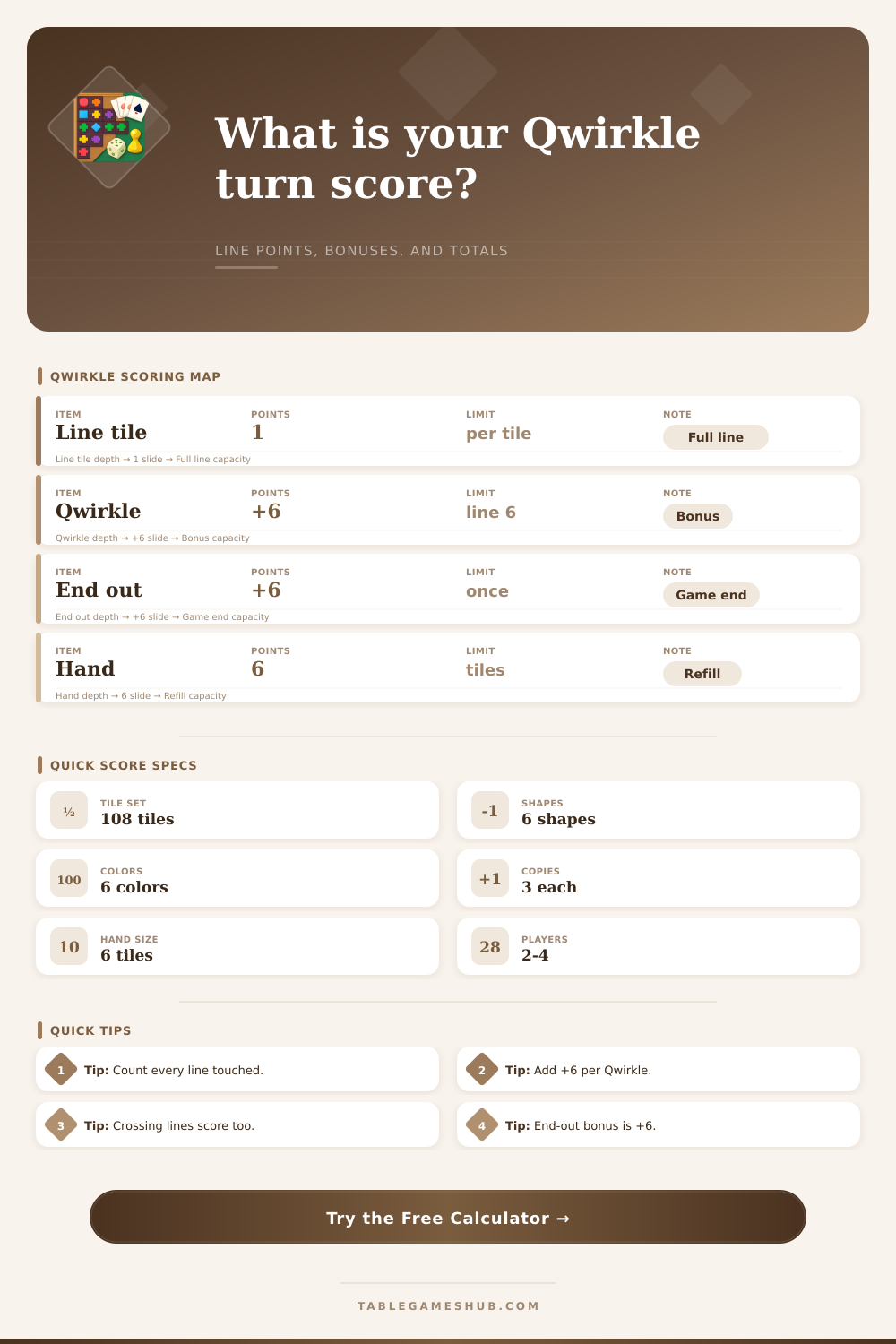
Each scored line gives one point for every tile in that line after the play.
A six-tile line is six line points and six extra points, for twelve before crossings.
Turn score divided by tiles placed shows how hard each played tile worked.
| Scoring item | Value | When to count it | Calculator input |
|---|---|---|---|
| Primary line | 1 point per tile | The row or column containing the tiles you placed this turn. | Primary line length after play |
| Crossing line | 1 point per tile | Each perpendicular line made or extended by a placed tile when length is at least two. | Crossing lines and average length |
| Qwirkle bonus | +6 points | Every completed six-tile line of one color or one shape. | Qwirkles completed |
| Endgame bonus | +6 points | First player to play all tiles after the bag is empty. | Endgame empty-rack bonus |
| Example play | Line points | Bonus points | Total |
|---|---|---|---|
| Three-tile opening line | 3 | 0 | 3 |
| One tile touches two length-two lines | 4 | 0 | 4 |
| Complete one Qwirkle line | 6 | 6 | 12 |
| Six-line plus two four-tile crossings | 14 | 6 | 20 |
| Endgame Qwirkle and empty rack | 6 | 12 | 18 |
| Component or rule spec | Standard value | Score relevance | Reference basis |
|---|---|---|---|
| Total tiles | 108 tiles | Limits tile availability and repeated combinations. | MindWare product specs |
| Unique tile identities | 36 combinations | Six colors multiplied by six shapes. | MindWare rules and BoardGameGeek |
| Copies per identity | 3 copies | Duplicate copies may exist in the game but not in the same scoring line. | MindWare product specs |
| Maximum line length | 6 tiles | The calculator caps scored line length and Qwirkle completion at six. | MindWare rules |
| Reference | Used for | Quality note | Link |
|---|---|---|---|
| MindWare official Qwirkle rules PDF | Line scoring, Qwirkle bonus, endgame bonus | Primary publisher rule sheet | Rules PDF |
| MindWare Qwirkle product page | Tile count, player range, component listing | Publisher product data | Product page |
| BoardGameGeek Qwirkle page | Component summary and publication data | Board game database cross-check | BGG page |
Count lines, not only placed tiles
A tile placed into both a row and a column can score in both lines. Enter the main line once, then add each crossing line that reaches at least two tiles.
Keep bonuses separate
The six tiles in a Qwirkle already count as line points. Add the six-point Qwirkle bonus only after the line points are included.
Qwirkle looks like an easy little kid’s game with its colorful tiles and uncomplicated shapes. But any player who’s ever given it a try will tell you: the action lie in its scoring system. On the surface, the rules are clear. Just lay down the tiles and draw a line from those with matching colors or patterns. For each tile in that line, you’ll score a point; for every six-tile long line, you’ll recieve a bonus. Sounds like simple arithmetic, right?
Only problem is: the board shift with each move. Lines cross and new ones open up. This makes it harder than expected to keep track of several overlapping lines while you also try to manage your hand. That’s what these tools do: they takes care of the math and leave you free to concentrate on the gameplay.
How to Score Points in Qwirkle
But line length is key mechanic. When you make a complete line (every tile in the line), you gets one point per tile. So if there are four red circles in a row, that’s four points. Regardless of who originally put down those individual tiles, they counts for the person who most recently played them. That adds some cool tension where sometimes you’re trying to build out your own lines but then also want to steal other people’s momentum. Like maybe you extend a line over three turns and then somebody drops one tile on top and takes away all five points.
Knowing how that works help explain why efficiency beats quantity. Two tiles that score ten points is usually better than six that score twelve, even though the second one appears larger on paper. How does it work? This calculator take all that complicated intersection math and does it for you. Just enter the lengths of the main line and any other lines (that meet the minimum length) to get a total number of base points plus the six-point bonus for completed Qwirkles. Then it displays a running total and compares it to your existing score.
One nice thing about this is the efficiency metric it gives you which I found really helpful during long games. Efficiency shows you how many actual points each tile in your hand is contributing. There aren’t many high efficiency plays, but when you do find one, it’s usually due to completing some line or filling a gap someone else overlooked. By looking through the breakdown table on the page, you’re able to see exactly where those points came from. It breaks them down between bonuses and line values, so you know what did what.
It’s all about strategy. Knowing what’s on your rack changes everything. Early on, you don’t want to trigger bonuses too quickly or set up long lines; you’ll typically hope to do it on your opponent’s turn. Delaying a Qwirkle until late in the game lets you decide the right moment to let someone else get their big kick-in-the-butt six points.
But once you’re late into the game, each point matter as you scramble to win the match. Getting the big six at the end swings even a tight game completely. If you’re down eight points and have three or four turns remaining, you won’t get back into it by playing it safe and only picking up single-digit points. It’s time for big moves: combining bonus with extending a line. Having a tool that tells you what your final score would of been given an anticipated number of turns ahead allows you to weigh risk versus reward… Does this aggressive move leave me wide open for my opponent? Will it pay off enough to matter?
The other frequent error is missing crossings altogether. Just one tile placement might finish off a horizontal row, but also stretch across to fill out two vertical columns, producing points along three lines with a single move. But players tend to get tunnel vision along one axis or another and thus miss out on the crossing opportunities. Be sure to count all of the possible lines that intersect with where you’ve placed any given tile. This not only helps with correct scoring; it keeps you thinking spatially, not simply linearly, about the board.
For practical examples of how those intersections play out, there is several tables provided as references below. Once you see the math laid out before you, it makes sense as to how certain modest-looking moves result in unexpectedly large totals.
The takeaway for me here is that the key to being really good at Qwirkle is understanding how to take advantage of position but also knowing that you can’t rely on small plays if you’re falling behind late in the game. Block off your opponents’ moves but maintain some for yourself. Know exactly how many points every move is going to earn so you don’t blow it all on the table and look like an idiot. You must also understand when to take risks. That knowledge will give you the edge whether you’re playing in a tournament or just around the house with your family.
Be creative and be precise. It’s not just a game that loves to reward creativity; it’s one that knows where all its points go. Know them and they’ll turn your good ideas into real wins, instead of having your ideas lost among everyone else’s.