Tute Score Calculator
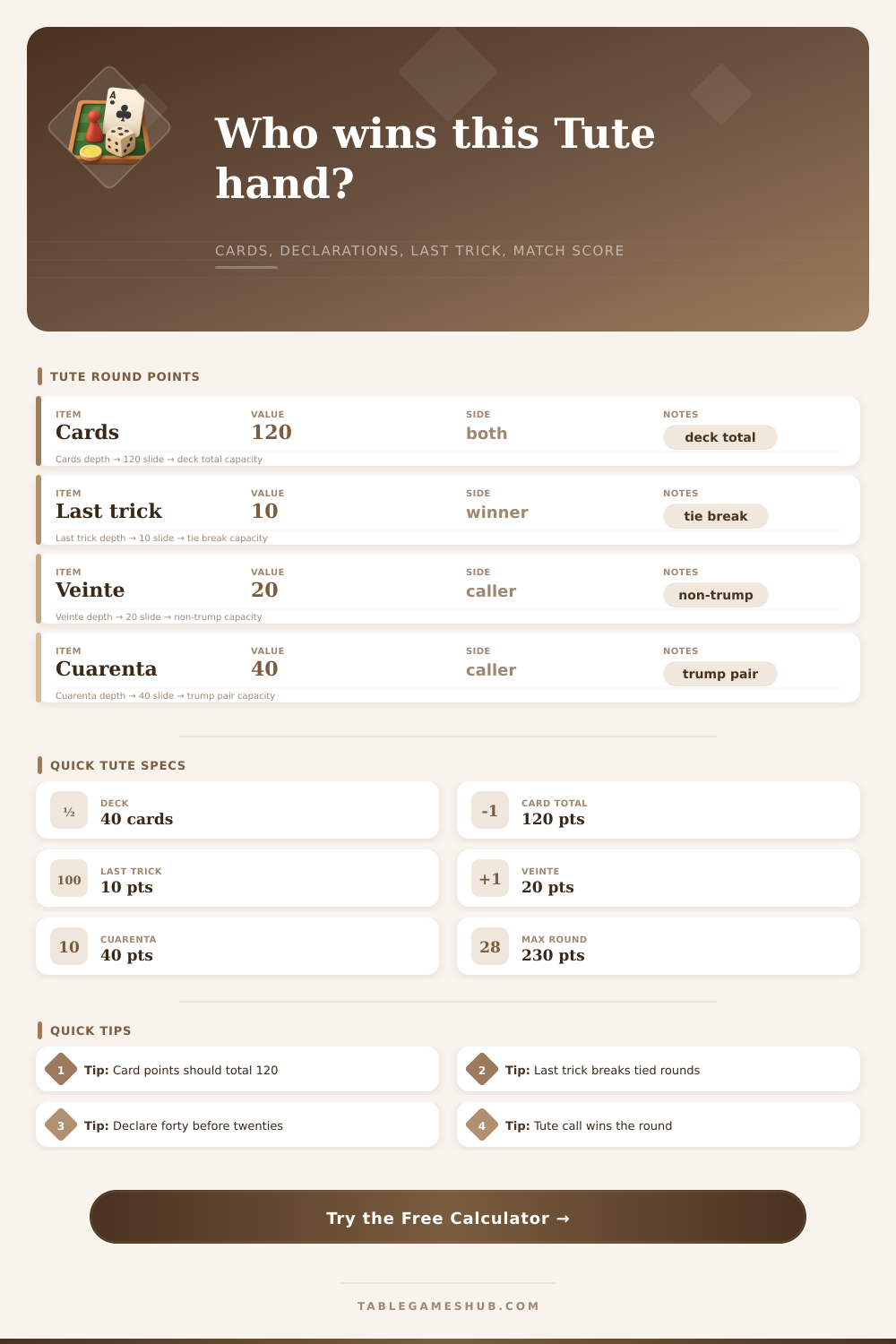
Total Spanish-deck card points, las veinte, las cuarenta, last trick, tute declarations, and the next match score for two-player or pairs Tute.
Tute Round Result
| Card rank | Spanish name | Point value | Count in deck |
|---|---|---|---|
| Ace | As | 11 | 4 cards, 44 total points |
| Three | Tres | 10 | 4 cards, 40 total points |
| King | Rey | 4 | 4 cards, 16 total points |
| Knight | Caballo | 3 | 4 cards, 12 total points |
| Knave | Sota | 2 | 4 cards, 8 total points |
| Seven, six, five, four, two | Cartas blancas | 0 | 20 cards, no card points |
| Declaration | Required holding | Round points | Calculator field |
|---|---|---|---|
| Las cuarenta | King and knight of trump suit | 40 | Las cuarenta owner |
| Las veinte | King and knight of any non-trump suit | 20 each | Non-trump twenties |
| Tute | All four kings or all four knights | Automatic round win | Tute call holder |
| Last ten | Win the final trick | 10 | Last trick winner |
| Format | Players | Opening cards | Score handling |
|---|---|---|---|
| Two-player tute | 2 | 8-card hands with stock | Each player totals own baza and calls |
| Tute in pairs | 4 | 10-card hands, whole deck dealt | Partners combine captured points |
| Practice count | Any table | Use recorded tricks | Checks arithmetic without match notes |
| Short match | 2 or 4 | Repeated rounds | Winner of each round gains game points |
| Scenario | Side A score | Side B score | Winner logic |
|---|---|---|---|
| Plain card count | 65 cards + last ten | 55 cards | Side A wins 75 to 55 |
| Forty comeback | 44 cards + 40 call | 76 cards + last ten | Side B wins 86 to 84 |
| Exact tie | 60 cards + last ten | 70 cards | Side A wins by last trick |
| Tute call | Any legal total | Any legal total | Caller wins immediately |
Somebody yells out word: tute. The table becomes silent. Cards, which moments before felt light as tissue paper, now seem weighted down by their own gravitas. There’s no shortage of bluffs here, but it isn’t just that. No, it’s math. Half the fight of Tute, a Spanish card game that seems like poker played with yelling and history, are scoring points. Half the fight is knowing how to score points at all.
The values of the cards themselves should be familiar to most players: aces score eleven, threes ten; face cards chip in with four, three, two. And that’s about as far as things go. Excepting, of course, the core of the game which is what makes the difference between winning and losing. And that’s the part that comes with declarations, claiming combinations of cards before the tricks has been played. That’s where the drama unfolds.
How to Score Points in Tute
For example, if you hold both the king and knight of trumps, that’s forty points (las cuarenta). If you have those two card in a side suit, they is just twenty points. That’s a huge discrepancy… Enough to win the round comfortabley or lose by a single point after a brutal shuffle. In high-speed action, memorization isn’t an option. Let the calculator do the work for you and be sure it won’t miss any claimed bonus when the new deal comes down.
And then there’s this. The final trick is that ten points at the end doesn’t sound like much. But in Tute, it’s a ten-point weapon that can used as a tie-breaker. If one team has caught 60 card points but neither team have declared enough to win, whoever wins the final trick wins the game. That means they must keep playing all the way to the end and not make common mistake of stopping once they think they have won the game.
Add in pairs play and things gets even more complex. For two player games, each player is on their own count. For four players playing as two teams, both partners pools their declarations and cards they have captured. That takes some trust and coordination. You want to know what your partner has so that you can call out the appropriate bonuses without stepping on one another’s toes or missing a declaration opportunity. It’s all explained nicely in reference table on the page and you can see how the point structure changes with format.
The novice is also tempted to ignore all those white cards. What good are they? Zero point value. Truth is, they’re unpredictable factors based off the game of control. They’re the ones you want when it comes down to winning tricks, and that last ten-point bonus. A hand full of high-value cards may look good on paper but what good are they if you can’t win the tricks to collect them? Theory meets practice, which is a classic.
If someone shouts “tute call” it’s an instant win… As long as they get it right. It doesn’t matter if you’ve got all four knights and all four kings; it’s done. No counting required. But proving that can be a task in itself. It requires a combination of faith in your partner and faith in your own recollection of what was on the discard pile. Get that wrong and penalty could of been severe.
It’s more than just math: there’s a certain psychological pressure added here. So while Tute is all about luck, it’s also about managing your resources. Before any bonuses are applied, total of the deck comes to a hundred and twenty points. If you know what’s left in play, you can determine if it’s worth taking a chance at making a declaration or whether you should be content with a slim lead instead.
Listen with your ears and look with your eyes at the table. What does the table say? What do the other players say? While the numbers give you an idea of where you are, the other players gives you an idea of where they are headed. You must learn the score before you can learn how to master the game.