Isle of Cats Score Calculator
Total cat families, lesson cards, rare treasures, rooms, rats, Oshax color choices, baskets, and fish for final scoring.
⚓Score Presets
🐈Cat Families and Oshax
📜Lessons, Treasures, and End Scoring
▦Room Completion Grid
🧺Baskets and Rescue Audit
🗺Boat End Grid
🧩Component Audit Cards
📊Family Scoring Reference
| Family Size | Family Points | Use For | Oshax Note |
|---|---|---|---|
| 1-2 cats | 0 | Color totals and lessons only | Still counts as chosen color |
| 3 cats | 8 | Small scoring family | May include assigned Oshax |
| 4 cats | 11 | Efficient mid-size family | Chosen color matters |
| 5 cats | 15 | Strong family target | Good with color lessons |
| 6 cats | 20 | Large family target | Often worth preserving |
| 7 cats | 25 | Major scoring group | Base cap before extras |
| 8+ cats | +5 each | 25 plus 5 per cat over 7 | Oshax can push over cap |
🚢End Scoring Reference
| Score Area | Rule Value | Calculator Input | Common Audit |
|---|---|---|---|
| Visible rats | -1 each | Visible rats | Count only rats not covered by tiles |
| Unfilled rooms | -5 each | Seven room selectors | A room is filled when no squares show |
| Rare treasures | +3 each | Rare treasures | Common treasures score through lessons only |
| Public lessons | Card value | Public lesson points | Use half mode for solo public scoring |
| Private lessons | Card value | Private lesson points | Reveal and total completed private cards |
| Fish | Tie-break | Fish remaining | Does not add points in standard scoring |
📝Lesson and Rescue Helper Table
| Helper Count | Use During Scoring | Direct Points | Calculator Field |
|---|---|---|---|
| Color cats | Exact-color and minimum-color lessons | Card based | Family size fields plus Oshax audit |
| Common treasures | Treasure-count lessons and map planning | 0 by default | Common treasures |
| Baskets saved | Rescue review and expansion lessons | Card based | Basket capacity inputs |
| Fish remaining | Tie-break and fish lesson checks | Card based | Fish remaining |
| Oshax color | Color lessons and family scoring | Family/card based | Oshax color audit fields |
✦Scoring Tips
Isle of Cats, especially the final round, combines tedium and triumph. Three rounds of haggling over tiles, juggling basket size, caging up fish, squirreling away cats. Now it’s time to tally up the score. In a game with as many moving parts as Isle of Cats, there are more variables involved than even most gamers would expect. Baskets saved. Rooms is filled. Treasures are collected. Lessons learned. There are families of cats. Rats lurk in shadows. It’s easy to get lost in the frenzy. A single forgotten Oshax color or one miscalculated rat could change outcome of a close contest.
But don’t worry, we’ve got the maths covered. Run the numbers yourself with our handy-dandy calculator. It will crunch the tedious number for you while you work out your post-game argument.
How to Score Points
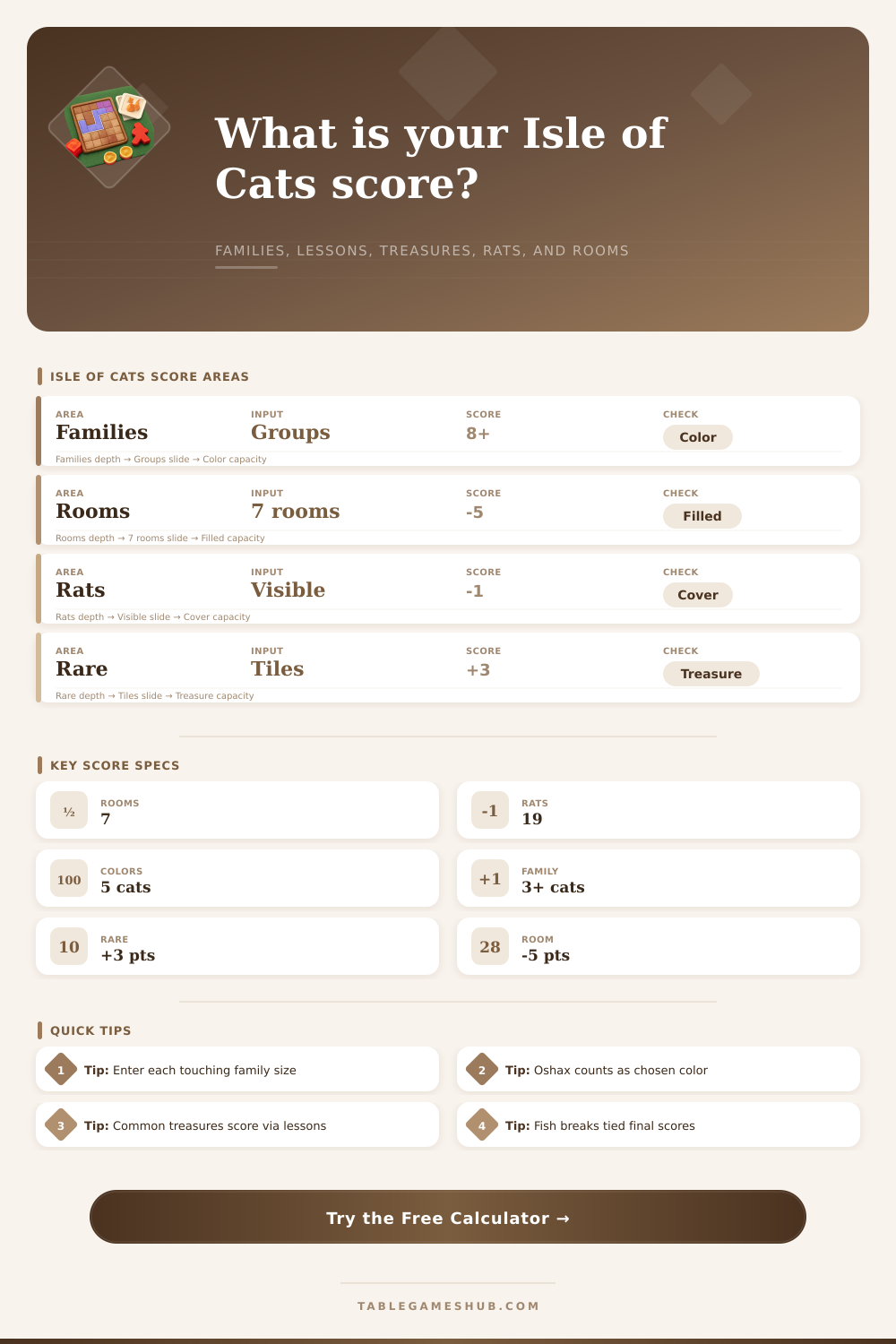
To make matters more interesting, points are scored according to various cat families. There’s a point total for every set of cats of the same color that is side-by-side (so diagonal doesn’t count). It sounds like a lot of points. It is an easy mistake to make if you are new to the game. What looks like a little cluster of connected cats actualy has no adjacent connection, so it does not qualify. The bigger the family, the more points. Twenty-five points get you seven cats. Five extra points per cat after that. That’s an exponential curve.
This means in most cases it’s better to try to preserve your biggest blobs of color instead of trying to spread them around to meet several lessons’ requirements. Big blobs of color = good. Scattered tokens = bad.
Oshax are wild cards that complicate things. At scoring time, they becomes whatever color you select, provided that stays the same all game long. For example, if you place an Oshax in your red family, it will be counted towards your tally of red cats for lessons as well. Double whammy, doubly effective as an engine of both direct family points, plus indirect bonus points from learning lessons. To prevent accidental double-dipping or missing out on bonuses, the calculator breaks those numbers apart. It keeps track of how many Oshax you’ve put down and which ones you want to color, then plugs them back together and adds them automatically to neighboring families.
And there’s more than just the cats that cause penalties in the board state. For example, for every room left empty on the ship you lose five points off your score. A room is not considered closed unless it has no visible empty space inside its border. It becomes a balancing act between closing out rooms and maximizing connections in those rooms. Do you give up that big family connection to close out a room? Or do you close out a room so that others don’t get their eyes on yours?
You also lose a point per visible rat. These little guys are easy to forget about until time comes to count them up, when they can eat away at a healthy lead established by good family scores. It pays to keep track of rat coverage while playing, because then you won’t find yourself surprised when you come up short at the end.
These penalties have some positives to offset them, such as lessons and treasures. Completing a public lesson earns you a straight-up point toward whatever its goal is (such as owning X amount of cats that match one color). A private lesson will give you more, but is at greater risk. You only get the reward if you finish the lesson. Rare treasures sitting on your boat score three points each. Any treasure counts towards filling out lesson cards which also score points, though they don’t score themselves. That total represents your gains, after subtracting rats and rooms. It makes it easier to understand where you really made money or lost money.
Instead of being a point source, fish act as a tie-breaker. Each fish doesn’t contribute any points to your final tally, unless there’s a tie at the end and it tips the scales in your favor. It’s a little thing that makes resource management meaningful down to the wire. Maybe you ignore a small point penalty so you can get an extra fish because you think score will be close? Your available fish are displayed on the calculator just in case you forget and there’s a tie.
For those who want to use pre-sets as practice scenarios or simply compare options, the preset buttons is there. Test out a heavy lesson focused approach vs a more well-rounded approach. The presets will fill in typical field values so that you can adjust each number separately and instantly observe result. This is a helpful tool for seeing tradeoffs without having to recreate your board entirely.
The key in scoring Isle of Cats is striking a balance between caution and aggression. While keeping rooms closed and rats at bay, chase after valuable lessons and big families alike. It’s easy math, yet as you multiply that by many parts, it becomes harsh. Every point counts, so getting the final number just right is important. Let the tool do the adding and subtracting. You’ll have confidence in the answer and be able to start planning your next move on the game board. There is no time to wait on the ship or the final tally.