🗺 Risk Reinforcement Calculator
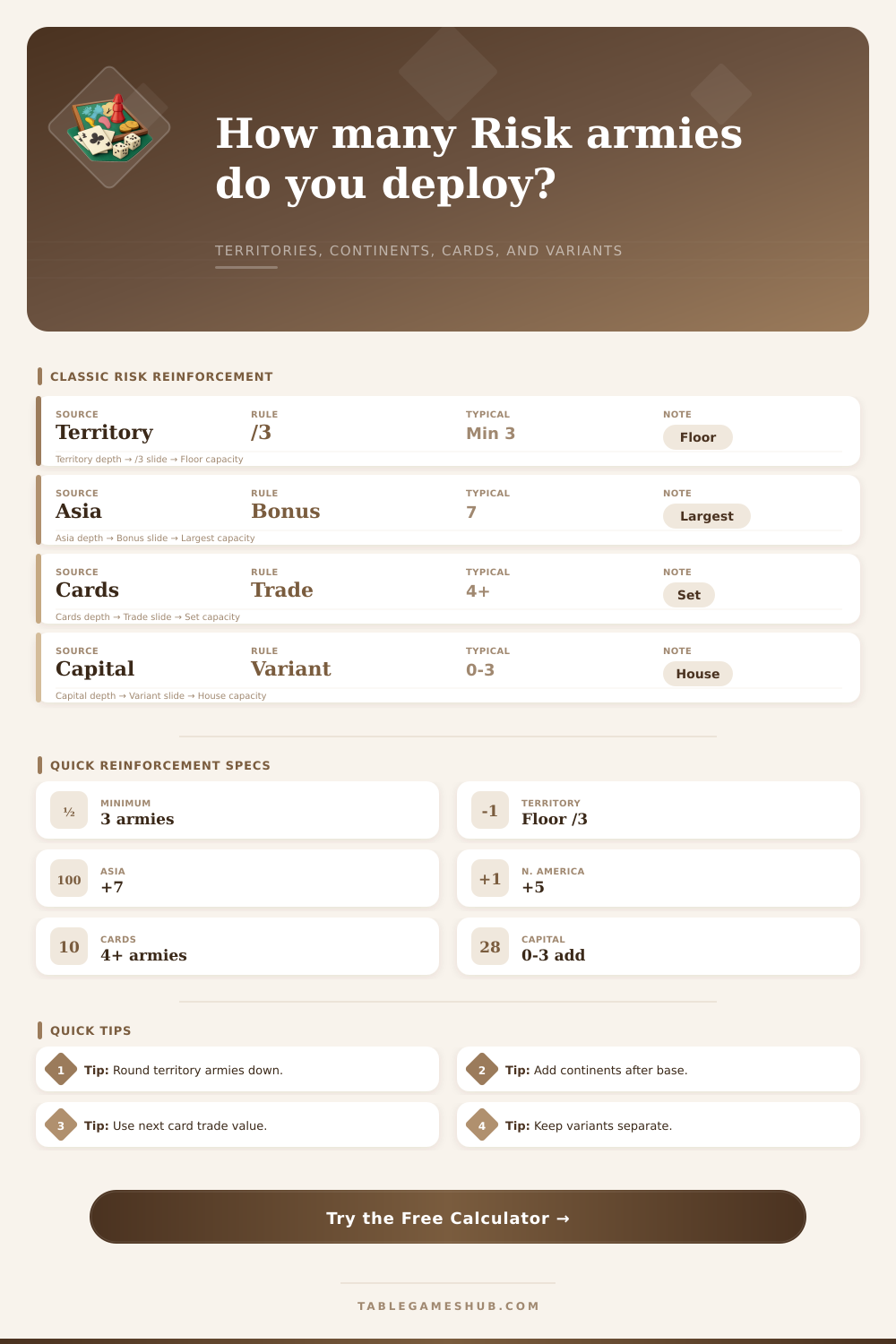
Total territory income, continent control, card trades, capital variants, mission reserves, and house-rule adjustments for a clean deployment count.
Toggle only continents that are fully occupied at the start of the reinforcement phase.
| Source | Armies | Formula | Notes |
|---|
| Continent | Territories | Classic bonus | Reinforcement note |
|---|---|---|---|
| Asia | 12 | 7 armies | Largest bonus and largest territory commitment on the classic board. |
| North America | 9 | 5 armies | High-value continent with three border pressure points. |
| Europe | 7 | 5 armies | Same bonus as North America with more concentrated territory count. |
| Africa | 6 | 3 armies | Middle-sized bonus, often adjacent to three continents. |
| South America | 4 | 2 armies | Small continent with a modest but efficient reinforcement add. |
| Australia | 4 | 2 armies | Small continent with a compact classic bonus. |
| Territories held | Raw division | Classic base | Why it rounds this way |
|---|---|---|---|
| 1 to 8 | 0 to 2 | 3 armies | The minimum reinforcement rule overrides the floor result. |
| 9 to 11 | 3 | 3 armies | Floor division now matches the classic minimum. |
| 12 to 14 | 4 | 4 armies | The first territory range that beats the minimum. |
| 15 to 17 | 5 | 5 armies | Every third territory adds one more base army. |
| 18 to 20 | 6 | 6 armies | Remainders are ignored until the next group of three. |
| 21 to 23 | 7 | 7 armies | Large positions can match a major continent bonus from base income alone. |
| Card trade type | Calculator setting | Armies counted | Use case |
|---|---|---|---|
| No set | No card trade this turn | 0 | Use when fewer than a valid set is being traded. |
| Classic escalating | Classic escalating set | 4, 6, 8, 10, 12, 15, then +5 | Common published sequence for long classic sessions. |
| Fixed set | Fixed set value | Custom input | Use for editions or tables that keep card value constant. |
| Matched territory | Matched territory bonus included | Custom input + 2 per match | Adds the usual two armies for each owned matched territory card. |
| Custom set | Custom card trade value | Custom input | Use when a scenario sheet names a specific trade value. |
| Variant component | Standard setting | Calculator output | Spec comparison |
|---|---|---|---|
| Capital held | +2 armies | Capital add | Small defensive headquarters reward. |
| Fortified capital | +3 armies | Capital add | Higher reward for scenario headquarters control. |
| Captured enemy capital | +5 armies | Capital add | Large swing used in conquest variants. |
| Mission reserve | Manual input | Mission add | Objective or mission card armies kept separate from base math. |
| House adjustment | Manual input | Adjustment add | Supports neutral boards, handicaps, and table-agreed variants. |
Keep Base and Bonuses Separate
Calculate floor(territories / 3) first, apply the minimum, then add continents and card trades. This prevents a continent bonus from accidentally masking a low territory count.
Audit Variant Armies
Capital, mission, elimination-card, and house-rule armies are displayed separately so every table can verify which rule created each reinforcement group.
When you play the game of Risk, you must determine the total number of armies that you will place on the board during your turn. The total number of armies that you have is important to your success in the game because the total number of armies that you have will determine whether or not you are able to defend one of your border or attack one of the game’s continents. The total number of armies is calculated as the sum of three different type of income that you may receive during your turn: territory income, continent bonus income, and card trade income.
The player calculates the total number of armies prior to the start of the attack phase of the game; during this phase, you will place all of your armies onto the board prior to any movement or attacking occurring during that players turn. The first type of income that you can receive is income from the territories that you control. To calculate the number of armies that you receive from your controlled territories, you divide the total number of your controlled territories by three, and then you take the floor of that number.
How to Count Your Armies in Risk
For instance, if you control eight territories, you will receive three armies; the floor of eight divided by three is two, but there is a minimum number of armies that you receive; you must have a minimum of three armies for any number of controlled territories between five and eight inclusive. Therefore, you receive the same amount of income from your territories if you control five territories as you would if you controlled eight. The second type of income is from the games continents.
If you control all of the territories within a continent, you will receive an extra number of armies for each continent that you control. For instance, the Asia continent provides players with the largest number of armies for each continent that they control, but requires the player to defend many of their border to retain such armies. Each of the other continents provides a bonus of five armies, though have different geographic shapes; South America and Australia provides a bonus of two armies each, and players often use them as small areas that can be controlled to hold an extra number of armies.
These armies are added to the income from your controlled territories. To receive any bonus armies from one of these continents, you must control all of the territories within that continent; should you lose one of your territories to another player, you will no longer receive the bonus armies from that continent. The third type of income is from the trading of cards.
In Risk, players trade in a number of their game cards to receive a specific number of armies in return. The number of armies provided from trading cards increases as the game progresses; during the early stages of the game, players may receive four or six armies from trading cards, but in the later stages of the game, a trade may provide more than twenty armies. Some groups use the rule that a trade can provide a matched-territory bonus, which awards players two armies for every card that matches the region of one of their territories.
This trade must be completed prior to placing armies on the map; the armies from card trades are combined with the armies from the controlled territories and each continents bonus to arrive at the total number of armies that a player will have during that turn. Beyond these three types of income, there are a variety of house rules and objectives that can impact the total number of armies that a player will have during that turn. For instance, some house rules include providing extra armies to the player who controls the games headquarters, or providing armies only after the player completes some specific mission card.
These armies must be tracked separately from the total number of armies; otherwise, a player may become unaware of why they have a certain total number of armies during their turn. Therefore, if players dont track these extra armies, they might become unaware of the reason for their total number of armies. Another rule that you should be aware of is the forced-trade rule.
The forced-trade rule requires a player to trade in some of their game cards if they have five or more cards in their hand. If a player reaches five cards in their hand, they must perform a trade prior to the end of their turn. If a player does not account for this rule, their total number of armies might change as a result of this trade.
Therefore, players should keep count of the number of cards that they have in their hand to account for this rule. After determining the total number of armies that you will have during your turn, you must decide on where to place those armies. You can place your armies on a border to help defend one of your continents, or you can place your armies as a preparation for attacking another players territories.
The armies that you receive through a trade are different than those received through a continent bonus; while the continent bonus will return each turn as long as you maintain control of the continent, the trade only occurs when you trade in your cards. By calculating each of these three types of income, you are able to make better decisions regarding where to place your total number of armies.