Fields of Arle Score Calculator
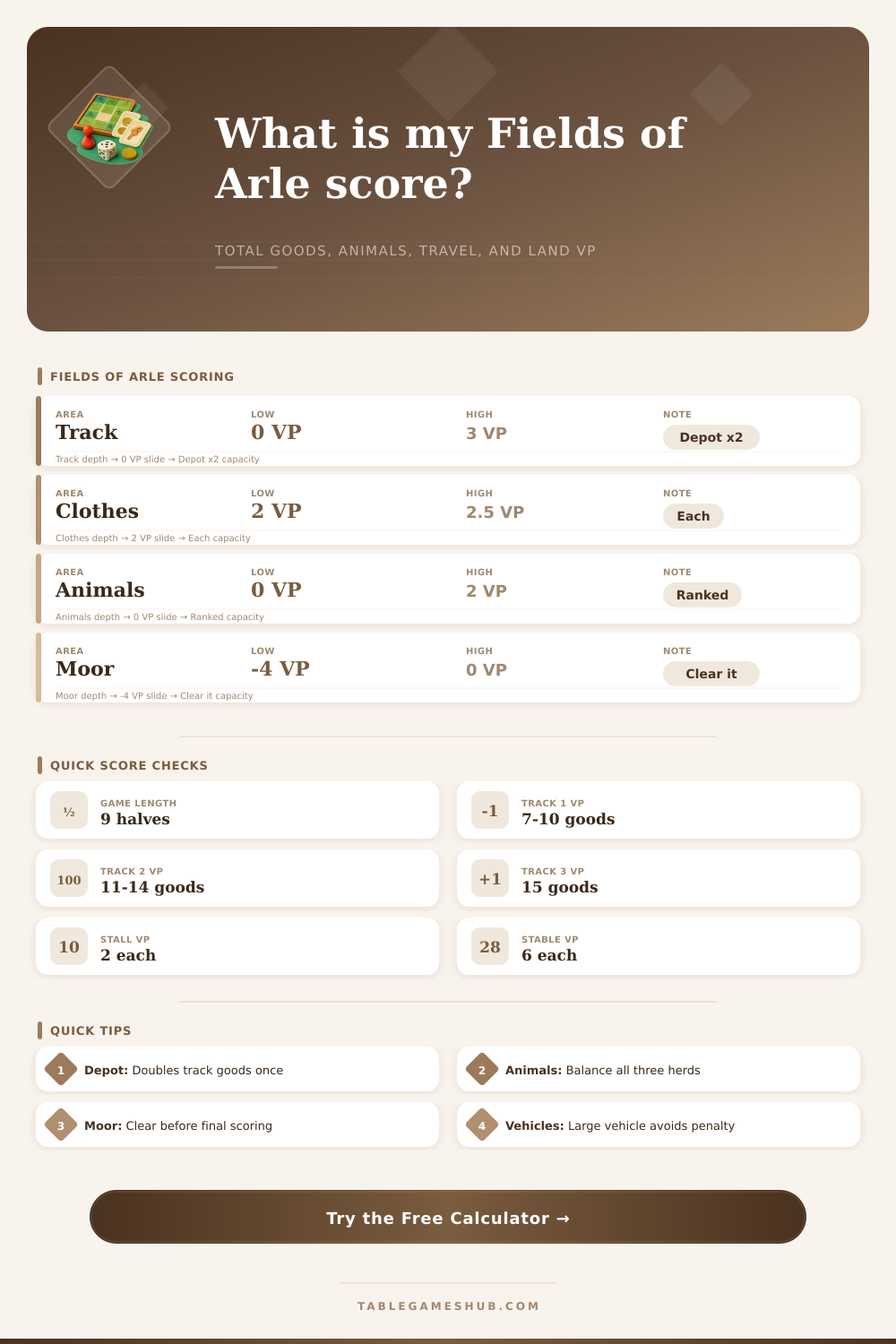
Total the big endgame categories: goods, buildings, animals, vehicles, travel destinations, dikes, moors, peat, and land development.
| Goods Category | Score Formula | Depot Effect | Calculator Fields |
|---|---|---|---|
| Food, flax, grain, wool, hides | 0 VP below 7, 1 VP at 7-10, 2 VP at 11-14, 3 VP at 15+ | One or more depots double this subtotal once | Five marker-space inputs |
| Leather, woolen, linen | 1 VP per remaining processed good | Not doubled by depot | Three processed-good counts |
| Summer wear | 2 VP per piece | Not doubled by depot | Summer wear count |
| Winter wear and leather wear | 2.5 VP per piece | Not doubled by depot | Winter and leather wear counts |
| Animal or Housing | Endgame VP | Important Detail | Calculator Method |
|---|---|---|---|
| Least numerous animal type | 2 VP each | Sheep, cattle, and horses are ranked from low to high count | Lowest count receives 2 VP each |
| Middle animal type | 1 VP each | Ties naturally share the same count before ranking | Middle sorted count receives 1 VP each |
| Most numerous animal type | 0 VP each | High count is useful in play but scores no animal VP | Highest sorted count receives 0 VP |
| Stalls, stables, double stalls | 2, 6, and 9 VP | Double stall is the flipped stable side | Housing counts are multiplied directly |
| Equipment or Vehicle | VP Value | Loading Role | Penalty Note |
|---|---|---|---|
| Peat boat | 1 VP | Can convert peat to goods during scoring prep | No large vehicle coverage |
| Plow | 3 VP | Supports field placement actions | No large vehicle coverage |
| Wagon and horse cart | 1 and 2 VP | More loading spaces after turning | Horse cart counts as large vehicle |
| Cart and droshky | 1 and 5 VP | Travel and goods delivery | Cart, horse cart, carriage, and droshky avoid -3 VP |
| Land and Board Area | Positive Score | Negative Score | What to Enter |
|---|---|---|---|
| Dikes | Enter printed or scorepad dike VP | Use unfinished gaps for audit pressure | Dike tile VP and dike gaps |
| Moors | Cleared moors avoid losses and open spaces | Calculator uses -4 VP per uncleared moor tile | Uncleared moor tiles |
| Fields, forests, parks | Use scorepad total for developed landscape | None inside this subtotal | Landscape VP field |
| Loose peat | Can be converted if a peat boat is available | No direct VP without conversion | Loose peat and peat boat count |
| Scoring Profile | Typical Strength | Risk to Audit | Best Result Card to Watch |
|---|---|---|---|
| Goods track with depot | Efficient late score bump | Depot only doubles the five track goods once | Goods and Materials |
| Animal-heavy board | Strong when herds stay balanced | One oversized herd scores no animal VP | Animals and Housing |
| Travel-heavy board | Pairs well with vehicle upgrades | No large vehicle penalty can erase a close result | Final Score |
| Land cleanup finish | Prevents avoidable negative VP | Uncleared moors and dike gaps can hide losses | Penalty Check |
Fields of Arle is a game about the management of limited space and limited resources for nine half-year. At the end of the game, the balance of many of the game systems at once derive a player’s score. These include the goods track, animal herds, building choices, vehicle upgrades, and the state of the lands.
Because each of these game systems interact with each other, it is difficult for many players to calculate a players final score at the end of the game. Many players find that the interactions between these systems isnt immediately obvious to players during their game of Fields of Arle. The calculator above will calculate for you the mathematics behind Fields of Arle after you enter you data for the game.
How to Use the Fields of Arle Score Calculator
You must enter your marker positions, clothing counts, animal numbers, building values, vehicle list, and land status. Each of these elements will be converted to the same categories that is used within the rulebook for Fields of Arle. Each of these details can have a significant impact on your score.
For instance, if you have a depot that doubles your goods track subtotal, or if you have an uncleared moor tile, your score can drop from 92 to 105. One of the more difficult calculations in Fields of Arle is that of the animal ranking. The animal ranking scores animals according to the size of each players herd; the smallest herd size earns two points per animal, the middle-sized herd earns one point per animal, and the largest herd earns zero points per animal.
Because the largest herd earns zero points, the game encourage players to maintain a balance within their herds; should any one animal type be maximized, that animal may earn zero points for that game. A player could of earned a higher score if they maintained an even number of each type of animal. Furthermore, similar to the animal ranking, the goods track uses thresholds to earn one, two, or three points for each marker placed after reaching those thresholds.
Players will find that the vehicles and equipment within the game will impact the score. Larger vehicles will earn more points as they avoid the three-point penalty, but take up more space within the game. Smaller equipment types, like a peat boat or plows, earn steady points.
Players must choose between these two options when completing their game. The other key component of the game is the land development score. Clearing moors will provide benefits for a player; however, leaving dike gaps or leaving land tiles uncleared will lead to deductions in the players score.
These deductions are easily overlooked during the game; therefore, they are included in the score calculation to provide a more complete and accurate picture of the players score. Players may become accustomed to focusing on the buildings in the game. While building values are an important part of Fields of Arle, they are not what will typically decide the outcome of a close game.
Instead, the goods track, animal scoring, and the avoidance of penalties will have a greater impact on the score. The score calculator makes these components visible to the player. Using this calculator prior to the end of the game will allow players to recognize any pattern to their scores across many games of Fields of Arle.
Should a player always score within a certain band of efficiency rating, the player can adjust their strategy for their next game. The numbers included in this calculator are specifically useful to players for creating a feedback loop between each players decisions within the game and the total score achieved. The calculator makes visible to each player the relationship between the decisions that were made during the game and the rewards that were earned from the game.
Furthermore, the calculator is useful to allow each player to recognize which decisions impact the total score in the game of Fields of Arle. Thus, the calculator transforms a scorepad at the end of a game into a tool that players can use for their next game of Fields of Arle.