PARKS Memory Scoring Calculator
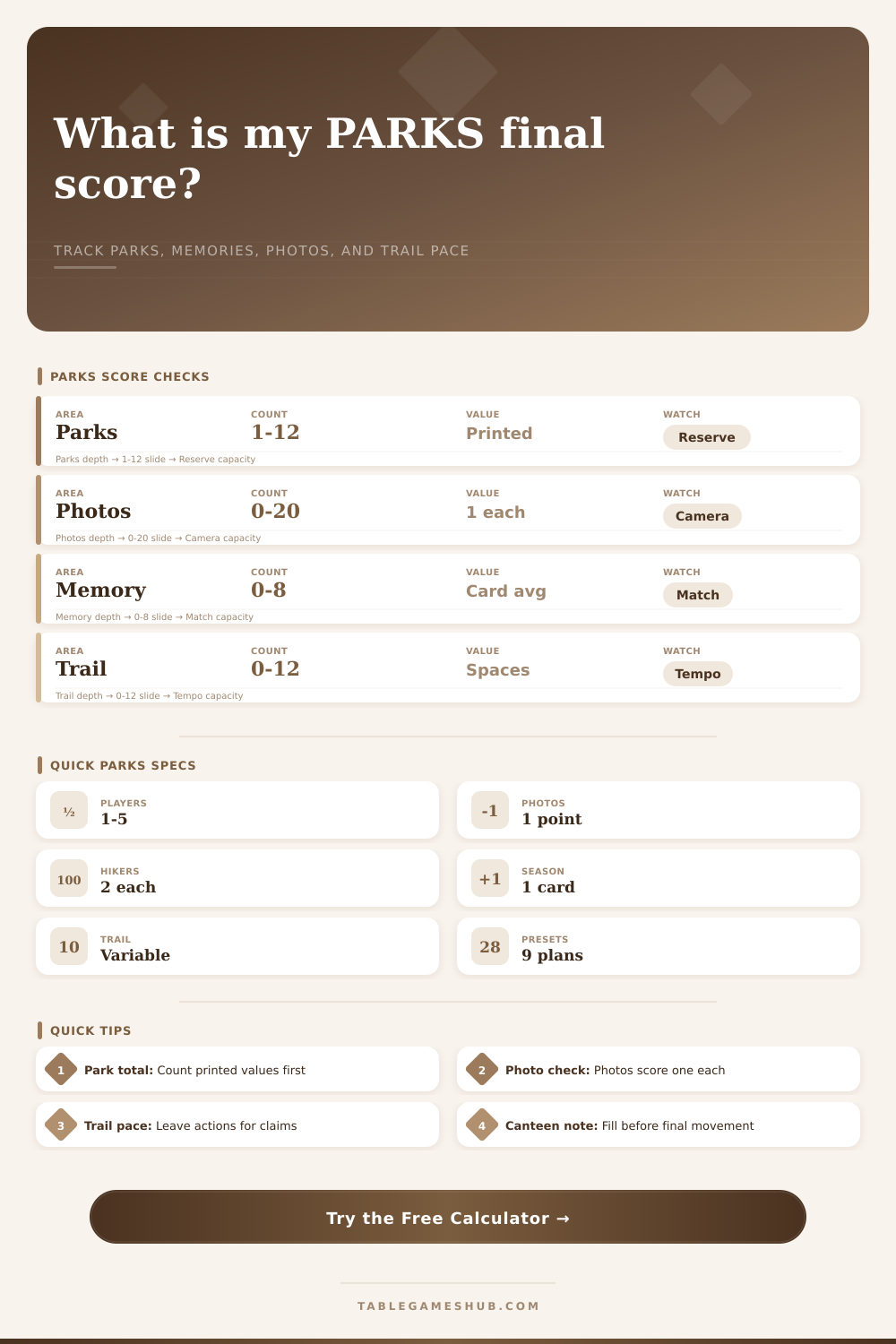
Total your park card values, memory bonuses, photo points, canteen tempo, and remaining trail movement before the final campfire.
| Scoring area | How to count it | Calculator input | Endgame caution |
|---|---|---|---|
| Claimed parks | Add printed values | Printed value total | Do not count reserved parks until visited |
| Photos | One point per token | Photo tokens | Camera timing matters in crowded trails |
| Memory cards | Use satisfied card values | Cards and average points | Unsatisfied cards should stay out of the estimate |
| Canteens | Convert water to actions | Fillable canteens | Value comes from the action it enables |
| Trail state | Typical remaining spaces | Claim outlook | Best use in calculator |
|---|---|---|---|
| Both hikers near trailhead | 10 to 18 total | Flexible but slow | Raise trail spaces and use balanced season |
| One hiker near park claim | 4 to 8 total | Strong final park chance | Keep park value realistic |
| Both hikers at end zone | 0 to 3 total | Scoring is mostly locked | Focus on photos and memories |
| Trail crowding heavy | 6 to 14 total | Tempo can collapse | Use late trail bottleneck season |
| Canteen plan | Water need | Likely effect | Scoring translation |
|---|---|---|---|
| Single fill | One water | One useful action | Small tempo bump |
| Two fill chain | Two water | Bridge to a park claim | Moderate tempo bump |
| Photo support | One or two water | Camera setup or resource patch | Photo and park support |
| Late dead canteen | No water path | No final action | Enter zero fillable canteens |
| Memory audit | Count method | Good estimate | Risk flag |
|---|---|---|---|
| Already satisfied | Use exact card value | Full value | Low risk |
| One action away | Use card value minus one | Conservative value | Trail tempo risk |
| Two resources short | Average partial value | Half value | Canteen dependent |
| Unmatched icon set | Do not include yet | Zero value | High risk |
In PARKS, the endgame never seems like a simple matter of doing some simple math. IT always seem more like you’re playing with a puzzle. Except they keep shuffling pieces around as you try to piece it together. Here’s what you got: A couple of hikers who may or may not make it all the way down this increasingly crowded trail. Some memory cards look tempting, but maybe too tempting? A few photo tokens might be just enough to push them ahead; or behind. And then, you try to figure out which one you will be when the game end before anyone else makes their move. There are so many factors swirling. It’s overwhelming.
With calculator up top, we’re going to crunch the numbers for you. Turn all these random variables into a single projected score. We will let you know where you realy sit.
How to Score Points in PARKS
First things first: Park cards aren’t points. They’re anchors. Your park cards, compared with all the others you claim, set your baseline. That’s your floor. What you see written on the back of those cards is the anchor that everything else will attempts to elevate. Say you’ve got seven card and their printed values add up to twenty-three. That’s your floor. Except it isn’t. It depend on how you play everything else in the game.
The easiest bonus is photos. One point per token. Sounds easy until you remember that getting these tokens mean giving up resources or movement. Is that extra point worth the turn it cost?
There is also more strategy with memory cards than most people realize. The page has a good reference table outlining it, but the essence are realy in the timing. At the end of the game, how many points will you get off of your memory card? So if you have a card that requires two different resources and you are missing one, then don’t take it as a full card. Only take it into account for number of points you’re going to get at the end of the game. And that’s why being honest about what you can reasonable achieve is important. The average number of points you put in forces you to stop and think about quality rather than quantity. Three half-baked objectives may be less valuable then one well done objective. The calculator asks for average because it wants you to differentiate between likely outcomes and wishful thinking.
Finally, we have the trail. Not only does it measure how much your hikers will move, but it also measures the cost of what they’re missing out on. Every space left on the trail represent an action that wasn’t taken. You’ll pay a heavy speed penalty if one or both of your hiker is far from their goal. How much do you lose because of inefficient movement? That’s measured by the pressure rating on the trail. The higher the number, the more you’re paying in tempo taxes. In other words, you’re moving around too much instead of scoring points. This is where people goes wrong. They look at the board, see the points and neglect the price tag of reaching those points.
The wild card here are canteens. Canteens represent potential actions and require you to spend water to unlock them. That’s not a score in its own right. It’s a means to an end. Does it let you get into a park? Claim a photo? Then it has value. Otherwise it doesn’t. Think of canteens like a tempo boost, which is exactly what the calculator does. They are a bridge but they’re not a destination.
The presets in the tool help you run through different scenarios. Are you debating whether to chase a photo sprint or go for a high-value park? Plug those two scenarios into the calculator and compare them. See what has a higher projected total. Take out the emotion from the decision. No more wondering if that risky move is worth it. You’re staring at the math, this isn’t about playing it safe. It’s about playing it smart.
By the time you reach the campfire scene, you’ll have a good idea where you sit in the rankings. That’s where the calculator comes in, helping you take away the mental arithmetic so you can focus on the final moves. All you should of do is trust the numbers and make your decision. The trail won’t wait for you to figure it out.