Farkle Probability Calculator
Estimate six-dice Farkle odds from your dice remaining, current turn bank, scoring combo rules, hot dice chance, farkle risk, and one-roll expected value.
| Scoring outcome | Roll count | Chance | Average chosen score | Dice note |
|---|---|---|---|---|
| Run calculation | 0 | 0% | 0 | Waiting for input |
| Dice to roll | Farkle outcomes | Total outcomes | Risk with singles and triples | Table meaning |
|---|---|---|---|---|
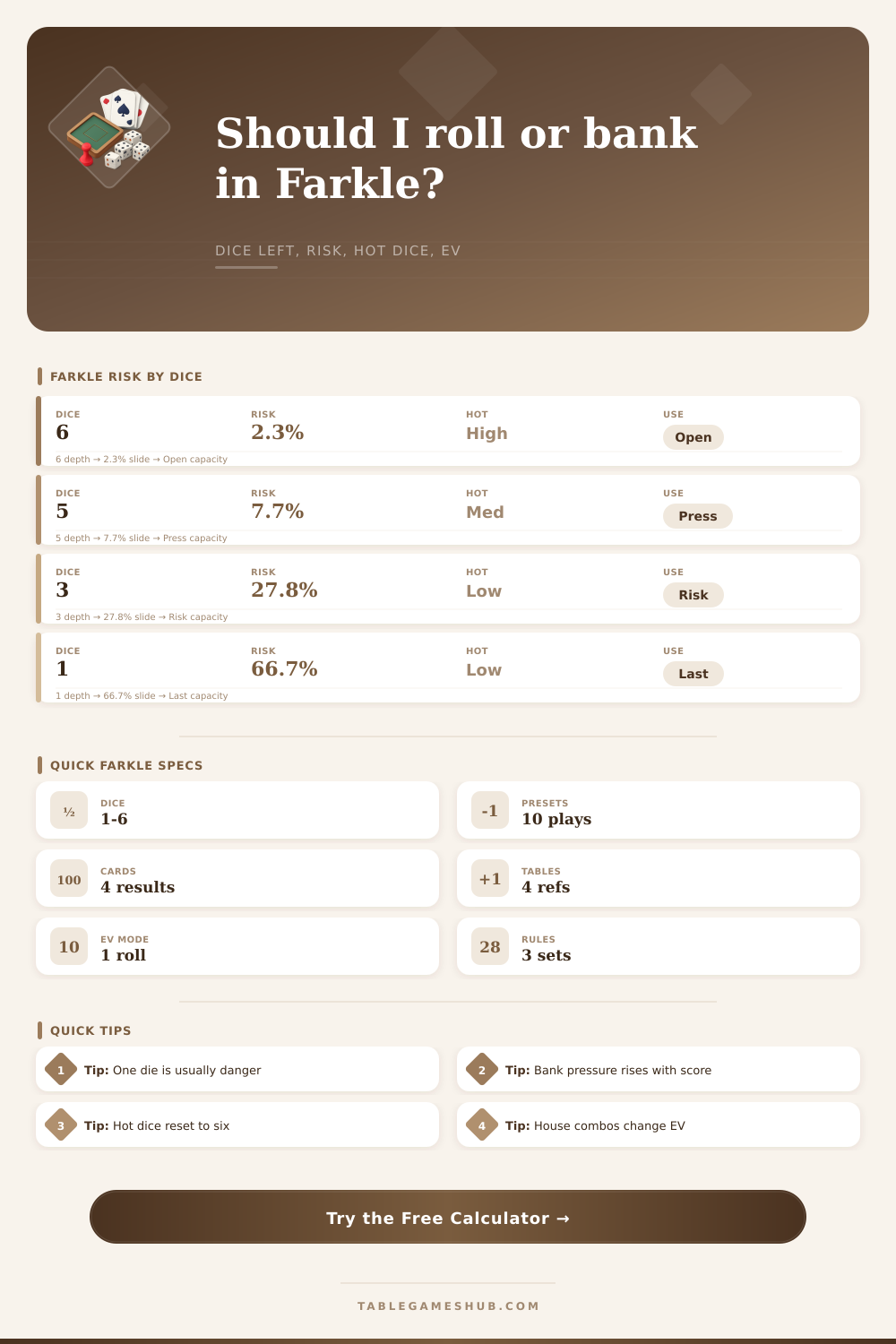
| 6 dice | 1,080 | 46,656 | 2.3% | Lowest immediate risk; hot dice and big combos matter most |
| 5 dice | 600 | 7,776 | 7.7% | Still playable when the turn bank is modest |
| 4 dice | 204 | 1,296 | 15.7% | Bank pressure starts to matter |
| 3 dice | 60 | 216 | 27.8% | Decision often depends on the current bank |
| 2 dice | 24 | 36 | 66.7% | Very high risk unless the bank is low |
| 1 die | 4 | 6 | 66.7% | Only a 1 or 5 keeps the turn alive |
| Combo | Modern value | Classic value | Dice used | EV effect |
|---|---|---|---|---|
| Single 1 | 100 | 100 | 1 | Common low score; often leaves fewer dice |
| Single 5 | 50 | 50 | 1 | Most frequent small keep option |
| Three 1s | 1000 | 1000 | 3 | Large EV boost on 3 or more dice |
| Three 2s to 6s | 200 to 600 | 200 to 600 | 3 | Creates stronger scoring rolls without singles |
| Four, five, six of a kind | Doubles upward | Triple plus singles | 4 to 6 | House rule choice can swing the EV |
| Straight, pairs, two triples | 1500 or 2500 | Variant only | 6 | Raises hot dice value on six-dice rolls |
| Situation | Risk driver | EV question | Calculator input to adjust | Useful readout |
|---|---|---|---|---|
| Fresh six dice | Low farkle risk | How much is a new roll worth? | Current turn bank = 0 | Expected scoring roll |
| Mid-turn three dice | Bank now matters | Does the scoring EV cover the bank risk? | Dice remaining and current bank | Roll EV vs bank |
| One or two dice left | Farkle risk is high | Is the turn bank too valuable to risk? | Decision style and bank | Recommendation |
| Hot dice reset | All dice scored | How often does a scoring roll reset to six? | Hot dice interpretation | Hot dice chance |
Farkle is a game of risk and reward management. Risk management in Farkle refers to the decision of whether to roll the dice for more turns or to take the points that has alredy been earned. A player may feel that they can roll the dice safely.
However, it is also possible for a person to be wrong about teh outcome of the roll of the dice. The outcome of the roll of the dice is probabilistic. It is essentially the likelihood of a certain outcome from rolling the dice.
When to Roll or Stop in Farkle
In Farkle, the decision must be made of whether or not the points that has already been earned are worth the risk of rolling further and possibly achieve a farkle. Should a player roll a farkle, the player will lose all of the points that were earned in that turn. The calculator included in this article use mathematical probability to help individuals make decisions while playing the game of Farkle.
All that is required to use the calculator is for an individual to input the number of their remaining dice and the number of points that they have earn on their turn. Based off these two values, the calculator can determine the probability of a farkle for that round of rolling dice. If the farkle probability is high, then the risk of losing one’s points for the turn is high.
However, if the farkle probability is low, then the risk of losing one’s points for the turn is low. By using this calculator, players can make decisions without the influence of emotion. Instead, the mathematical facts of the game can inform the player of there next moves.
The current turn bank is an essential value for the calculator. The current turn bank is the total number of points that will be lost if an individual farkle. If the current turn bank value is low, then the risk of farkling is low.
However, if the turn bank value is high, then the risk of farkling with the current number of dice is high. Many groups of individuals use the concept of a minimum bank threshold. A minimum bank threshold is the number of points that a player must reach before they are allowed to stop rolling dice.
By introducing a minimum bank threshold into the game, the risk level for the player increase. This is due to the fact that a player is required to continue to roll the dice to reach the minimum bank threshold, even if they wish to end their turn. The scoring combination in Farkle can change the mathematical outcome of the game.
For instance, some versions of Farkle reward specific combinations of dice roll. Therefore, these combinations change the value of the rolls that is performed. The calculator for Farkle accounts for these scoring combinations because farkles will provide different outcomes for players depending on the number of each types of scoring roll.
For instance, if a player rolls a scoring combination with the dice, a player may be awarded the “hot dice” option. Hot dice allows a player to roll the scoring dice again. This is beneficial for the player because it reset the number of dice to six.
By resetting the number of dice to six, a player has reduce the probability of a farkle. The concept of expected value, or EV, is the most important mathematical concept related to the game of Farkle. The expected value will not help a player to determine the outcome of one roll of the dice.
Instead, the expected value will help to determine the average outcome of rolling the dice if the same decision is made numerous times. If the expected value is a positive number, it means that the potential points to be gained from Farkle is greater than the potential points to be lost. However, if the expected value is a negative number, it means that the potential points to be lost is more greater than the potential points to be gained.
Though the expected value for a turn is important to consider, there are other factors to consider in Farkle, as well. For instance, another factor to consider is the target score and the current game score. If the target score is near the current game score, it may be a good idea to stop rolling, even with a positive expected value.
There are different playing style for the game of Farkle. For instance, there is a bold playing style and a conservative playing style. A bold playing style is associated with taking the risks necessary to earn a high number of points during a turn.

However, playing the bold style will result in farkles more frequently than a conservative playing style. A conservative playing style is associated with the desire to avoid farkles and to protect the number of points that has already been earned during the turn. This article includes a reference table to inform players of the danger zones for each number of dice.
Danger zones are specific area in the game of Farkle in which a player is likely to farkle. For instance, rolling six dice at once is considered to be safe. However, rolling three or fewer dice is a danger zone for farkling.
Rolling a single die is the highest risk for farkling. A player can use the reference table to determine the probability of farkling with any number of dice. Youll find that the results are alot more predictable once you understand the math.
Its better to be cautious than to loose everything on one roll. You should of used this calculator earlier.