Evolution Population Calculator
Estimate a board position from species count, current population, body size, food supply, trait package, carnivore attacks, watering hole food, and end score bonuses.
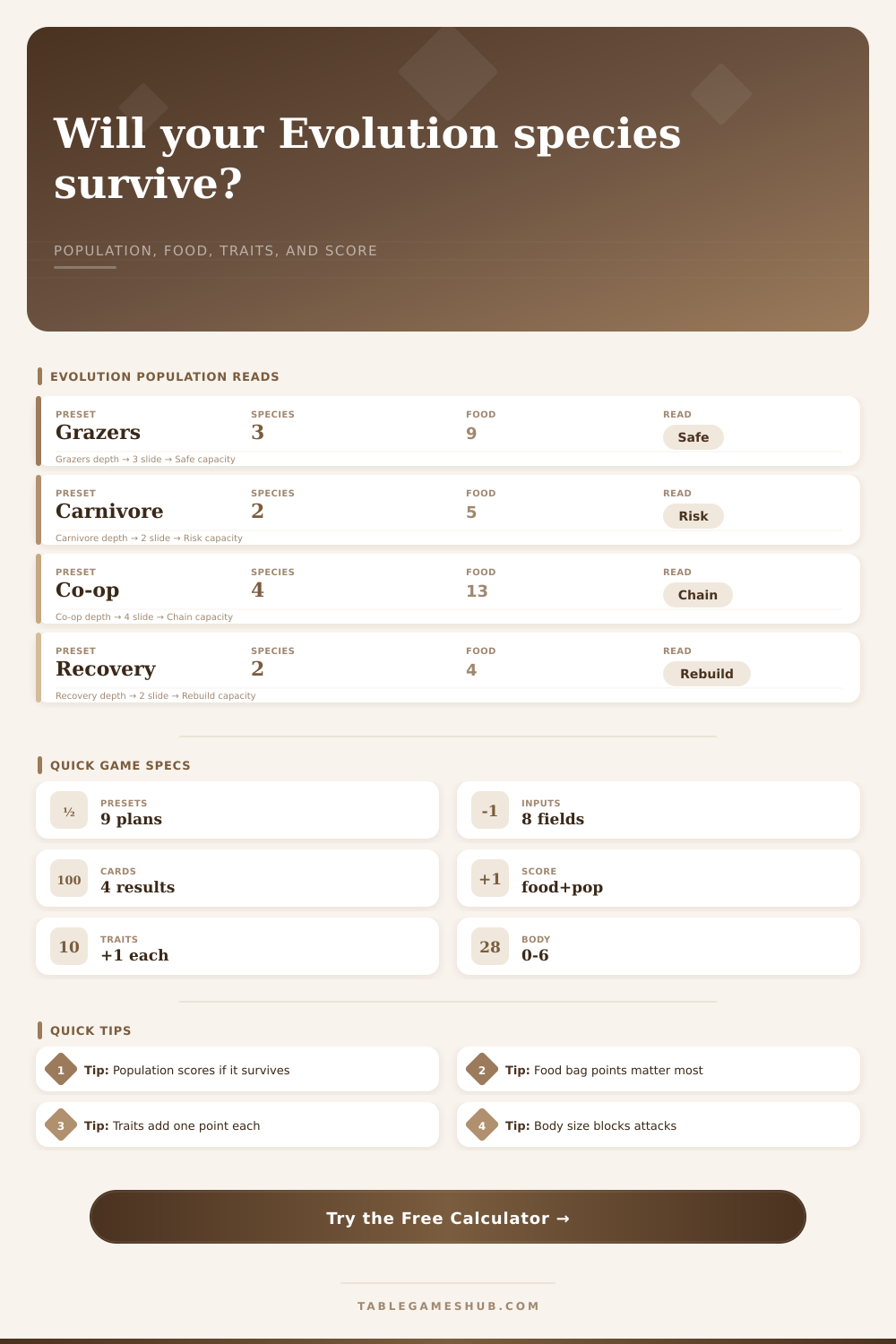
This calculator models the Evolution board game scoring flow: food eaten is worth points, surviving population is worth points, trait cards are worth points, and attacks or food shortages reduce the population that survives to score.
| Trait package | Calculator effect | Best signal | Score note |
|---|---|---|---|
| Long Neck | Adds automatic plant food before shortage is checked. | Low watering hole | Raises food bag points without needing first pick. |
| Foraging | Improves plant conversion for hungry population. | Wide herbivore board | Strong when several species need one more food. |
| Cooperation | Feeds neighbor chains after the first species eats. | Many species | Turns one food source into several food points. |
| Fat Tissue | Uses stored food as a reserve before famine loss. | Large body | Protects population that would otherwise disappear. |
| Defensive shell | Reduces successful attacks through body and defense. | Carnivore table | Usually preserves more score than it adds directly. |
| Board shape | Population need | Food source | Calculator read |
|---|---|---|---|
| Two tall species | 8 to 12 food | Watering hole plus Long Neck | Efficient if attacks are low and both species survive. |
| Four small species | 8 to 16 food | Foraging or Cooperation | High score ceiling, but famine can cut several points. |
| One carnivore pair | 4 to 8 meat | Successful attacks | Food score depends on enough legal targets remaining. |
| Recovery board | 2 to 6 food | Small plant pool | Survival matters more than maximum food bag scoring. |
| Attack pressure | Body size cue | Defense cue | Population result |
|---|---|---|---|
| 0 to 1 attack | Any size | None needed | Population score mostly depends on feeding. |
| 2 to 3 attacks | Size 3 or more | One defense trait | Expect partial losses unless food is secure. |
| 4 to 6 attacks | Size 4 or more | Hard Shell style | Defense preserves population better than more growth. |
| 7 or more attacks | Large targets | Multiple defenses | Extinction risk rises, especially with famine too. |
| Preset | Main input pressure | Result card to watch | When it helps |
|---|---|---|---|
| Long Neck Grazers | Automatic food | Food Bag Points | Use when plant food is thin but attacks are manageable. |
| Carnivore Pressure | Attack loss | Surviving Population | Use to test how many population points remain after meat hits. |
| Cooperation Feeding Line | Chain feeding | Estimated Score | Use for boards that convert one food into neighbor food. |
| Fat Tissue Reserve | Stored food | Survival Read | Use when body size and reserves can cover a dry watering hole. |
| Extinction Recovery | Small rebuild | Survival Read | Use after losing species and preserving a low but live score. |
A hopeful species board sits before you as you take your seat at table. Four different critters is developing side by side, each with its own characteristics that sound good on paper. It’s tempting to grow out one or more, to bulk up what you already have or add another species. But before you put those cards down, you wonder: Can my population even eat? This calculator lets you find out if your expansion efforts will be sustainable.
Will they be a house of cards that crumbles once the food bag are empty? Evolution is about survival versus growth. Do you sacrifice your resource pool for larger population? Each surviving creature add to your final score. However, if you can’t feed them… They don’t survive.
Plan Your Food and Survival
The calculator, above, does all the math for you. It uses your starting values (body size, number of species, and available food) to tell you what happens. It models how trait bonuses and attack bonuses works alongside your base need to sustain your population.
Many people misunderstand that body size alone is a direct scoring rule. It’s not. That said, it’s not worth any points by itself. What it’s actualy good for is defense. Carnivores find it difficult to kill larger animals. So when you enter your average body size into the tool, what you’re doing is estimating the percent of your population that may survive an aggressive round. Small prey without any defensiveness can see a significant portion of their population wiped out if attacked once, which results in losing a lot of score potential. To account for this, the tool lowers your estimated surviving population based off expected carnivore pressure.
Then there’s another level of complexity, which is hard to keep straight in your head: Traits. With a Long Neck you get free food from the watering hole… until there isn’t any left. Neighbors who cooperate can feed off each other, creating a chain reaction where one resource becomes many resources. All these seem like nice ideas on paper. In reality, you need enough base population for them to become meaningful, along with the right timing. The page has a reference table spelling all that out. It tells you what traits excel given certain conditions in the board. Like, Fat Tissue is only good when you’ve got so much food stashed away that it’s worth anything. Otherwise the trait is nothing but dead weight in your deck.
Many players fall into the trap of maximizing species count at the expense of population depth, many people get caught in the trap of having lots of different species, even though they might only have one of that type on the board. That’s not very resilient! You’re one death away (perhaps due to an attack, or a drought) from losing 25% of your board. Typically, it’s better to have two healthy species with all their creatures alive. That way, you’ve got some wiggle room.
How do you know if you’re balancing things right? The calculator shows this dilemma by displaying your estimated points. These points depend on whether you have fewer but bigger populations, or more but smaller ones. The great equalizer is food. You can’t score what isn’t present, no matter how clever your trait system. Your population will diminish if it has no way to forage, if it lacks long necks, or if the watering hole run dry. That’s why bag points matter when considering food. How do you know you have the right amount of buffer to ride out a bad turn? The calculator makes it easy to see how you are stacking up.
It forces you to face the fact that while going for a max score might be best in theory, sometimes surviving is what matters most. “Risk management, not score-chasing, is the key to playing Evolution well. Each round you’ll need to ask yourself: Can I afford to let my population shrink in order to gain trait points? Sometimes the answer will be yes. More often, though, it’s best to hunker down and play conservatively, keeping your creatures alive even if that sacrifices a chance at immediate growth. Those are the rounds of quiet decision-making that separate victory from defeat. Feed your species. Shield them from their predators. And allow the score to accumulate gradualy from there.”