Abalone Score Calculator
Track a live Abalone score, test the current sumito, add legal ejections, compare the win race, and read clock pressure without turning the calculator into a rules guide.
1Named Abalone Presets
Load a realistic match state, then adjust the score, push line, position risk, and clock fields for the board in front of you.
2Match Score Inputs
3Current Sumito Check
Inline push line
Board pressure and clock
| Check | Value | Formula | Meaning |
|---|
4Four Formula Cards
Score after push
current + legal rim eject
The calculator adds one ejection only when the tested sumito is legal and the pushed line exits over the board rim.
Legal sumito
pushers > defenders
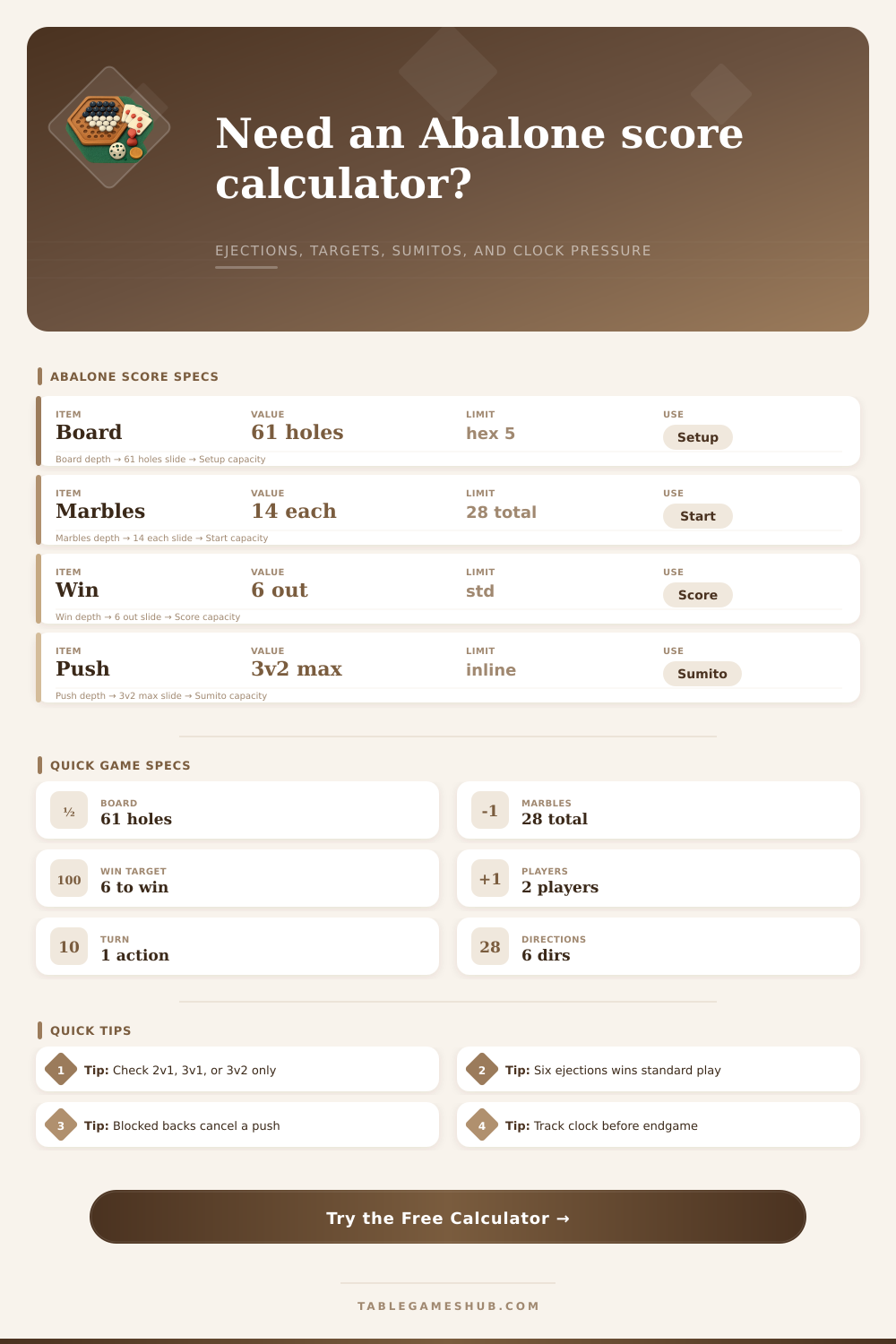
Normal legal push patterns are 2 against 1, 3 against 1, and 3 against 2, with contact and an empty or rim space behind.
Race margin
your needed - opp needed
A negative margin means you are closer to the target than the opponent; zero means the ejection race is level.
Pressure index
score + rim + center - risk
This non-official estimate weighs ejection lead, legal push value, edge threats, exposed marbles, isolation, and clock swing.
5Component and Spec Grid
6Abalone Reference Tables
| Mode | Target | Calculator use | Best fit |
|---|---|---|---|
| Standard Abalone | 6 ejections | Uses the official win condition and all normal sumito limits. | Most two-player games. |
| Timed standard | 6 ejections | Adds clock pressure without changing the official ejection race. | Club or tournament-style play. |
| Race to three | 3 ejections | Keeps the same score math but shortens the target. | Teaching, drills, fast rematches. |
| Custom target | 1-14 | Lets you audit variants while preserving legal push checks. | House formats or practice tasks. |
| Your line | Opposing line | Legal? | Calculator note |
|---|---|---|---|
| 2 marbles | 1 marble | Yes, if inline and unblocked | Can push to an empty space or over the rim. |
| 3 marbles | 1 marble | Yes, if inline and unblocked | Strongest simple one-marble pressure. |
| 3 marbles | 2 marbles | Yes, if inline and unblocked | The largest normal sumito pattern. |
| 1 marble | 1 marble | No | No numerical superiority. |
| 2 marbles | 2 marbles | No | A balanced pac cannot be pushed. |
| Any line | Blocked behind | No | A back marble or missing contact blocks the push. |
| Input | Positive effect | Negative effect | Why it matters |
|---|---|---|---|
| Opponent marbles on rim you pressure | Raises pressure index | None directly | Rim targets are closer to becoming score. |
| Your marbles exposed on rim | None directly | Lowers pressure index | Exposed edge marbles can become opponent ejections. |
| Connected central groups | Raises pressure index | None directly | Central connection usually supports mobility and defense. |
| Your isolated marbles | None directly | Lowers pressure index | Detached marbles are easier to attack or herd. |
| Clock swing | Faster side gains pressure | Slower side loses pressure | Timed games reward good score with enough time to convert it. |
| Reference | Used for | Quality note | Link |
|---|---|---|---|
| Abalone Classic rules PDF | Win target, contents, move and push limits, timed-game note. | Publisher/brand rule sheet with Asmodee trademark notice. | Rules PDF |
| Abalone 2019 English rules PDF | Black first, sumito patterns, glossary terms, ejection condition. | Official-style rules PDF distributed by a game publisher. | 2019 rules |
| BoardGameGeek Abalone page | Player count, play time, age, game database cross-check. | Long-running board game reference database. | BGG page |
| PlayAbalone rules page | Plain-language confirmation of sumito and win condition. | Dedicated Abalone rules resource. | Rules page |
7Scoring Tips
Score tip: Treat the tested rim push as pending until the line is confirmed legal: same line, adjacent contact, numerical superiority, and no blocked back space.
Clock tip: In a timed game, a one-ejection lead with a large clock deficit can still be fragile, so review the pressure index alongside the raw score.
The seemingly simple hexagonal board that Abalone plays on actualy makes for a very complex spatial geometry and momentum management game. With only fourteen marbles to begin, you need to figure out how to knock six of your opponents’ pieces off the rim. There is no straight line solution, as you have to learn what moves applies pressure and what moves are simply a waste of time.
This mental tracking while monitoring the timer become tiring. It is easier when you can check legality and visualize your next move by seeing the score outside your head.
How to Play Abalone Smarter
Push (sumito) mechanics is the heart of all Abalone strategies. You can use up to three marbles to push, but they must form a straight line that touches other player’s pieces. After entering your existing number of ejects and the arrangement of your push, calculator above does the math for you. You won’t have to guess about whether a 3v2 engagement is legal or wonder if it will harmlessly bounce off a blocked path.
Being able to distinguish between what’s a legal push vs what’s not is key, since a wasted turn typically pass initiative to your opponent. As you might notice from the reference table on this page, just having numerical superiority isn’t sufficient; you also require an open space behind the pushed marbles for the move to count towards either a positionally gained move or a scored move.
There’s also a tendency for many player to only consider the bare ejection numbers and regard it as nothing more than a numbers race (most = best). That overlooks the pressure dynamics that establishes control of the board. For example: having led 3-1 in ejections doesn’t mean you’re safe, not if your remaining marbles is isolated and exposed on the rim. Pieces far apart from one another, especially those on the rim, are subject to multi-angle attack. Connected ones closer to center has defensive depth and are stable.
The tool calculates this tradeoff between rim exposure vs. It assigns a pressure index based off central connections to better represent how fragile your situation actualy is. High score but low structural integrity won’t last long.
It also complicates things with time management, something that becomes even more important during tournaments when the clock is ticking. When you’re up on marbles and down on time, it’s critical that you use your position before running out of time makes you rush, which will likely result in at least one error. On the other hand, when you’re behind on score but well ahead on time, you can safely go defensive until your opponent eventually overextends and leaves his marble hanging out there ripe for the picking.
The calculator accounts for the time used by both players. This gives you a visual look at the tradeoff, so you know if you can hold your lead or if you are just burning your clock to look like you are in control. Knowing this changes Abalone from a frantic scrum to a strategic game of inches.
It’s no longer a matter of reaction but of foresight. You think three steps ahead, wondering where those marbles will fall and how each change in the layout of the board affect them. You’re trying to leave your opponent in situations in which any action they take will only make theirs worse; be it by knocking one off the board or squandering valuable seconds on their clock. It is about inevitability, not hoping for an opportunity.
Replaying games this way will help you get better. Replay all those times when you were sure you had it, and then you didn’t. See if you might of been in trouble even though it looked like things would work out. You can use these tools to take the emotional noise out of any given moment and focus on what’s really true about the board. And each push becomes a calculation, not an impulse.
It becomes part of one story, the ongoing story of applying pressure until you can’t anymore and then releasing it. Hex waits there, ready for your move again. Now you know its weight.