Tangram Area Calculator
Calculate a tangram square side, total area, piece fractions, missing-piece loss, scaled dimensions, board coverage percent, and display board size.
| Piece | Count | Fraction Each | Unscaled Area Each | Scaled Area Each |
|---|---|---|---|---|
| Large right isosceles triangle | 2 | 1/4 | 9.00 in² | 9.00 in² |
| Medium right isosceles triangle | 1 | 1/8 | 4.50 in² | 4.50 in² |
| Square | 1 | 1/8 | 4.50 in² | 4.50 in² |
| Parallelogram | 1 | 1/8 | 4.50 in² | 4.50 in² |
| Small right isosceles triangle | 2 | 1/16 | 2.25 in² | 2.25 in² |
| Piece Type | Linear Dimension Rule | Current Dimension | Scaled Dimension |
|---|---|---|---|
| Large triangle | Leg = side / sqrt(2), hypotenuse = side | Leg 4.24 in, hyp 6.00 in | Leg 4.24 in, hyp 6.00 in |
| Medium triangle | Leg = side / 2, hypotenuse = side / sqrt(2) | Leg 3.00 in, hyp 4.24 in | Leg 3.00 in, hyp 4.24 in |
| Small triangle | Leg = side / (2 sqrt(2)), hypotenuse = side / 2 | Leg 2.12 in, hyp 3.00 in | Leg 2.12 in, hyp 3.00 in |
| Square | Piece side = side / (2 sqrt(2)) | 2.12 in side | 2.12 in side |
| Parallelogram | Long edge = side / 2, height = side / 4 | Long 3.00 in, high 1.50 in | Long 3.00 in, high 1.50 in |
| Missing Selection | Area Removed | Pieces Present | Set Coverage |
|---|---|---|---|
| No missing pieces | 0.0% | 7 | 100.0% |
| One small triangle | 6.3% | 6 | 93.8% |
| Both small triangles | 12.5% | 5 | 87.5% |
| Any 1/8 piece | 12.5% | 6 | 87.5% |
| One large triangle | 25.0% | 6 | 75.0% |
| Both large triangles | 50.0% | 5 | 50.0% |
| Display Board | Pixels Per in | Scaled Side | Frame Coverage |
|---|---|---|---|
| Current preview | 53.33 px/in | 6.00 in | 56.3% |
| Half preview | 26.67 px/in | 6.00 in | 56.3% |
| Print preview | 75.00 px/in | 6.00 in | 56.3% |
| Large display | 100.00 px/in | 6.00 in | 56.3% |
A tangram set is made of seven geometric piece that fit together to create many different shape. If you’re old enough, I’m sure you played with tangrams when you were little. Up to the point where someone loses a piece, it’s all magic. And then there’s no more complete square and suddenly your head model of what’s going on has gone away.
Tangrams is generally thought of as only a bit of geometry. But most folks forget about area math that binds entire set. And that means when they’re planning a class activity or working with some real-world version of tangram, it’s harder then it needs to be.
Why Use a Tangram Calculator
Until now: The calculator on this page will calculate exactly how much area each shape covers no matter what you’ve put together. With missing shapes, with scaled shapes, the computer do the math and lets you get on with thinking about the shapes.
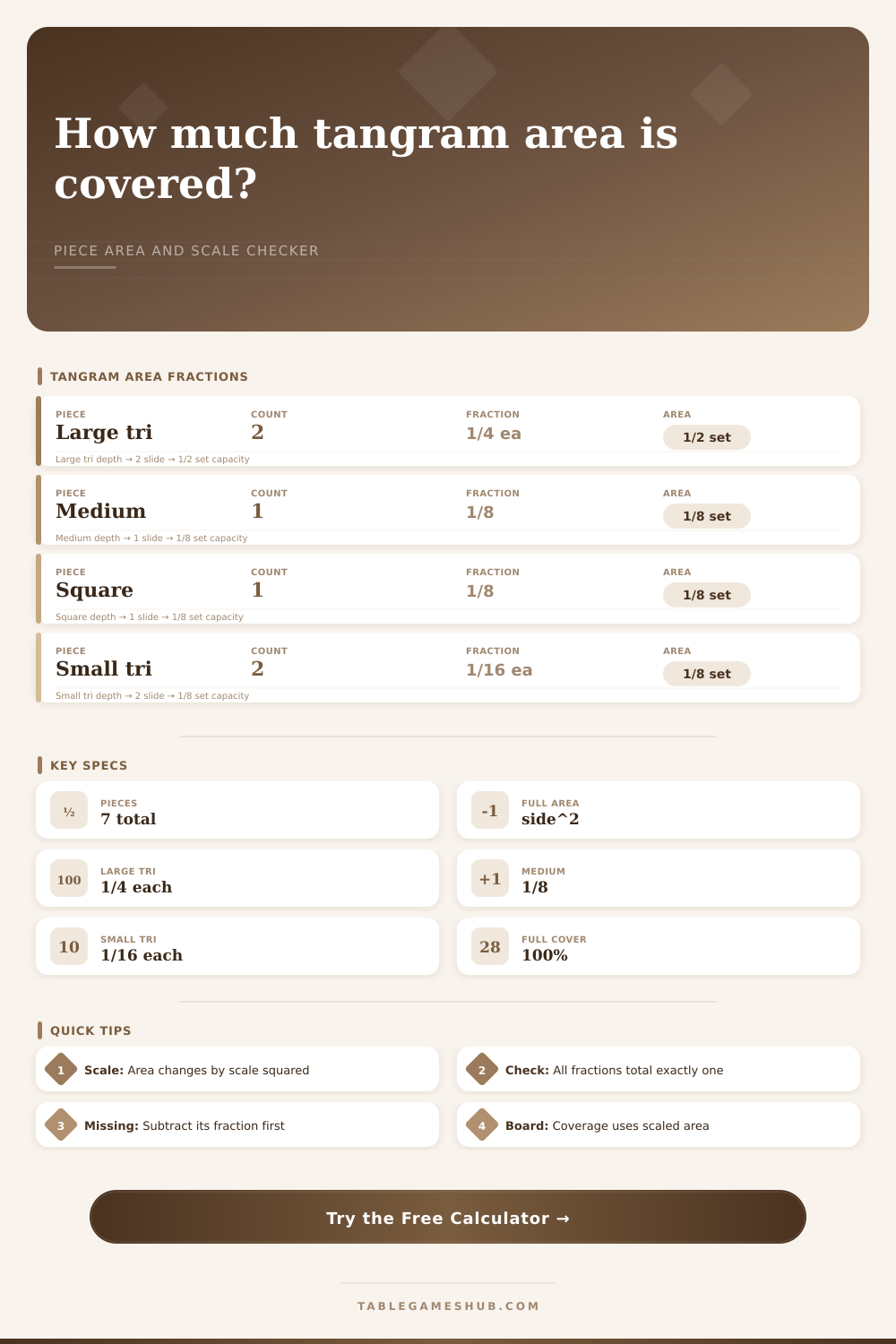
Every tangram set begin with the same square. And regardless of how you cut it, total area never changes. Half of this total is represented by two large triangles. A quarter are claimed by each large triangle. The medium triangle, the square, and the parallelogram each takes up an eighth. The rest of space is divided between the two small triangle. Together they makes up a sixteenth of the total area.
These fractions is rigid: You can’t alter them without fundamentally changing the puzzle itself. The calculator verifies these fraction instantly. It ensures that what you’ve input matches normal geometric rules. That way, if (and when) you begin to scale things down, there’s no error later on.
The mistake folks commonly make is scaling. Length doesn’t increase linearly to size. Your tangram square’s size doubles but its area quadruples! Quadratic, it’s called. It matter if you’re designing print or flooring.
When you plug-in your scale factor, the calculator do the math. No more guesswork about “is this too big for my desk?” Enter the percent scale and let the machine calculate new square feet. What fits on your desk at 100%? It fits on a table top at 150%. Knowing that beforehand should of saved wasted paper or floor space.
A second wrinkle is when we’re missing some pieces. Losing one little triangle mean losing slightly more then six percent of the whole. Lose a big triangle, and you lose a quarter. That makes a huge difference in how much of the board it cover. If you’re doing a class activity with tangrams, the real value here is being able to know exactly how much space is left so that you can resize the board appropriately. Or toss on some extra pieces as necessary.
The tool takes out missing fractional part first, then applies whatever scale factor you need. The result is a true picture of what’s still there, which transforms that annoying hole into something you can plan around.
In practice, that means several set at once. If you’re a teacher, that could mean four for a classroom exercise. If you are a designer, it could mean a giant floor set for an event. For all these situations, the calculator supports multi-set calculations so you can stack areas without having to do any math by hand.
In addition, it keeps track of your display board size in pixels. This helps connect physical dimensions to digital previews, which is handy if you create your own templates. You want them to look good in hand and on screen. The visual preview will update as you go and show you precisely how the pieces fit together before you commit to printing or cutting.
The other common error is failing to distinguish between an area measurement and a linear one. “If I scale it down 50%, then it’s only half as big,” is a frequent thought. Nope! Scaling down 50% makes side lengths half as large and the area a quarter as large. So you either end up with puzzle pieces that are too big or frames that is too small.
The calculator explains this because it will show you not just the scaled side length but also what percent of original area it covers. The coverage percentage lets you see in your head how much of your board will be covered. That’s the tradeoff: more percentage = tighter fit; less percentage = plenty of space for extra design elements or labels. Knowing this helps you make better layout choices.
A tangram is not just a toy. It is an exercise in geometry. It tests geometric conservation. It is a study in spatial reasoning. First comes the area. Second comes the fun. Lock down the numbers with the tool. Let the shapes do the talking next.
If it fits, the math has worked. What makes sense? That’s up to your imagination.