Evolution Body Size Calculator
Compare an Evolution species before feeding by balancing body size, population, food need, carnivore pressure, defensive traits, attack modifiers, fat tissue, and victory point value.
| Body Size | Board Meaning | Predator Effect | Food Pressure | Common Use |
|---|---|---|---|---|
| 0-1 | Tiny species | Needs trait cover | Easy to feed | Early population growth |
| 2-3 | Medium species | Blocks some attacks | Manageable hunger | Balanced herbivore line |
| 4-5 | Large species | Forces size answer | High food demand | Defensive herd or fat build |
| 6 | Maximum size | Only specialized predators threaten it | Very hungry | Endgame VP protection |
| Preset | Body Plan | Trait Idea | Food Plan | Calculator Read |
|---|---|---|---|---|
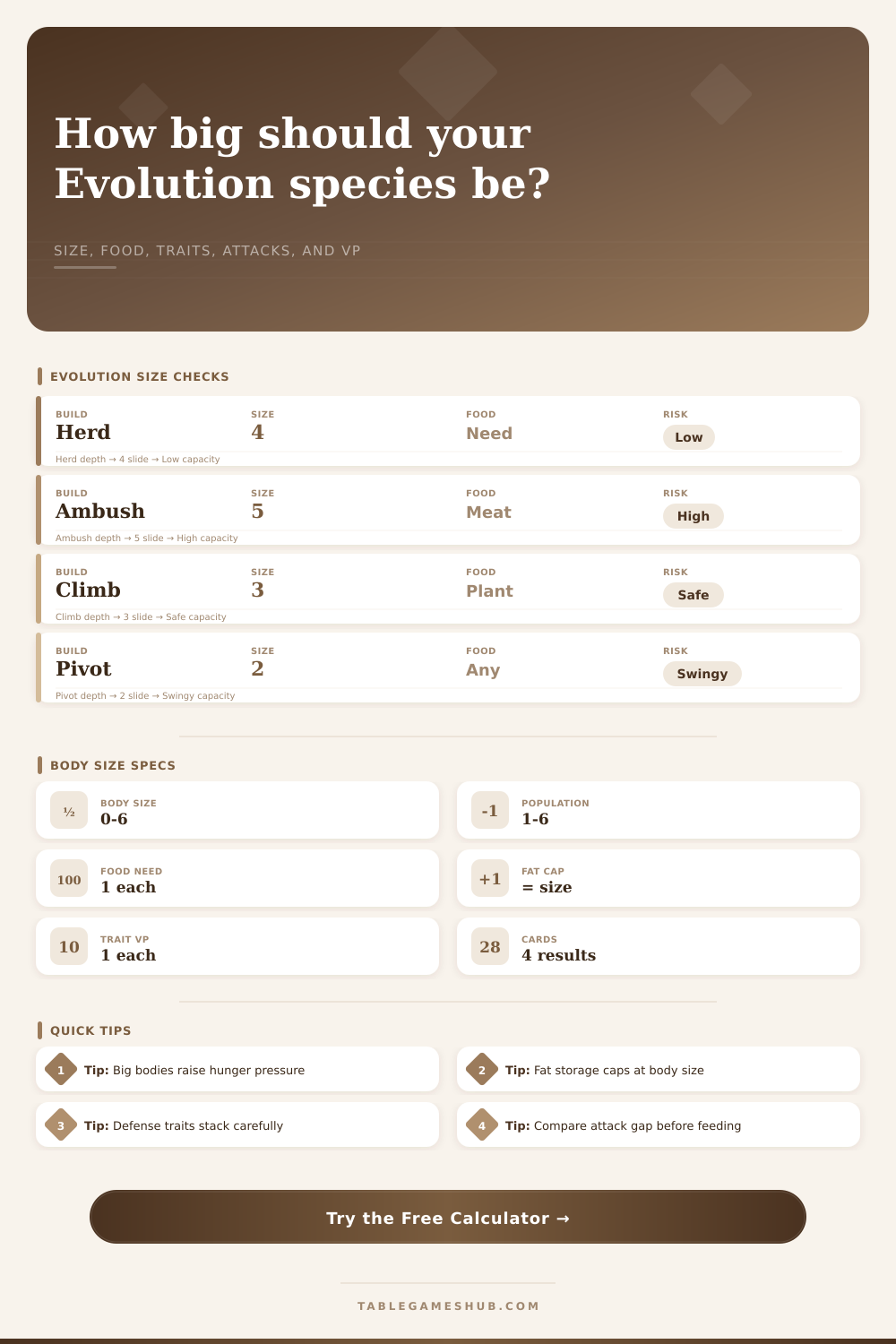
| Defensive Herd | Size 4, pop 5 | Hard defense | Plant line | Protect VP if food covers |
| Ambush Carnivore | Size 5, pop 3 | Attack answer | Meat line | Needs prey gap |
| Climbing Grazer | Size 3, pop 4 | Climbing | Efficient food | Low risk profile |
| Scavenger Pivot | Size 2, pop 3 | Flexible trait | Any food | Scores from table churn |
| Defense Trait Band | Examples | Calculator Value | What It Offsets | Watch For |
|---|---|---|---|---|
| None | No cover | 0 | Nothing | Size must do the work |
| Soft defense | Symbiosis support | 1 | Loose attacks | Can be bypassed |
| Specific defense | Climbing, Burrowing | 2-3 | Many predators | Matchup dependent |
| Hard defense | Horns, Shell suite | 4-5 | Attack packages | Still needs food |
| VP Source | How To Count | Size Link | Calculator Field | Endgame Note |
|---|---|---|---|---|
| Population | One per token | Larger bodies protect it | Population | Lost population is lost VP |
| Trait cards | One per card | Specialization costs slots | Species trait cards | Three is a full build |
| Stored fat | Food on Fat Tissue | Cap equals size | Fat tissue stored | Banked food can swing score |
| Banked species VP | Food already eaten | Worth protecting late | Current species VP | High value favors safety |
Natural selection becomes a balancing act in the board game Evolution. Every trait comes with a cost, you hope it’s worth it in the long run. You want your species to score points and survive until end of game. But the math doesn’t add up neatly most of the time. Plug in your stats to the calculator above, and it do all that messy work for you.
It’s about knowing how to balance being big (enough) to matter against being small (enough) to survive. You must decide whether or not your herd will be able to bank victory points before starving. Everything on the board flow from the body size; that’s why it’s the anchor of the system. Bigger bodies has a greater chance at survival by providing a barrier between you and any predator that might want to knock down your numbers. That sounds nice until you realize that each point in body size require more calories to sustain life. If you’re big enough, then you must be eating a lot. As the game continues, food get rarer and your desire to eat never changes. It all adds up. Before long, most people grows too large before they secure the food they need to survive.
How to Balance Size and Food in Evolution
Long term, it’s about how well you’re going to score. It is also about your population. Each token on the board give you an end-of-game point. So, maxing out those numbers is good. During feeding rounds, however, those tokens become liabilities, as you try to feed all of them without running out of food.
To calculate your survival pressure, the tool compares how much food you have available versus how much you need. If you fall below a comfortable level of coverage, you’re flirting with extinction. This is why people miss this aspect of it, they focus too much on trait combinations but don’t consider the simple arithmetic of survival.
Beyond just “big is better,” there are layers of complexity from the defense traits. If you climb or burrow, you aren’t just safer, you change which predators can even target you. If you have shells or horns, you’ve added a tougher wall, but only under certain conditions. This is laid out in the reference table on the page, which groups them by their band (how much they offset attack pressure) and shows where they apply. Consider both the VP cost of these cards versus the protection they offer. Maybe that cheap defense leaves you open to one kind of hunter. Or maybe that expensive set of protections ties up slots that should of been used for other things like food generation or other scoring engines.
This tension can be buffered temporarily through fat storage, which allows you to save up resources against future draws. Think of it as a reserve or shock absorber against intermittent resource shortages. Because smaller bodies is limited by their size, they has less space to store reserves. That’s why there’s an evolutionary split: Big animals go after stored value and stability while small creatures needs to keep overhead down and be agile to compete.
The currency is victory points. But those victory points can be shaky; you don’t get points for having a dead species in the last round. How do you protect a lead? That’s not the same as how you build one up.
In early game, it pays off to expand and acquire traits: there’s no shortage of food, and predators aren’t yet paying much attention to you. In late game, though, it becomes all about conservation, losing a population token are directly subtracted from your score. The calculator will help make that transition visible by showing how many rounds of feeding you have left. You’ll see how many more times you can feed yourself. It will also display an estimate of whether your present size is causing unsustainable hunger pressure on you.
Knowing which of your species should be optimized isn’t always about just yourself. Optimizing one without reading the board state can actualy hurt you. What’s effective now may not work later when predators adapts to your protections. You must think about where others are going to place their pieces while filling the holes you create. Keeping some species small and unproductive can serve as a distraction to draw out predators who prey on your most valuable scoring machine. When the VP math lines up behind that sacrifice, it becomes a good move: the pawn died protecting the king.
But in the end, Evolution will reward those who honor the ecosystem as much (if not more) then their own designs. Running out of food on turn three doesn’t get a pass with “Nature is cool though.” The calculator helps you see those risks more clearly, allowing for intentional decisions rather than hopeful ones. Having big bodies increases hunger pressure, but it also makes your points harder to attack. Balancing that tension between safety and size is where the good players is separated from the great. You want to be just big enough to matter. And just safe enough to last.