🍣 Sushi Go Score Calculator
Score tempura, sashimi, nigiri, maki, and pudding with clear tie rules and a full breakdown.
| Category | Inputs | Formula | Score |
|---|
| Card | Count | Rule | Score note |
|---|---|---|---|
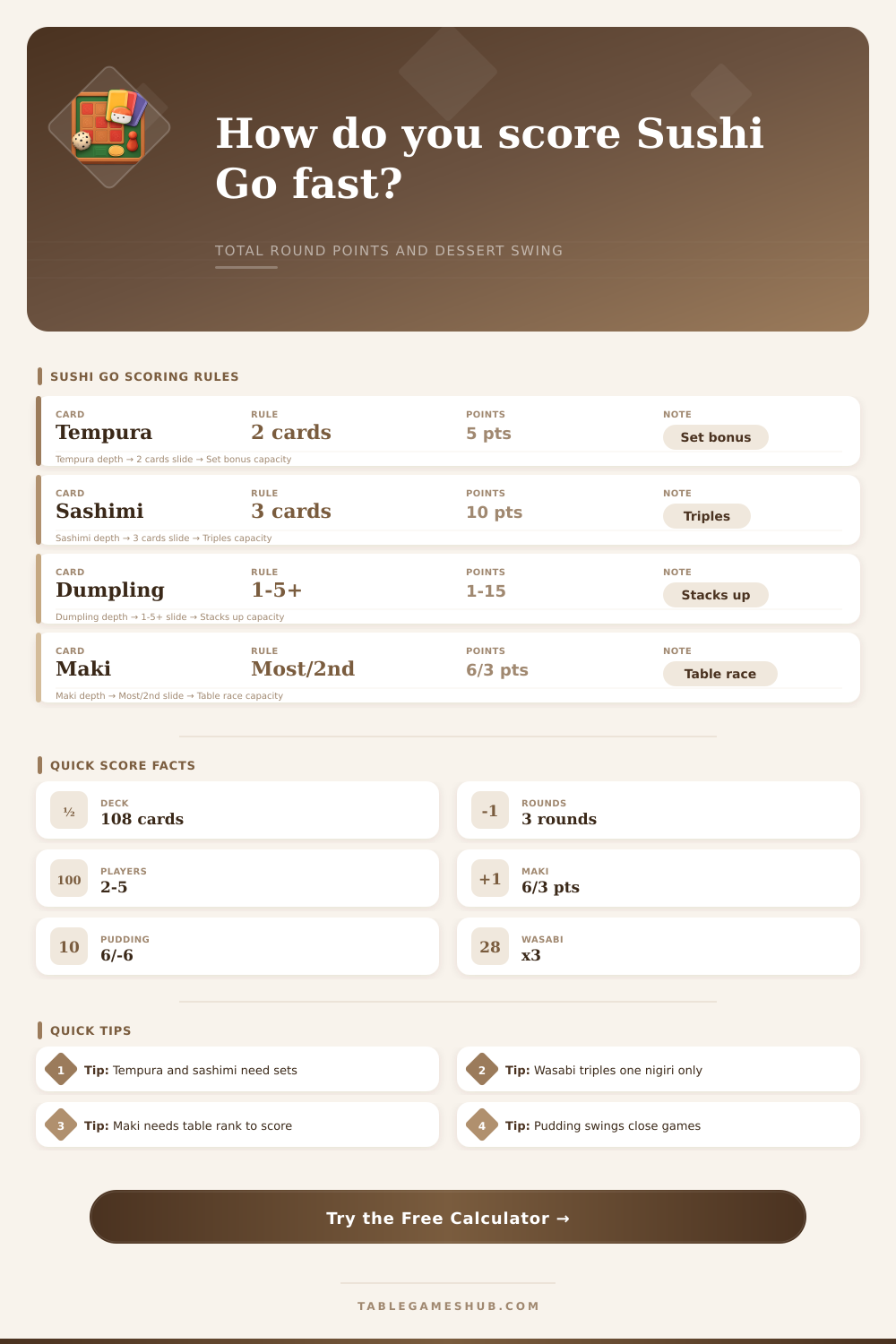
| Tempura | 14 | 2 cards | 5 points |
| Sashimi | 14 | 3 cards | 10 points |
| Dumpling | 14 | 1 to 5+ | 1 to 15 |
| Nigiri | 20 | Squid, salmon, egg | 3, 2, 1 |
| Wasabi | 6 | Triples one nigiri | Boost only |
| Chopsticks | 4 | Swap for 2 | No points |
| Maki place | Points | Tie rule | Note |
|---|---|---|---|
| Most | 6 | Split evenly | No second if tied first |
| Second | 3 | Split evenly | Only if first is unique |
| Third+ | 0 | None | No award |
| Zero maki | 0 | None | Can still win pudding |
| Pudding place | Points | Tie rule | Note |
|---|---|---|---|
| Most | 6 | Split evenly | Endgame bonus |
| Least | -6 | Split evenly | 2-player skip |
| All same | 0 | No swing | Table is flat |
| Two players | 6 only | No penalty | Least does not score |
| Players | Cards dealt | Rounds | Table note |
|---|---|---|---|
| 2 | 10 | 3 | Use dummy hand |
| 3 | 9 | 3 | Quick draft |
| 4 | 8 | 3 | Standard play |
| 5 | 7 | 3 | Fastest table |
Spend wasabi on squid first
Tripling a higher-value nigiri gives the biggest lift, so the calculator boosts squid before salmon and egg.
Watch the table race
Maki and pudding can swing a close game even when your round sets are small, so keep the tie fields accurate.
Use this Sushi Go score calculator to total set bonuses, nigiri with wasabi, maki rankings, and pudding swing points so each board snapshot is easy to compare.
Sushi Go is a game in which player have to calculate there score after each round of the game. The game features many different type of cards with various point value associated with each type of card. Furthermore, there are tie situation with certain cards that provide bonus to players that has those types of cards.
A scoring tool can help each player to calculate these point, and can help to avoid any argument between players due to the mathematics calculations that is required. Cards like tempura provides five points for each set of two card, so four tempura cards will provide ten points for the player that have them. Sashimi cards provides ten points for each set of three card, so a player must collect three sashimi cards to earn the ten points for that card type.
How to Score Points in Sushi Go
Dumpling cards has a point value of one for the first dumpling, three point for two dumplings, six points for three dumplings, and ten points for four dumplings. However, five dumplings or more is worth fifteen points for a player, and players should of avoid collecting four dumplings due to the decreasing point value of each additional dumpling. Nigiri cards has a point value of one for egg cards, two points for salmon cards, and three points for squid card.
Additionally, wasabi cards will triple the point value of any nigiri card that are played with the wasabi card. Thus, if a player plays a wasabi card with a squid card, the squid card becomes worth nine point. However, since wasabi cards will triple the point value of a nigiri card, it is best to play wasabi with the type of card with the highest point value.
Maki cards provides six points to the player with the most maki icon, and three points to the player with the second most maki icons. Thus, if there is a tie for the most maki icons, the players will divide the six points equally among each player with that number of maki icon. Furthermore, there are no point provided for the player with the second most maki icons if there is a tie for the most maki icons.
Pudding cards is scored at the end of the game. Most pudding cards provides six points each to the players with the most pudding card. Additionally, some pudding cards provides minus six points to the players with the least amount of pudding cards.
If all players has the same number of pudding cards, there are no points award to anyone for their collected pudding cards. When playing the game, care must be taken when there are ties in any category. For instance, if a player has the most maki icon cards, they will receive more fewer points due to the tie.
Additionally, if a player has the most pudding cards, they will receive fewer points due to the tie. Furthermore, players should also take care to not overvalue dumpling cards, as there are fewer points provide for each additional dumpling card collected. A scoring tool can help each player to determine the best strategy for the game.
For example, each player can use the scoring tool to determine if wasabi cards are a better value than tempura card reliablly. Additionally, the scoring tool can provide information regarding the impact that the number of players have on the game. Finally, the scoring tool will manage the mathematics of the game, allowing the players to focus on the drafting of the game cards.