Fjords Score Calculator
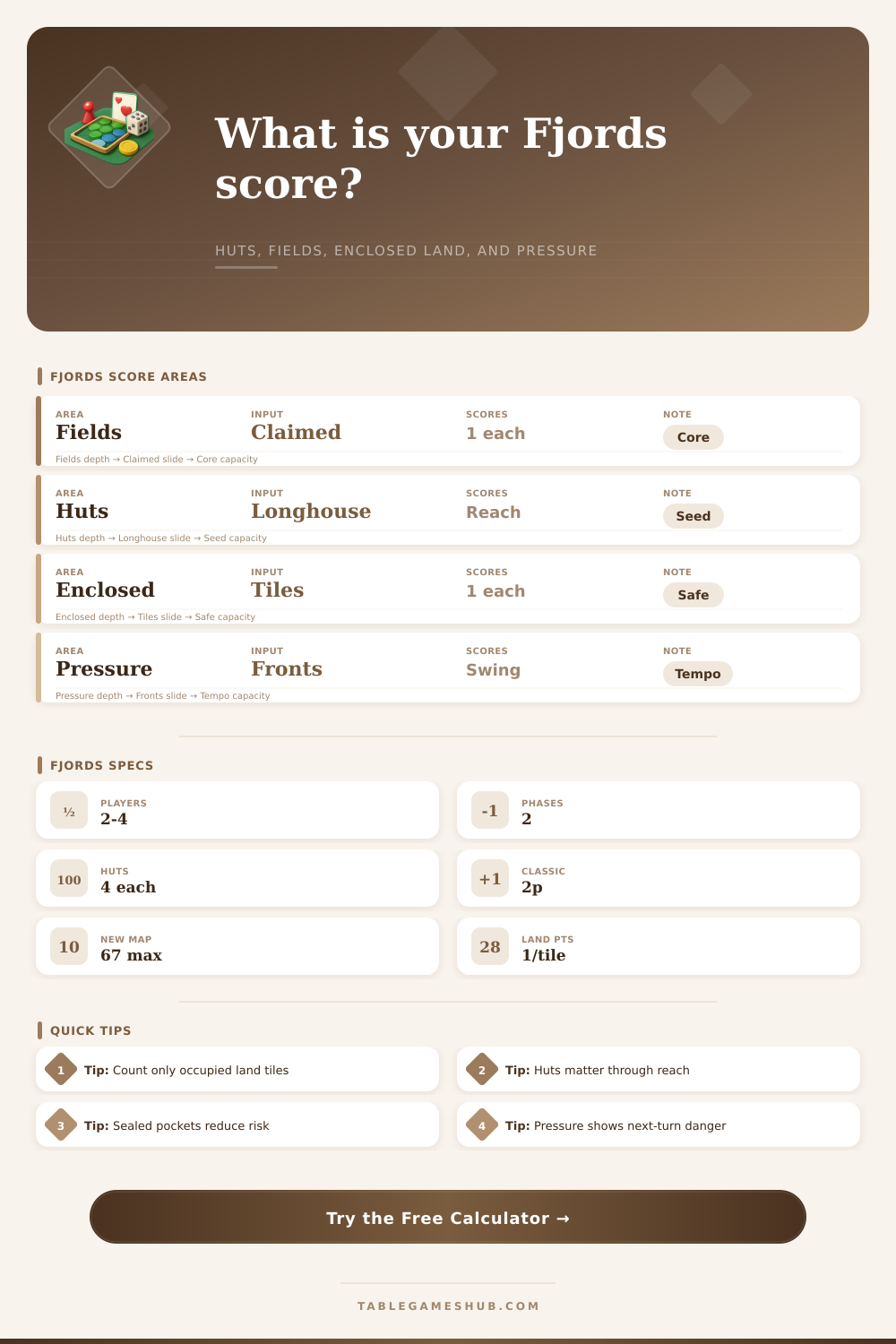
Total settlement points, longhouse reach, enclosed pockets, and map pressure for a Fjords endgame or late-game board state.
Standard uses occupied land tiles as the core score.
Player count changes map size pressure and target bands.
Your placement seeds for the settlement phase.
Huts that still give practical access to open land.
Count occupied plains or open land spaces.
Use for new edition maps where cliffs are claimed land.
Tiles inside pockets your rivals cannot now enter.
Converts sealed land into a realistic secure estimate.
Add Home, Strength, Water, Friendship, or similar bonuses.
Open tiles rivals can plausibly claim from their huts.
Unclaimed tiles still reachable from your longhouses.
Spaces where one move can open or close a region.
Score Breakdown
| Scoring Area | What To Count | Calculator Input | Why It Matters |
|---|---|---|---|
| Settlement land | Occupied fields, plains, cliffs, or legal land spaces | Fields + cliffs | Main final score line |
| Longhouse reach | Huts that still connect to usable open land | Active huts | Shows whether exploration placements paid off |
| Enclosed pockets | Sealed areas that only your clan can enter | Enclosed safe tiles | Turns map shape into secure future points |
| Rune modules | Home, Strength, Water, Friendship, or variant bonuses | Rune bonus points | Adds optional new-edition scoring without changing core land math |
| Board State | Pressure Read | Common Signal | Planning Use |
|---|---|---|---|
| Open coast | Volatile | Many reachable open tiles for both sides | Score the next two turns, not just current land |
| Mountain cutoff | Positive if yours | One choke controls a wider field | Value contested fronts highly |
| Sealed pocket | Stable | Rivals cannot enter from any hut | Count as secure unless a module changes access |
| Hut isolated | Weak | Placed longhouse has no useful continuation | Discount reachable land and watch efficiency |
The last few rounds of Fjords are just about a certain type of panic. You’ve claimed your fields, you’ve put down your longhouses, there’s a tangle of wood fences and disputed territory on map. Whoever has the most obvious piece of real estate might win… or they might be the person who best counted all the pieces of real estate safe from their opponents. This thing helps remove any guesswork, translating your jumbled up board situation into a clear score.
Fjords’ main gameplay mechanic is called settlement, but the win condition are straight-up land tile count. While that’s not too hard to track mentally, the calculator will do that math for you after you input what you have now. Simply begin with total number of huts you’ve laid down (and how many of them remain actively linked up to open space). Why make this distinction? Well, a disconnected hut is nothing but a sunk cost, wasting action points when placing it, but providing no value toward a score. Use the calculator to determine if you’re racking up high-priced liabilities or really cashed-in from all that early aggression.
How to Score Points in Fjords
And then there’s the count itself. That’s when you see the number of plains tiles and cliffs you has under your control. It’s simple math on standard edition: each tile gets you a point. But it gets more interesting once you throw in enclosed areas: pockets of land you hold that your opponent can’t access from his hut, either due to distance or the placement of mountains between them. Because complete isolation is uncommon, there’s almost always some sort of choke point where an opponent might sneak inside if he managed to put down a hut in just the right spot. To reflect that, calculator requests a control percentage. Slide that around and you’re forced to honest assess the extent of your lead.
Of all the parts of late-game scoring that people misunderstand, map pressure might be the most. It’s an abstract-sounding thing, but it’s just a measure of volatility. How many open tiles do you each have access to within several moves from your own longhouse? And how many can they get to? That number tells you if board state is stable, and how likely one turn is to flip scores by tens or even dozens of points. This tool measures that and lets you know if your current score is solid and comfortabley, or more like a house of cards. If it’s higher, stay defensive. Don’t gamble for possible growth; secure what you’ve got first.
Those reference tables shows the basics of what these inputs mean, explaining where rune modules are used in newer editions and exactly how many points a given longhouse reach is worth. If you’re playing with the rune cards, for instance, their bonus points don’t count towards the normal land counting, those should of been added on yourself or you might think you’ve got it in the bag while your opponent’s hidden bonus gives them the win.
The most common pitfalls involve overestimating how much land they can reach. You see a big field next to your hut and you think, ‘Oh, yeah, I’ve got that.’ But there might be a hut on the opposite end of that field, and then it becomes contested territory. Pressure reveals this danger by making you calculate weight of your accessible tiles versus your opponent’s. It reminds you that in Fjords, good positioning beats raw acreage. A small territory sealed off entirely from opponents is worth many times more than a sprawling empire with open borders.
And then what? Well, it’s about feeling good about how you played. It’s about coming away feeling confident that you played smart and you didn’t screw up something critical in the last phase. It’s about having a clear picture of where you are: every tile is either safe, threatened, or inaccessible. This removes the emotion from the endgame. Now all you have are numbers, and they speak for themselves. They allow you to sit back and enjoy the calm feeling of a job well done and the steady rhythm of a completed trip.