Everdell Pearlbrook Calculator
Total a Pearlbrook city with pearls, wonders, adornments, river destinations, events, cards, tokens, and journey scoring.
🐸Real Pearlbrook Presets
⚙Scoring Inputs
Pearlbrook Result
🧮Pearlbrook Component Grid
📊Reference Tables
| Wonder Tier | Score Value | Pearl Pressure | Calculator Entry |
|---|---|---|---|
| Small wonder | 10 VP | Lower resource race | Select 10 VP wonder |
| Mid wonder | 15 VP | Good balanced target | Select 15 VP wonder |
| Large wonder | 20 VP | Strong final swing | Select 20 VP wonder |
| Starfalls tier | 25 VP | Highest Pearlbrook race | Select 25 VP wonder |
| Pearl Source | Scoring Treatment | When to Count | Input Field |
|---|---|---|---|
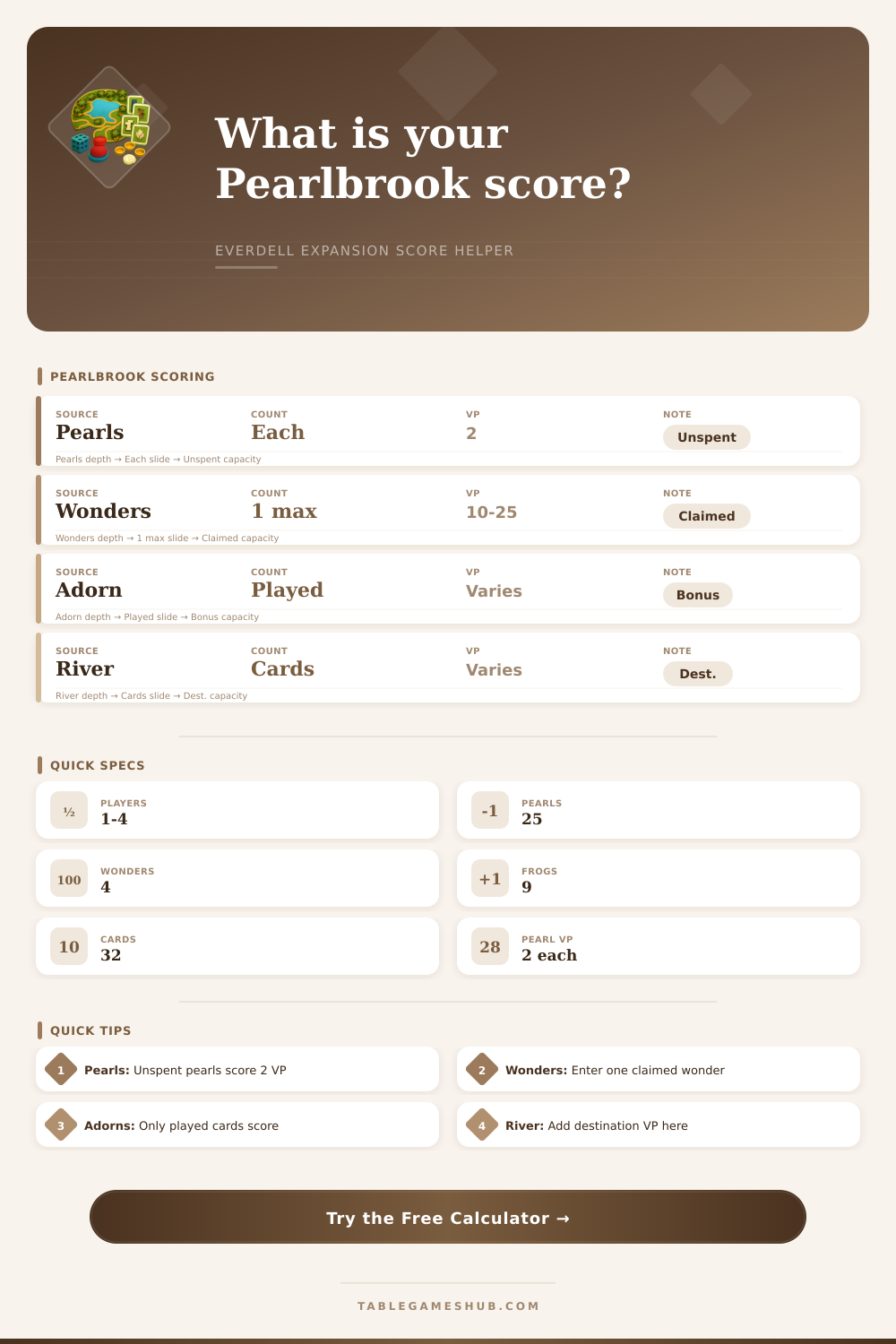
| Unspent pearls | 2 VP each | End of game | Unspent pearls |
| Shoal visit | Pearl gained, no printed VP | After frog placement | Pearls spent or held |
| River destination | Rewards vary by card | After requirement is met | Destination VP and rewards |
| Card effects | Use printed or bonus VP | When card scoring applies | Pearlbrook card bonus VP |
| Adornment Use | Pearl Cost | Immediate Role | Endgame Entry |
|---|---|---|---|
| Bell-style resource burst | 1 pearl | Boost berries or tokens | Adornment bonus VP |
| Green production repeat | 1 pearl | Trigger production city | Adornment bonus VP |
| Card-type scoring goal | 1 pearl | Rewards city composition | Adornment bonus VP |
| Unplayed adornment | 0 spent | No ability used | Do not count bonus |
| City Area | Normal Score Logic | Pearlbrook Add-On | Where It Goes |
|---|---|---|---|
| Cards | Printed VP in city | Aquatic critters and constructions | Printed VP on city cards |
| Tokens | Point tokens earned | Pearlbrook production and rewards | Point tokens |
| Events | Event cards and specials | Pearlbrook special events | Events and special events VP |
| River | No base-game equivalent | Ambassador destinations and pearls | River and pearl inputs |
💡Scoring Tip Boxes
In Pearlbrook, you’re balancing short term gratification against long term sustainability. With the new expansion, Everdell introduce sparkly pearl tokens that entice you into pursuing easy, fast wins. You build out a gorgeous-looking city. Then, when scores are tallied at the end, you realize you didn’t really consider what all those little points here and there was adding up to.
That’s where a calculator can serve not as mere convenience item but as a way to make you consider your strategy as a whole, not as individual moves but as an entire financial picture. Pearls are where it’s at in Pearlbrook. They serves as a score point generator (the more you leave them unspent at game’s end, the more points they provide) but also as currency that allows you to take powerful actions: to claim wonders and to activate adornments. In other words, every pearl you spend is a decision you’re making, using it for instant power now or banking it on potential score points later.
How the Calculator Helps You Win
That’s why the calculator keeps track of pearls not only spent but pearls kept in reserve right up until the end-of-game tally. It will tell you if your aggressive spending realy earned you enough points to offset the two points per pearl you forfeit by leaving them unspent. This can be the difference between a close call and cruising toward victory.
Finally, think about the destinations on the rivers carefully. The frog ambassadors will let you venture into new territories, but just because you visit a place doesn’t mean it’s going to pay off big time. Some destination have resources that benefit your engine; some destinations has points right there for the taking. Pay attention to both before settling in. If you go all-in on picking up resources without making sure those points is worth something, you may end up with a fat city but nothing showing on the scoreboard.
You can also enter the rewards from each destination into the tool, along with your usual event and card points. This way, everything you get from the river adventures are credited correctly when it comes time to add things up.
Finally there are wonders. Wonders has their own set of complexities. They can turn a game around if you get them, but also require some setup conditions or major investment of pearls to claim. The calculator has options for lower and higher tiers of wonders which show how much you fall behind when deciding against claiming the big wonders. It’s not always the biggest that wins but rather then most efficient. Claiming a huge wonder late may have cost you too much and were less effective than a smaller wonder gained earlier. The tables provided on the page as reference will help explain this by showing you what those tiers mean in terms of resource pressure and victory points.
The same is true for adornments. They may not be as glamorous or do as much, but they definitely work wonders. Like other cards, playing them has an instant impact. In some ways, they’re even more valuable because they can supplement whatever else you’ve built into your city. The calculator also keeps track of multiple adornment and their bonuses being played all at once, which helps you understand what the total impact is of all those little gains you’re picking up.
It’s something I always forget about with adornments (and cards like them): Each one played add up to matter significanty over time. What this does is stress-test your strategy. Run it and it will highlight places that you were perhaps too aggressive (with wonder claims) or too conservative (with pearls). And here’s the part: it doesn’t just give you a score, it diagnoses your decision making process in the result. You get a feel for what happens when you shift some money from spending to savings. You can play around with different scenarios. That sort of analysis improve your approach for the next time out, translating random experience into learned tactics.
Overall, Pearlbrook asks you to walk a line between consolidation and exploration. You’re tempted to spend all of your time exploring the river; but the city needs constant tending if she’s going to flourish. A calculator take the guesswork out of that equation. You don’t have to waste time mentally running numbers while your friends twiddle their thumbs; you can sit back and simply play the game. When you know exactly how everything adds up, it’s easier to let go and relax. You can play the game with more confidence and less fear of making a simple math mistake. The numbers gets worked out for you so you can enjoy the beauty of the board without losing yourself in it.