Endless Winter Card Play Calculator
Estimate whether a tribe, animal, culture, megalith, or multi-card turn is ready by weighing food, labor, tools, culture icons, hand pressure, and eclipse timing.
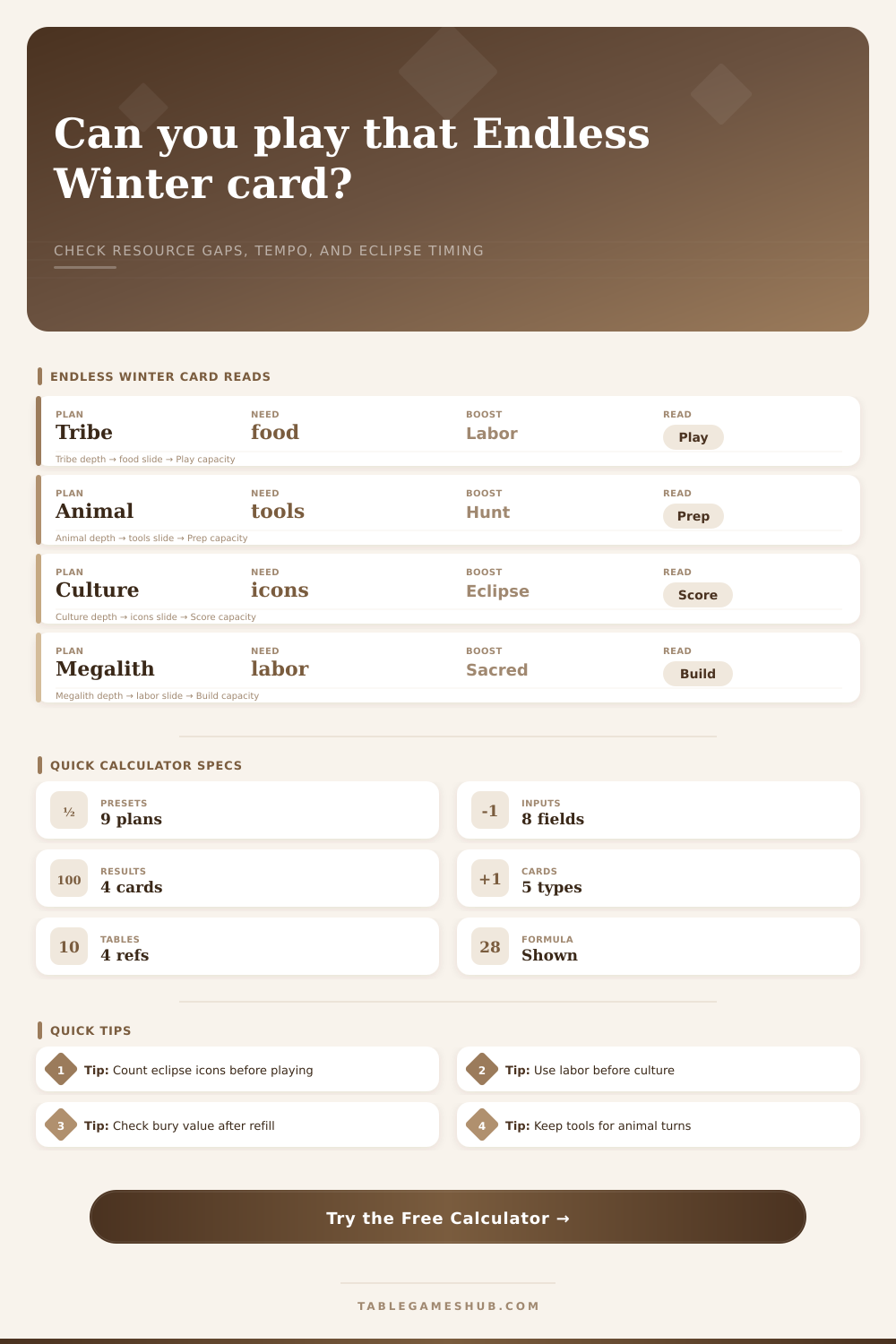
Use this calculator for Endless Winter: Paleoamericans when a card play competes with a gather, hunt, sacred stones, or eclipse setup action. Enter the card requirement and the support already available this round.
Card play result
| Card focus | Main pressure | Useful support | Best read |
|---|---|---|---|
| Tribe card | Food and labor | Develop action, hand refill, icon match | Play when resource gap is under one weighted point |
| Animal card | Tools and hunt tempo | Hunt action, food surplus, draw support | Prepare if tool gap blocks the animal chain |
| Culture card | Icons and eclipse timing | Culture stock, matching symbols, final round pressure | Score when the eclipse pace clears two points per round |
| Megalith support | Labor and sacred tempo | Sacred stones action, labor stock, bonus card play | Build when action tempo covers the labor shortfall |
| Combo turn | Mixed resources | Chief action, buried payoff, hand size | Play only if the second card stays above break-even |
| Action space | Calculator boost | Primary resource | Card play use |
|---|---|---|---|
| Develop tribe | High | Labor | Improves tribe readiness and hand pressure |
| Hunt animals | High | Tools | Supports animal turns and food conversion |
| Gather support | Medium | Food | Closes broad resource gaps with less card tempo |
| Sacred stones | Medium | Labor | Pairs with megalith scoring or icon setup |
| Eclipse setup | Variable | Culture | Best when icons and rounds are already aligned |
| Chief action | Flexible | Any | Helps a narrow final gap or a second card play |
| Resource | Weight | Why it matters | Typical bottleneck |
|---|---|---|---|
| Food | 1.00 | Basic tribe support and broad action fuel | Early tribe card turns |
| Labor | 1.25 | Develop, megalith, and stronger card play lines | Middle round planning |
| Tools | 1.45 | Animal and hunt-driven plays have tighter timing | Animal-heavy turns |
| Culture | 1.35 | Icon and eclipse value often converts late | Final eclipse push |
| Scenario | Useful range | Risk signal | Calculator target |
|---|---|---|---|
| Early tribe | Round 1 to 2 | Low hand size after play | Readiness gap below 1.0 |
| Animal chain | After hunt action | Tool shortfall remains | Play score above 90% |
| Culture burst | Near eclipse | Icons below two | Eclipse pace above 2.0 |
| Megalith pair | Sacred turn | Labor gap after boost | Tempo score above 3.0 |
| Two-card finish | Final round | Second card drains hand | Final call is Play or Set Up |
Finally, you’ve got the card that seems ideal for your plan. But before you take it, you pause. Are there any other resources you need? Is it time to pay for help? Whether your turn proceeds like clockwork or grinds to a halt in Endless Winter depend on these kinds of split-second judgements regarding how best to use your resource. It’s okay to be hesitant; the game penalizes greedier choices far more severely then cautious ones. Yet the game also values player who can recognize the moment the odds work in his or her favor.
To understand what’s ready, first know that not all resources is created equal. Food has less heft than labor (it’s basic fuel), but tools are even denser value since they enables animal chains that define mid-game tempo. To run the numbers, the calculator above assigns custom weights to each type of resource. That way, instead of wondering if you have two labor and three food, you’re wondering whether you have enough… Regardless of how many of each you are holding. One missing tool can ruin an otherwise solid plan, while excess food might simply go uneaten.
How to Use Your Resources Wisely
The one thing that does trip people up is timing. Sure, you could look at your hand and make a possible play. But have you considered how many more rounds there is until the next eclipse? Burying some cards will thin down your deck, which is often a better choice than making an unimportant play for a few points when you’re three rounds away from the end. To account for this, it asks for your current round number. Then, depending on whether it is time to start scoring or keep building, it change the recommendation to match. That helps distinguish between what you need versus what would be nice to improve.
Another nuance is how much hand pressure you’re under. It’s an empty-turn trap when you make a good card play and then realize you have no idea what to do next turn. Playable cards in hand is that reminder of the later impact. Say you have the resources to play a tribal card but it’ll leave you with too few cards in your hand to function. The calculator will flag hold even though you can afford it, avoiding one of those empty-turn traps that confuse beginner players fixated on the current moment instead of their action economy.
So let’s talk about icons: Icons are latent value, not instant power. They’re not just score multipliers but ways to set up future efficiency. And the way to think about that is through the reference table on the page, which explains how icon support changes the calculation behind culture cards. If your icons matches, you increase your payoff while reducing risk at cost. A marginal play becomes a must-play.
One common mistake is to ignore the bury value completely. A lot of players think about deck thinning as a side effect rather than something they want to do. When you enter with a high bury value it tells the tool that you are trying to clean your deck and that may cause it to change its recommendation from “hold” to “play.” It shifts your perception of the card from a scoring piece to an engine component.
The tool’s not meant to replace judgement; rather, it helps sharpen it. By removing all the other factors vying for our attention, it can provide a clean read as to whether the math will support the decision or not. In times of scarcity, where resources get tight, you must feel out the game and trust your gut. Yet, in moments when the math does line up, why question yourself? Pull the trigger. Take the points. And delay the end of the game just a little longer until the final score is tallied. One should of considered how many more rounds there are left. A luxurius moment like this should not be wasted.