Double Dutch Jump Rope Length Calculator
Size two matched ropes for turner spacing, jumper count, lane width, rope arc height, floor clearance, and rhythm speed in double dutch setups.
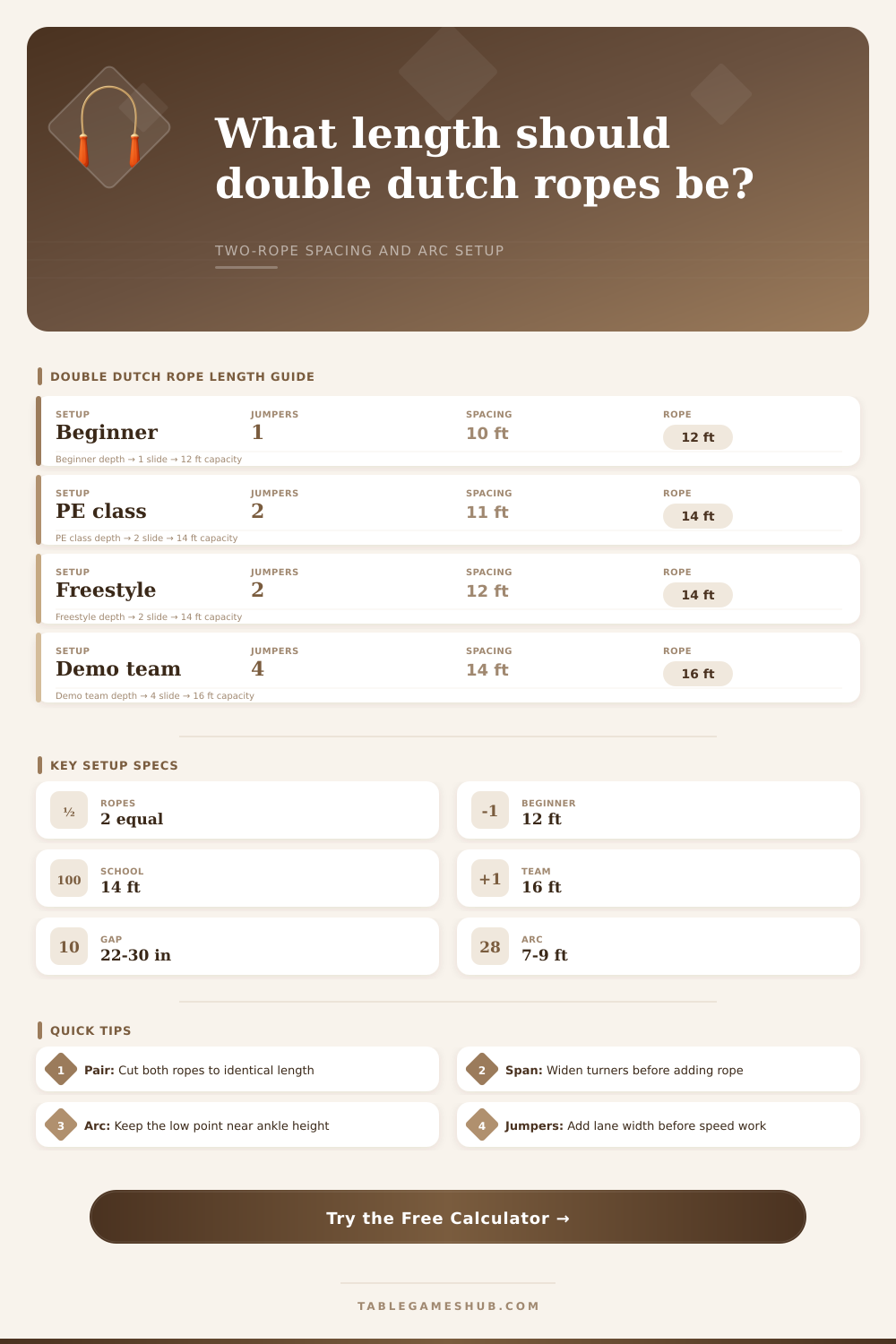
| Setup Type | Active Jumpers | Turner Spacing | Common Rope Pair |
|---|---|---|---|
| Beginner single jumper | 1 jumper | 9 to 10 ft | Two 12 ft ropes |
| School or recreation pair | 2 jumpers | 10.5 to 11.5 ft | Two 14 ft ropes |
| Freestyle or tricks | 1 to 2 jumpers | 11 to 12 ft | Two 14 ft ropes |
| Team demo line | 3 to 4 jumpers | 13 to 15 ft | Two 16 ft ropes |
| Wide stage routine | 4 to 5 jumpers | 15 to 17 ft | Two 18 ft ropes |
| Jumper Count | Lane Width Target | Turner Spacing Target | Best Fit |
|---|---|---|---|
| 1 jumper | 18 to 30 in | 9 to 10.5 ft | Beginners, speed step, entry practice |
| 2 jumpers | 48 to 60 in | 10.5 to 12 ft | Partner routines and basic crossing |
| 3 jumpers | 78 to 90 in | 12 to 14 ft | PE class groups and team practice |
| 4 jumpers | 108 to 126 in | 14 to 16 ft | Demo lines and choreographed sets |
| 5 jumpers | 138 to 156 in | 16 to 18 ft | Stage spacing with slower, larger arcs |
| Rope Style | Arc Feel | Buffer Need | Typical Use |
|---|---|---|---|
| Beaded double dutch rope | Visible, steady, moderate sag | 3 to 5 percent | School, recreation, team drills |
| Cloth or cotton rope | Soft, slightly deeper arc | 5 to 8 percent | Traditional practice and playground sets |
| PVC licorice rope | Fast, lighter arc | 3 to 5 percent | Freestyle and compact indoor practice |
| Speed rope pair | Tight, quick, low tolerance | 0 to 3 percent | Speed-step drills with one jumper |
| Heavy training rope | Large momentum, slower cycle | 5 to 10 percent | Turner strength and rhythm control |
| Preset | Rope Pair | Arc Height | Rhythm Range |
|---|---|---|---|
| Beginner single | Two 12 ft ropes | 6.5 to 7.5 ft | 55 to 65 turns per minute |
| School pair | Two 14 ft ropes | 7 to 8 ft | 65 to 80 turns per minute |
| Freestyle duo | Two 14 ft ropes | 7.5 to 8.5 ft | 70 to 90 turns per minute |
| Speed contest | Two 12 to 14 ft ropes | 6.5 to 7.5 ft | 90 to 120 turns per minute |
| Demo team | Two 16 ft ropes | 8 to 9.5 ft | 55 to 75 turns per minute |
Calculating the correct length for double dutch rope is a necessary process because the length of the ropes will determine how the ropes will move and how the jumpers will have to move. If the rope is too short, the ropes will strike the ankles of the jumpers, and the turners will have to use awkward arm position to move the ropes. If the rope is too long, the arc of the rope will sag too low and the timing of the ropes will drag.
If the timing of the ropes drags, the jumpers will have to make larger movement with their feet to continue with the jumping, which will break the rhythm of the double dutch jumping session. The calculator will remove the guesswork involved in determining the length of the ropes. The calculator will use the spacing of the jumpers, the height of the jumpers’ grip on the ropes, the floor clearance of the jumpers, and the number of jumpers in the session to calculate the appropriate length of the ropes.
How to Find the Right Rope Length for Double Dutch
To perform double dutch, two ropes are used that turn in opposite directions. The spacing of the turners will determine the width of the frame the ropes will travel through. This spacing is a critical measurement that will impact the ropes’ travel.
The width of the jumpers’ shoulders will determine the amount of lane space that is required for the jumpers to complete the activity. The height of the jumpers’ grip on the rope and the clearance of their feet from the floor will determine the arc of the rope and the length of the rope. Each of these measurements will impact the finished length of the rope.
Therefore, the calculator requires each of these measurements to provide the length of the ropes that will work in the established jumping session. One of the first decision that the turners must make is how many jumpers will be jumping in the ropes at one time. If only one jumper is to jump in the ropes, the ropes will require a narrow lane for that single jumper.
However, if two jumpers will participate in the double dutch session, double the shoulder width of the jumpers will be required. For three or four jumpers, even more space will be required in the lane for the jumpers to jump in the ropes. The more space required, the farther apart the turners will have to stand from each other or the length of the ropes will have to increase to allow the jumpers’ feet to remain clear from the floor.
The calculator will take into account the number of jumpers and will indicate if the lane width established for the jumpers is too wide for the space between the turners. If the lane is too wide, the turners will have to make a decision regarding the widening of the turners’ spacing, or increasing the length of the ropes. The type of rope that will be used is another important factor in setting up a double dutch ropes.
Ropes with beads tend to maintain an even arc of the ropes. Cloth ropes will sag more in the arc than rope with PVC licorice rope handles. Speed ropes allow for almost no slack in the ropes.
Finally, the heavy training ropes have more momentum moving through the air. Therefore, a factor that relates to the type of ropes will be incorporated into the calculator to determine the length of the ropes that will work with the different types of ropes. Therefore, one cannot expect the same length of rope to exhibit the same characteristics regardless of the type of rope.
The clearance of the jumpers’ feet from the floor is a variable that will impact the length of the ropes. For most jumping setups, the clearance will be four inches from the floor. However, if the clearance is lowered from this starting number, the length of the ropes will shorten.
If the clearance is increased, the length of the ropes will have to increase as well. These two variables will be visible on the calculator for the turners to change the grip height of the jumpers or the clearance of their feet from the floor and to see how these changes will impact the length of the ropes. For example, if the jumpers change from the gym floor to the outdoor sidewalk, the clearance will change and the ropes will have to be adjusted accordingly.
The desired rhythm for the jumpers will determine the length of the ropes. For beginners learning to perform double dutch, a slow rhythm will allow the jumpers to adjust their wrist position as they turn the ropes. For more experienced jumpers, a speed-step rhythm for double dutch will require the jumpers to turn the ropes at a faster rate, and shorter ropes will be required for fewer jumpers than those performing the slow rhythm for double dutch.
The calculator will estimate the cycle time that the jumpers will use to turn the ropes, and if the ropes are not of the correct length to support the desired tempo, the jumpers will have to fight the ropes. Most people will make a mistake when calculating the length of the ropes for double dutch by treating the activity as two separate ropes for one jumper each. An individual will measure the length of one rope for one jumper and will cut a second rope of the same length.
This is a mistake because the lanes will be too narrow for the number of jumpers and the ropes will have to turn in opposite directions. However, if the ropes are set up with handle allowances for the jumpers, the extra length of rope will account for the extra lane width for the jumpers. Therefore, the calculator will include a handle allowance for the ropes so that when the handles are attached to the ropes, the ropes will reach the appropriate length.
Finally, other environmental factors for the location where the jumpers will perform their activity will impact the length of the ropes. For example, the texture of the floor may impact the length of the ropes due to the ropes dragging on the floor. Humidity may also affect the activity because of the type of rope that is used.
The jumpers’ height will affect where the jumpers should grip the rope. Therefore, the length of the ropes will have to be cut a little long initially and then trimmed after the jumpers begin to perform their routine. There are two reference tables that include the typical number of jumpers, the spacing between the jumpers, and the length of the rope.
These tables is a starting point for jumpers who are either in a school or who are demonstrating double dutch for others. These tables are not rules. For instance, a class of jumpers in a PE class may have to widen the turners’ space for the jumpers if the jumpers have broad shoulders.
The reference tables are merely starting points. Use the length and the grip height measurements for the jumpers and enter these actual measurements on the calculator. The calculator will take these actual inputs to determine the length of the ropes that will work for the jumpers.
The goal will be the establishment of a working double dutch jumping setup. When the ropes turn appropriately and maintain an even arc, the jumpers will be able to jump in and out of the ropes.