Shuffleboard Table Length Calculator
Choose an indoor table length from room length, cue clearance, cradle allowance, playfield length, player space, and scoring zone proportions.
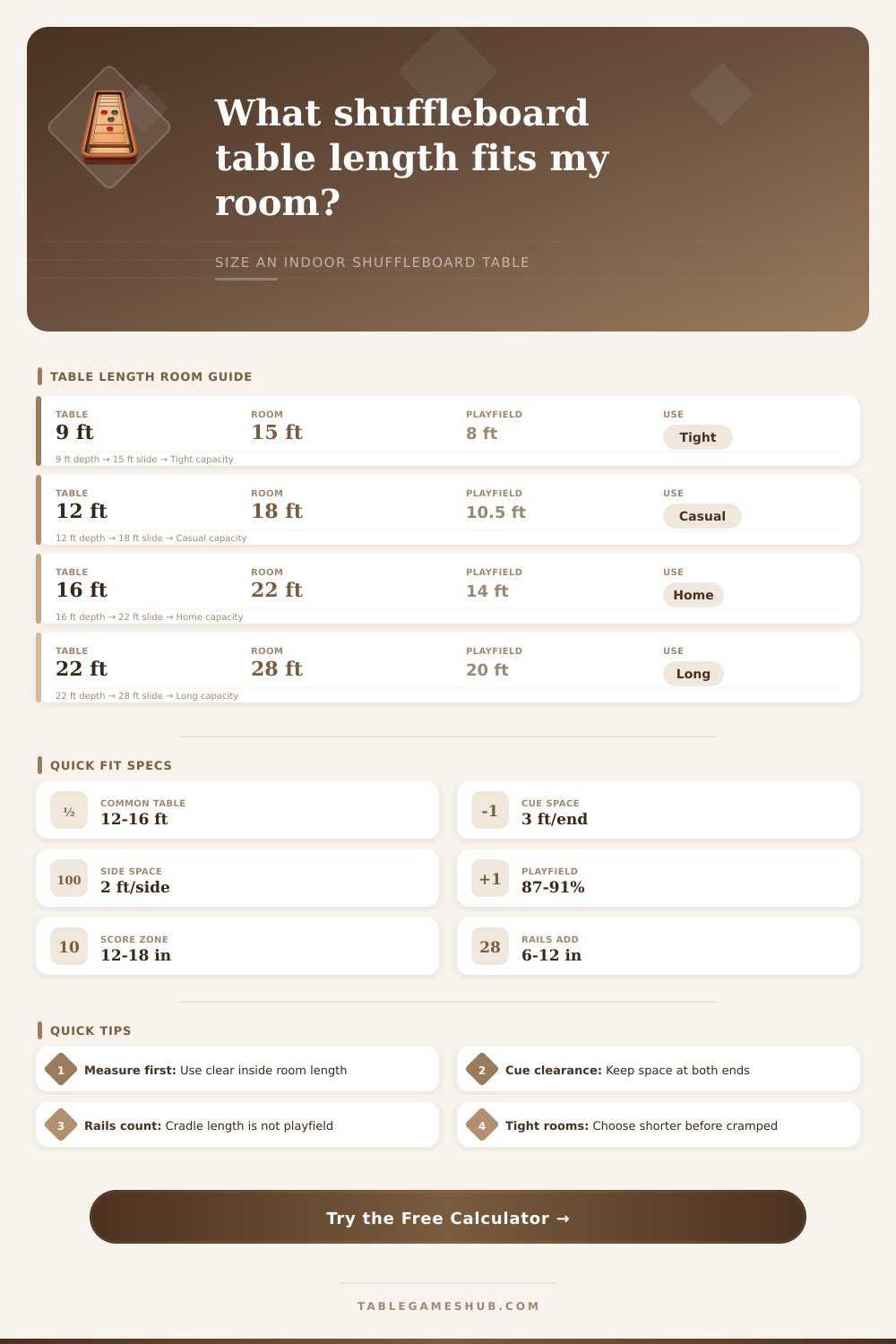
| Nominal table length | Typical playfield length | Best room type | Fit comment |
|---|---|---|---|
| 9 ft | 7.5 to 8 ft | Apartment or den | Short throw, easiest to fit |
| 12 ft | 10.5 to 11 ft | Small rec room | Casual home play length |
| 14 ft | 12.5 to 13 ft | Family game room | Noticeably smoother travel |
| 16 ft | 14 to 14.5 ft | Basement game room | Popular balance of length and fit |
| 18 ft | 16 to 16.5 ft | Long rec room | Needs deliberate end clearance |
| 20 ft | 18 to 18.5 ft | Dedicated game room | Long-table feel at home |
| 22 ft | 20 to 20.5 ft | Large game room | Full-length indoor table choice |
| Clearance item | Tight value | Comfort value | Why it matters |
|---|---|---|---|
| End cue space | 2.5 ft per end | 3 to 4 ft per end | Backswing, stance, and puck delivery |
| Side walkway | 1.5 ft per side | 2 to 3 ft per side | Players, scoring, and passing room |
| Wall buffer | 0 to 3 in | 6 to 12 in | Baseboards, trim, doors, and furniture |
| Players waiting | 2 to 4 people | 4 to 8 people | More players need more open end space |
| Table part | Measured as | Common range | Calculator use |
|---|---|---|---|
| Nominal table length | Outside cabinet length | 9 to 22 ft | Main buying size |
| Playfield length | Wood playing surface | 87% to 92% of table | Throw length estimate |
| Cradle allowance | Cabinet, gutters, rails | 8 to 24 in total | Subtracted from table length |
| Scoring zone per end | End-marked area | 6% to 10% of playfield | Proportion check only |
| Clear room length | With 3 ft end clearance | Comfortable table | Notes |
|---|---|---|---|
| 15 ft | 9 ft max | 9 ft | Works best when side traffic is light |
| 18 ft | 12 ft max | 12 ft | Good casual room size |
| 21 ft | 15 ft max | 14 ft | Choose 14 ft if furniture shares the room |
| 24 ft | 18 ft max | 16 to 18 ft | Great home shuffleboard range |
| 28 ft | 22 ft max | 20 to 22 ft | Enough length for a full-size cabinet |
When you are shopping for a shuffleboard table, you have to make sure that the length of the shuffleboard table is the apropiate length for the available space in your room. The size of the shuffleboard table cabinet is just one consideration; you also must provide space for the individual to stand and swing the cue. Your room may contain various obstacle that limit the usable length of the room.
For instance, the door may limit the length of the shuffleboard table that can be install in the space. Additionally, baseboards and other furniture may limit the usable length of the space within your room. The available end space within your room is one of the primary considerations in your purchase of a shuffleboard table.
Measure the Space for Your Shuffleboard Table
A person needs to have end space to properly stance while playing the game. A person also needs to be able to draw the cue back without hitting a wall or another player. Each end of the shuffleboard table should have a minimum of 2.5 feet of end space.
Less than 2.5 feet of end space will require people to stand in a cramped stance and will limit the length of the backswing of the cue. Many people prefers to have 3 to 4 feet of end space at each end of the shuffleboard table; this provides space for other players to stand and watch the game. The width of the shuffleboard table is another of the consideration in purchasing such a table; however, the width is typically less important than the length of the shuffleboard table.
Shuffleboard tables are typically 30 inches in width; however, players must be provided space to retrieve their pucks and to move around other player. One and a half feet of width at each side of the shuffleboard table may suffice if the room will have light traffic within it. However, 2 feet of width at each side of the shuffleboard table is preferred.
If your room has less than 2 feet of width at each side of the shuffleboard table, players will have to step to the side or wait for other players to finish their turn. The playfield is the area of the shuffleboard table where the puck will travel; however, the length of the playfield is not the same than the length of the shuffleboard table cabinet. The shuffleboard table cabinet contain the rails, gutters and wooden cradle.
The cradle takes up space at each end of the shuffleboard table; the cradle allowance for these rails and gutters ranges from 8 to 24 inches in length. You will need to reduce the length of the cabinet by the cradle allowance to determine the length of the playfield. For instance, a shuffleboard table cabinet that is 16 feet in length may have a playfield length of only 14 feet.
Scoring zones are located at each end of the shuffleboard table playfield. Each scoring zone is roughly 6 to 10% of the length of the shuffleboard table playfield; scoring zones are approximately 12 to 18 inches in length. The scoring zones are part of the playfield; therefore, the length of the scoring zones will change with the length of the shuffleboard table.
A short shuffleboard table will have short scoring zones because the playfield length will be shorter. The shape of the room is another of the critical considerations in purchasing a shuffleboard table. An area that is long and narrow may be able to accommodate an 18-foot shuffleboard table.
However, a square room of the same square footage may not have the necessary side clearance for shuffleboard table. Measure your room prior to purchasing a shuffleboard table. Standard shuffleboard table lengths are available in a variety of lengths.
For example, 9 foot shuffleboard tables are common in apartments and dens. Twelve foot shuffleboard tables are common in recreation rooms. Shuffleboard tables that are 14 and 16 feet in length are some of the most common; they provide enough length for pucks to travel at an appropriate speed while still accommodating other furnitures in the basement.
Eighteen foot shuffleboard tables typically require a dedicated game room in the house. Provide 6 to 12 inches of space between the shuffleboard table ends and the walls. This space will prevent the baseboards from damaging the shuffleboard table while it is in use.
This additional space will also provide forgiveness for any error in installing the shuffleboard table. Another of the considerations is the number of individuals that are to stand near the shuffleboard table. Two or four individuals may use the shuffleboard table and may require less end space.
Six or eight individuals stand near the shuffleboard table may require more open space within the shuffleboard table. Finally, the choice of shuffleboard table that you select is going to depend upon your personal preference. For example, some individuals prefer to purchase the longest shuffleboard table that will fit within the room.
Others may have a preference for a shorter shuffleboard table. Your primary consideration, however, should be to ensure that the shuffleboard table will fit in the room and that it will not act as an obstacle to the placement of other furnishings in the area. When the clearances and lengths of the shuffleboard table are appropriate, the shuffleboard table will become a piece of furniture that can be incorporated into the environment in which it will be used.