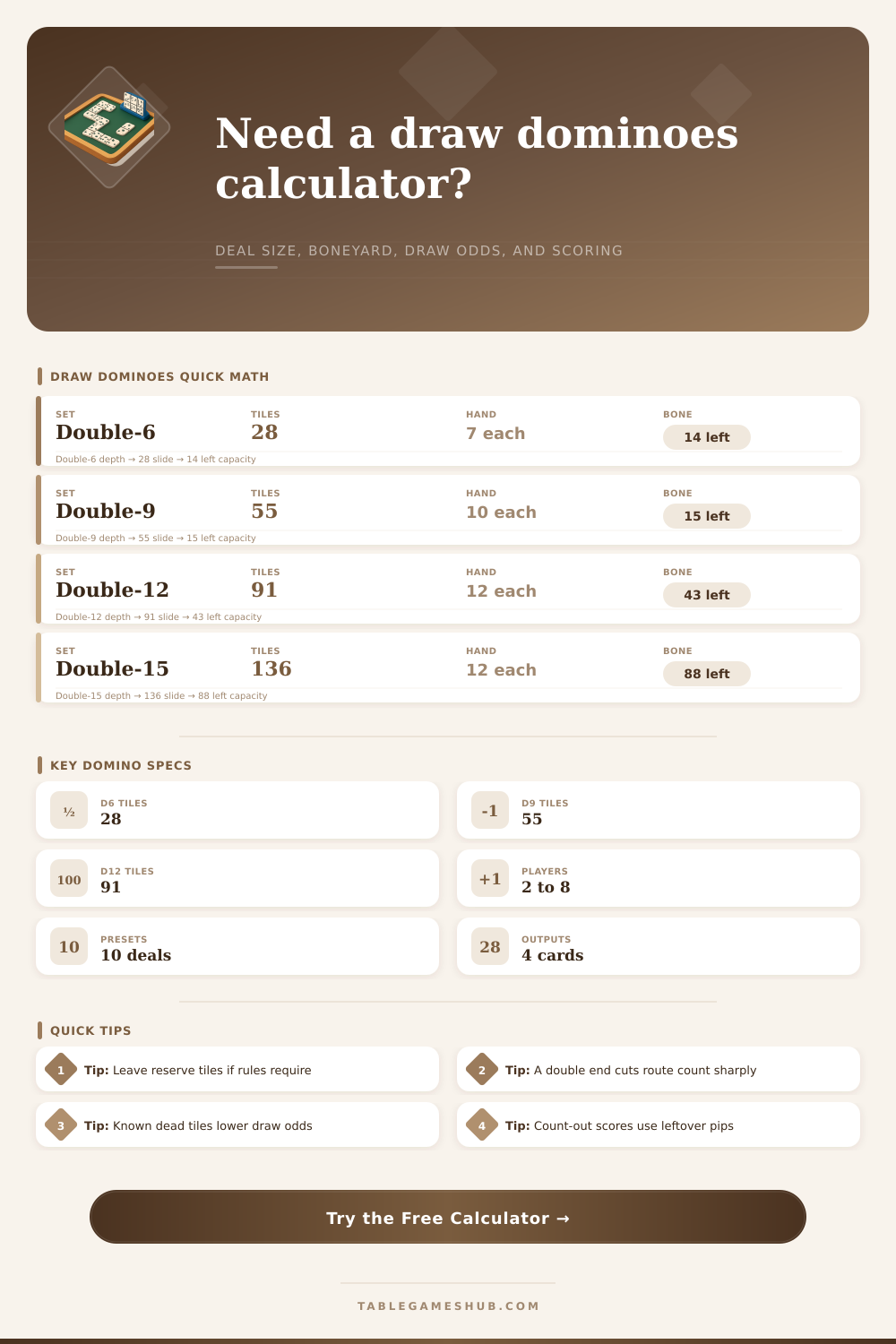
Draw Dominoes Calculator
Plan a Draw Dominoes deal, estimate boneyard pressure, measure playable-tile odds from the two open ends, and project count-out scoring from leftover pips.
1Draw Dominoes Presets
Pick a named table setup, then adjust the set, hands, open ends, boneyard reserve, and pip totals.
2Game Inputs
3Domino Component Specs
4Reference Tables
| Set | Total tiles | Total pip marks | Average tile pips |
|---|---|---|---|
| Double-six | 28 | 168 | 6.00 |
| Double-nine | 55 | 495 | 9.00 |
| Double-twelve | 91 | 1092 | 12.00 |
| Double-fifteen | 136 | 2040 | 15.00 |
| Double-eighteen | 190 | 3420 | 18.00 |
| Setup | Players | Starting hand | Starting boneyard |
|---|---|---|---|
| Classic double-six | 2 | 7 each | 14 tiles |
| Four-player double-six | 4 | 5 each | 8 tiles |
| Three-player double-nine | 3 | 10 each | 25 tiles |
| Four-player double-nine | 4 | 10 each | 15 tiles |
| Five-player double-twelve | 5 | 12 each | 31 tiles |
| Open-end state | Double-six routes | Double-nine routes | Formula |
|---|---|---|---|
| Ends match, such as 6 and 6 | 7 tiles | 10 tiles | n + 1 |
| Ends differ, such as 6 and 3 | 13 tiles | 19 tiles | 2n + 1 |
| One route known dead | subtract known tiles | subtract known tiles | routes - dead |
| Boneyard draw pool | boneyard - reserve | boneyard - reserve | available draws |
| Round score | Use when | Formula | Practical reading |
|---|---|---|---|
| Winner score | One player dominoes | opponents' leftover pips | Full count-out award |
| Blocked net | No player can move | opponent pips - own pips | Only positive margin scores |
| Lowest hand | Blocked comparison | lower hand wins margin | Small hands matter late |
| Rounds to target | Race to score goal | target / round score | Estimate game pace |
5Draw Dominoes Tips
Draw pressure: When the two open ends differ, the full set has roughly twice as many matching routes as a matched double-end position.
Count-out check: In blocked rounds, compare leftover pips before awarding points; a low hand can turn a clogged boneyard into the best position.
Without anything to play, no one has a move. That’s where a certain kind of tension develops at a domino table. At some point in every game, naturaly sometime after three hours, boneyard empties out and it’s time for someone to shuffle. But first, they need to simulate the deal.
That’s where the tool comes in. It spares you from having to do math regarding probability and setup. This lets you see how game works under its various constraints before you lay down your first tile on the felt. That’s why I like having a sense of how fast or slow round will go in each case, especially since size of the set determine that pace.
How to Use the Tool
With only twenty-eight tiles on a double-six set, things feel very tight, and when one tile is eliminated you have a decent idea of its location. Move up to a double-twelve set with ninety-one tiles, and you’re playing a memory management marathon, making educated guesses about your risk assessment.
Enter the calculator, which allow you to vary your hand size and number of player, and you’ll get an idea of how quickly the reserve pool will empty out. It’s less about counting tiles different than feeling the pressure curve during the course of a round. This is where the whole probability engine runs on the open end(s) of the layout.
Having two outs that match reduces your playable routes substantially more then having a mismatched spread. Seeing a three and a six isn’t like holding a seven if you’re trying to turn, it goes from probable to pray. And the reference tables indicates that matched outs reduce options sharply, whereas the opposite (divergent ends) keeps things fluid.
Adjusting these changing inputs lets you play with chances of hitting your next draw and whether or not it’s connected to anything useful. Many players forget the boneyard reserve, a common house rule used to discourage hoarding, until they reach their last tile. Setting this as part of the calculator will make you think twice when planning your final plays.
It’s the mental barrier that alters your strategy when running low on tiles. Set this based off your table’s actual rules, the tool allows you to set this reserve manually to reflect the specific rules of your game. Either way, adjusting this shifts how you account for the odds of getting next matching tile. When there are only a couple tiles left, it makes you consider that some pieces is basically out of play before the end of the round.
A third example is how you’re intuitively not counting right. When someone blocks your hand, most people only think about blocking them back, not the fact they have a certain number of pips left in their hands. Remember: whenever anyone blocks you, it’s a scoring event.
The tool enables you to enter number of pips left in each person’s hand. Then you’ll know what final round score might be if one of several things happened. If you’re playing for the lowest hand or the winner’s count, this will tell you whether to push to make a risky connection. It also shows whether to lay down and try to get a block with low pips and hope for the best.
This is a game of not just luck, but also of information management. There’s only one set of tiles, yes, but more that go down, the more your view of which are still in play changes. By doing these calculations ahead of time, you eliminate guesswork from the set-up stage and spend more time playing the game itself.
Your understanding of how volatile small sets is, and how deep large ones are, grows. And when the room falls silent and the boneyard runs dry, you’ll know precisely where the odds turned against you. But even better, you’ll know how you could of steered through those tides at the starting gun.