Water Balloon Launcher Distance Calculator
Estimate recreational launcher range, peak height, flight time, and splash zone using pullback, launch angle, balloon mass, elastic strength, wind, and field limits.
Launcher Estimate
| Preset | Pullback | Angle | Best recreational use |
|---|---|---|---|
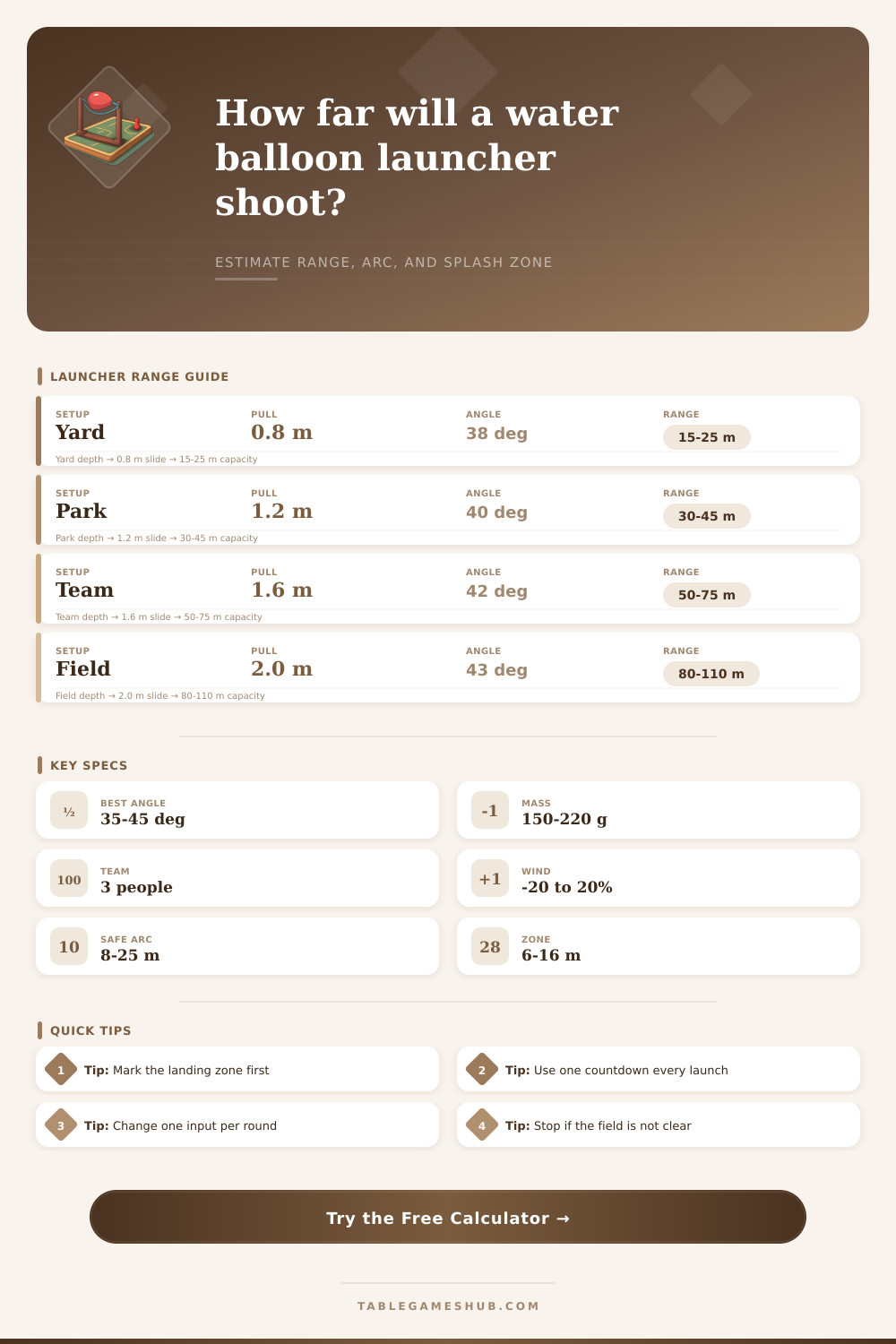
| Backyard Soft Toss | 0.75 m | 38 deg | Short tosses inside a small marked yard. |
| Park Casual Lob | 1.15 m | 40 deg | Moderate three-person launches in a clear park field. |
| Team Standard | 1.55 m | 42 deg | Balanced range, arc, and splash predictability. |
| Wide Field Check | 2.10 m | 43 deg | Distance testing only in a large open field. |
| Heavy Balloon | 1.45 m | 45 deg | Slower launch with shorter travel and steadier wind behavior. |
| Light Balloon | 1.65 m | 39 deg | Longer carry where wind drift can be watched. |
| Low Arc Boundary | 1.25 m | 28 deg | Lower peak where overhead clearance is limited. |
| High Lob Zone | 1.35 m | 52 deg | Taller lob into a closer, wider marked zone. |
| Headwind Day | 1.70 m | 44 deg | Compensates for a mild headwind range loss. |
| Adjustment | Distance effect | Arc effect | Use when |
|---|---|---|---|
| Add 0.25 m pullback | Usually increases range | Raises peak height | The current splash point lands short and the field remains clear. |
| Lower angle by 5 deg | May add range below steep arcs | Lowers peak height | The shot floats high or drifts in wind. |
| Raise angle by 5 deg | Often shortens forward range | Raises peak height | The target zone is closer and needs a softer lob. |
| Use a heavier balloon | Usually shortens range | Reduces launch speed | Light balloons drift too much for the marked field. |
| Reduce active bands | Shortens range | Lowers peak height | You need a calmer setup for a shorter boundary. |
| Check | Comfort range | Warning result | Adjustment |
|---|---|---|---|
| Peak height | Below max comfortable arc | Peak exceeds selected limit | Reduce pullback or lower angle. |
| Landing distance | Inside clear field cap | Zone crosses a boundary | Choose a lower-power preset. |
| Landing width | Zone fully marked and empty | Zone is narrow or uncertain | Increase zone width or reduce power. |
| Wind | Calm to mild | Strong shifting wind | Pause launches until conditions settle. |
| Angle band | Flight shape | Typical behavior | Best use |
|---|---|---|---|
| 25-34 deg | Flatter, faster path | Lower peak and longer skip risk | Boundary games with clear forward space. |
| 35-45 deg | Balanced arc | Predictable range for team timing | Most recreational distance games. |
| 46-58 deg | Higher lob | More hang time and wind drift | Closer target zones with soft splash goals. |
| 59-70 deg | Steep arc | Shorter range and high peak | Only with wide open overhead clearance. |
When playing water balloon games, there is several factor that you must consider in order to determine how far the water balloon will travel. The distance that the water balloon will travel into the field will depend upon the launch angle, the stretch length of an elastic, the weight of the water inside of the water balloon, and the condition of the wind. The amount of space in which the game is to be played will also limit the distance of which the water balloon can be thrown.
By understanding how these different variable impact the distance of which the water balloon will travel, you can form a safe setup for the game. The energy that is create when the elastic is stretched and subsequently released will propel the water balloon. The angle of the water balloon will determine how far it will travel and how high it will reach.
What Makes a Water Balloon Go Far
Angles that is closer to the ground will cause the water balloon to travel further, but may cause it to skip on the ground. Angles that are more steeper will cause the water balloon to land more softly, but the water balloon will not travel as far. The steep angle will also increase the height to which the water balloon will travel.
You must consider the height to which the water balloon may travel, as it may land in trees or power lines. The weight of the water balloon will also impact its travel. If the water balloon is heavy, it will leave the pouch more slow.
The extra weight will cause the water balloon to travel a shorter distance. However, a heavy water balloon will travel more steady in the presence of light wind. A water balloon that is lighter will travel at a faster speed and will travel a farther distance, but it will drift more in the presence of a breeze.
If you are playing in an area with varying wind speed, adding more water to the balloon will provide more predictably results. The presence and direction of the wind will impact the travel of the water balloon. A headwind will reduce the distance to which the balloon travel.
A tailwind will add to the distance that the balloon travels, but make it more difficultly to judge where the balloon will land. Crosswinds will impact the water balloon lateral. You can make calculations of the effect of the crosswinds if they are expressed as a percentage of the strength of the water balloon throw.
The height from which the water balloon is released and the consistency of the throw will also impact where the balloon will land. If the water balloon is released from a greater height, it has more time to travel before it hit the ground. Counting together and even pulling the elastic will result in the water balloon landing in a set zone.
If there is any rush or uneven pulling of the elastic, the zone in which the balloon land will be wider. Changing the power and angle of the throw can adjust the distance and height of the water balloon. Increasing the stretch of the elastic will increase the distance and the height of the balloon.
Decreasing the angle of the water balloon will increase the distance the balloon travels without increasing its height. Only one variable should be adjusted at a time in order to determine its impact upon the landing point of the water balloon. The boundary of the field will limit the distance of the water balloon.
Calculations can compare the distance that the balloon will travel to the clear distance of the field. If the landing zone of the water balloon go past the boundary of the field, it is necessary to reduce the power or use a preset that creates a soft launch. In different setups, the distance of the balloons can be adjusted to account for different environment.
In a backyard, distances of twenty-five meters or less are appropriate due to the size of backyards and the risk of the balloons hitting object in the yard. In parks, distances of approximately forty meter are possible. In large field, distances of eighty meters or more are possible.
You can maintain safety by paying attention to the variable that may impact the water balloon. Before launching the water balloons, make sure that the zone in which the balloons will land is empty of people. Make sure to use a single countdown to all participant to ensure that the water balloons are released at the same time.
Finally, if the wind change or people enter the range of the water balloons, the game should be immediately end. While the mathematics will allow you to calculate the distance to which the balloons will travel, the math cannot replace the need to visually observe the field in which the balloons will be launched.