Hearts Shooting the Moon Calculator
Compare a Hearts moon attempt against normal scoring, failed capture points, opponent penalties, target pressure, and the table rule in use.
| Player | Now | Moon | Fail |
|---|---|---|---|
| Shooter | 42 | 42 | 66 |
| Left | 48 | 74 | 49 |
| Across | 36 | 62 | 37 |
| Right | 51 | 77 | 52 |
| Rule | Shooter | Opponents | Use case |
|---|---|---|---|
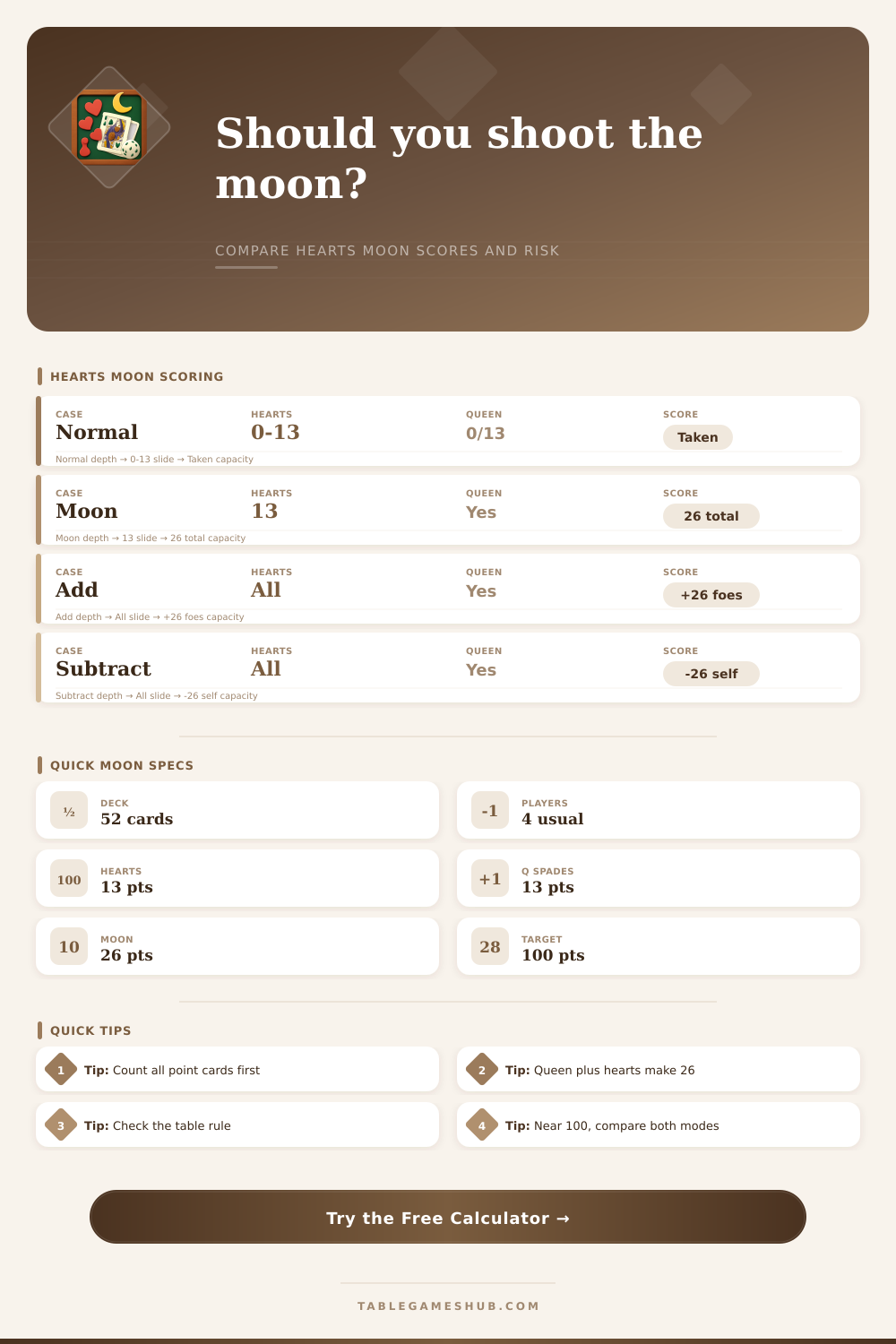
| Add 26 | No hand points | Each +26 | Common digital rule |
| Subtract 26 | Score -26 | No moon add | Comeback tables |
| Choose best | Lower branch | Depends | House option |
| Failed moon | Keeps captures | Missed points | Normal scoring |
| Card group | Count | Each | Total |
|---|---|---|---|
| Hearts 2-A | 13 | 1 | 13 |
| Queen spades | 1 | 13 | 13 |
| All point cards | 14 | Mixed | 26 |
| Non-points | 38 | 0 | 0 |
| Band | Need | Chance | Read |
|---|---|---|---|
| Complete | 0 | 100% | Apply moon |
| Strong | 1-4 | 70%+ | Often viable |
| Thin | 5-10 | 40-69% | Scorepad check |
| Blocked | Any escaped | 0% | Normal score |
Check the rule before scoring
Some tables add 26 to the other three players, while others subtract 26 from the shooter. The same hand can create a different leader.
Count blockers before the final push
If any heart or the queen of spades has already escaped to another player, the moon branch is blocked and the hand reverts to normal penalty scoring.
This calculator focuses on scorepad math for Hearts moon attempts. It does not model card-play strategy, hidden information, or house rules outside the selected moon scoring branch.
There’s a certain kind of tension found only in the game of Hearts. It arises when you hold not just cards in your hand but weapons. When you have the opportunity to shoot the moon, the ultimate gamble; you goes from playing defense to offense in twelve tricks. Most people think shooting the moon is reckless (or lucky), but it’s realy social risk plus some arithmetic.
After entering the status of your cards and your scores, the calculator on the page do the rest for you, saving you the confusion of conversions and coefficients that confuse even seasoned group. Leverage is the best part of shooting the moon. In regular Hearts, you are trying to avoid points. Also, if you has a bunch of hearts, you dump them on someone else to keep them hidden.
When to Try Shooting the Moon in Hearts
When you’re going for the moon, though, you turn the table. You go and take all twenty-six penalty point for yourself. Depending on how you play at home, either it will add twenty-six to everybody else’s score, or subtract twenty-six from yours. Either way, that’s a big swing in who’s leading right then and there.
Before you lead a heart, use the calculator to see what will happen. The problem with it is that people tend to overestimate their chances of getting there when they thinks about success alone. They think about what happens if everything goes perfectly and they use every trick, without accounting for what happens if they don’t succeed. If you miss even one point, you’ve just handed your opponents a gift basket of penalties while keeping some yourself.
This tool allows you to break it down; it shows you the odds of getting all the way there and how much would of been missed if you do fail. And it makes you realize that sometimes going safe is better then risking a failed moon. The reward of success is glorious, but penalty of failing is hidden from view. In this case, context trumps probability.
Before you do anything, look at the scorepad. Do you have ten hands remaining and are down by forty? Maybe you can shoot the moon and catch them up to you. Are you ahead comfortabley? Taking the shot now would be vanity and could cause a revolt on the table. Your opponents will be under target pressure; and the calculator has factored that in. It’ll tell you if a successful shot protect you or drives someone else over the limit. We are after more than winning the hand; we are after the game state.
That’s not the whole story. There are house rules at play here that change things further. Under the add rule, for example, the other players will be docked. Under the subtract rule, shooter will receive a break. For some tables it doesn’t matter as they let you decide which works best after you’ve played the trick. Knowing what rule your table plays by is key to figuring out how much value you can expect from such an attempt. The page does provide a handy table that explains the variations in rule sets.
But it’s not just about numbers. There’s a social aspect here that can’t be measured by any calculator. When you’re making hearts early on in the hand, everyone sees this and starts playing defense. They split up what could of been winning combinations and throw away potentially lethal queens, knowing you’re going for the moon. It’s tough enough to pull off based off the odds but adding in the mental stress of everyone knowing you’re trying to do it often complicate things more than expected. Now you’re battling both the deck and your friends’ gut reactions.
Is the queen of spades still alive? Look and make the decision. Unless it’s in play, there’s no moon for you. Now you need to look at what hearts you’ve managed to grab. Plug in your heart count into the tool, and note how much the score will swing based off that. But then consider the table. Is anyone looking tired? Are any opponents engaged and paying close attention? Occasionally, looking like you’re going to win is better than actualy doing it, let them spend precious time defending against a bluff that never materializes.
It’s a score and a story about shooting the moon: It takes nerve, calculation, and confidence. Trust your judgment on all but the arithmetic; let the tool do that. The cards will play out as they may, but the night will be defined by how you play them. Controlling the narrative becomes more important then not taking points, and that tension connects back to the opening hand.