Quiddler Longest Word Calculator
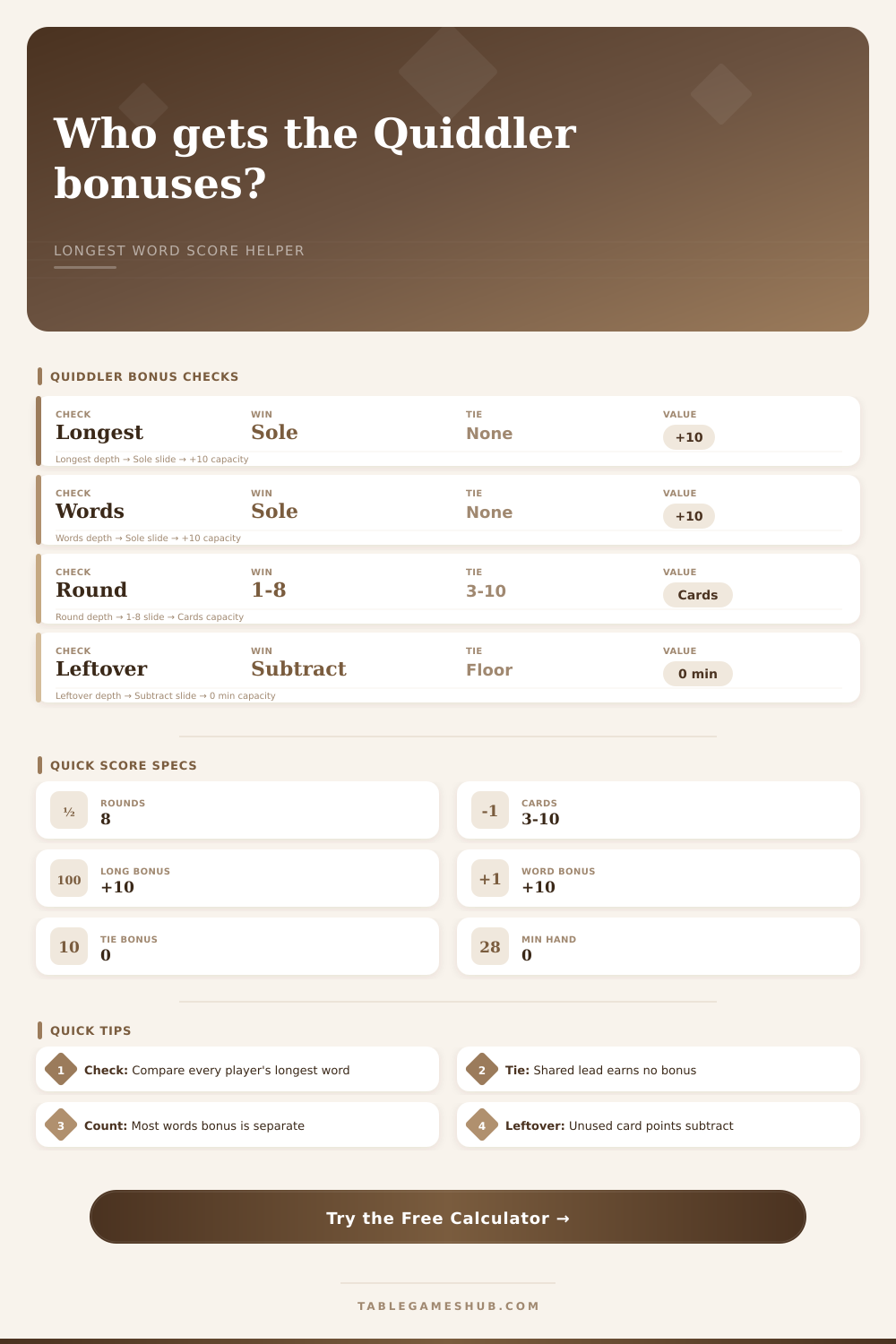
Total a Quiddler hand with word points, leftover card penalties, round cards dealt, most-words bonus, longest-word bonus, and tie handling.
| Category | Your Entry | Bonus Check | Score Effect |
|---|---|---|---|
| Longest word | 5 letters | Sole leader | +10 |
| Most words | 2 words | Sole leader | +10 |
| Leftover cards | 0 points | No penalty | 0 |
| Round size | 3 cards | Round 1 | Logistics |
| Round | Cards Dealt | Score Focus | Logistics Note |
|---|---|---|---|
| 1 | 3 cards | Short words | Small leftover swings matter |
| 2 | 4 cards | One or two words | Count bonus is still hard |
| 3 | 5 cards | First split hands | Track both bonus leaders |
| 4 | 6 cards | Longer builds | Deadwood can erase word points |
| 5 | 7 cards | Bonus competition | Two bonuses may separate players |
| 6 | 8 cards | Multi-word turns | Compare longest word by letters |
| 7 | 9 cards | High totals | Unused high cards are costly |
| 8 | 10 cards | Final swing | Double bonus can change standings |
| Category | Sole Leader | Tied Leader | Behind Leader |
|---|---|---|---|
| Longest word length | +10 points | 0 points to tied players | 0 points |
| Most words made | +10 points | 0 points to tied players | 0 points |
| Same player leads both | +20 total bonus | Tied category drops to 0 | Only held categories count |
| Unknown at scoring | Compare all players | Mark tie before totaling | Do not estimate bonus |
| Step | What To Count | Math | Calculator Input |
|---|---|---|---|
| 1 | Valid word cards | Add card values | Word points scored |
| 2 | Unused cards | Subtract values | Leftover card points |
| 3 | Longest word | +10 if sole leader | Longest word status |
| 4 | Most words | +10 if sole leader | Most words status |
| 5 | Hand score | Apply 0 minimum | Final result card |
| Card Group | Typical Values | Score Use | Leftover Risk |
|---|---|---|---|
| Common vowels | 2-4 points | Build flexible words | Low penalty |
| Mid consonants | 5-8 points | Boost word totals | Moderate penalty |
| Combinations | 7-10 points | Long word helpers | Noticeable penalty |
| High letters | 10-15 points | Large word scores | Heavy penalty if unused |
A Quiddler match isn’t stressful because it’s hard to come up with words. Sure, “dog” or “cat” is easy enough. But what’s more nail-biting is what happens after everyone has placed their word: the quiet pause as each player tallies their score and checks against their opponent(s) for bonus points.
And that’s where this gadget is handy. What could of been an argument turns into a fast calculation. Subtract leftover cards. Deal with any tie breakers. Let the calculator do its work and get back to having a good time.
Why This Calculator Is Helpful
Here’s where it gets tricky: there are some rules governing these bonuses. For example, the “longest word” bonus give you 10 points, as does the “most words in a round” bonus. It sounds like a good deal at first but here’s the catch: if you happen to tie on the long-word bonus with someone else, it’s nullified. Everyone gets nothing.
This means you need to keep an eye on your own cards and also on what everybody else is playing. That person may well have a seven-letter word up his sleeve. This would take some mental work; remember that if you tie with anyone else for a bonus category, that bonus dissapears entirely.
But the calculator make it easy for you to enter how you stack up against the others: did you come in first place? Tied? Were you second? It’ll add the appropriate bonus (or remove it). That takes away all the math of keeping track of the tie-breakers as things get moving. It also allows you to see the tradeoffs visually.
Is it better to take a safe word count bonus instead of reaching for a really long word and risking having high value cards left over? Each card not used will be subtracted from your total, and unused cards can quickly erase the value of your word points.
The stakes change as the game progresses. When there are only three or four cards in play during early rounds, leaving something behind isn’t so costly. But by the time you reach the eighth and final round, you’re sitting on ten cards. Leaving behind one of those high-point-value letters, such as the Z or the X, will cost you twenty-five points or more. That’s enough to make a massive swing in a game where ties happen frequent.
Included with the tool are some reference tables, which break down the feel for the game in each round; according to them, deadwood can wipe out word points fast in the middle rounds. It’s good to know, so you can shift your strategy accordingly, away from aggressively finding words toward carefully managing resources as the hand size increases.
But also psychologically, tracking these numbers helps. Do I want to take that hard decision of breaking up a longer word just to use up those tricky letters? Once you’ve got a sense for exactly how much it costs per leftover point, you can make harder decisions about whether to break up a long word just to use those tricky letters. Sometimes having a good (but not great) score is worth it if it means no leftovers. This happens if one have a big penalty.
You can try this math out immediately on the calculator. Enter in some scenario where you leave a long word intact and see what score you get. Then enter in another scenario where you break it up and go through every card. See how far apart the final hand scores are. That tells you which option is more safer.
It’s easy for players to make scoring errors because you forget there are two different category (the bonuses). For example, I might win the longest word but someone could have more overall words. The one who is alone in the lead gets ten points. If two player are tied for the lead, that bonus disappears entirely. They each get an extra twenty points.
And the tool clearly shows how it handles the bonuses so people don’t mistakenly add them up wrong or fail to take away the leftovers later. It’s like having a neutral referee making sure everybody agrees on the score before you move onto the next round.
So overall it comes down to balance. Do I have enough words for a good count? How about a few long ones for the length bonus? Oh no, I’m not using my entire hand! That’s bad. It goes on like that; the more cards you deal the harder it is to balance those factors.
Doing this in your head would be annoying (and likely wrong) and distract from the fun of the game. A quick-and-dirty summary of your hand allows the game to continue smoothly while keeping the player focused on the strategy instead of the math.
Next time someone asks whether a tie cancels the bonus, just check the status field and let the numbers speak for themselves.