Egg Drop Padding Calculator
Estimate cushion thickness, impact speed, stopping distance, peak G-force, and shell safety margin for classroom egg drop builds.
| Material | Best Use | Usable Crush | Energy Efficiency | Peak Multiplier |
|---|---|---|---|---|
| Open-cell foam | Predictable central nest | 60-75% | 68-76% | 1.6-1.9 |
| Large bubble wrap | Light package wrap | 50-70% | 58-68% | 1.8-2.2 |
| Cotton balls | Small cavity fill | 55-70% | 52-62% | 1.9-2.4 |
| Crumpled paper | Wide box filler | 35-55% | 38-50% | 2.2-2.8 |
| Kitchen sponge | Flat impact face | 55-70% | 62-72% | 1.7-2.1 |
| Straw truss | Frame plus air gap | 30-50% | 35-48% | 2.3-3.0 |
| Drop Height | Impact Speed | Energy for 180 g | Good Starting Padding | Design Note |
|---|---|---|---|---|
| 6 ft / 1.8 m | 13.9 mph | 3.2 J | 1.5-2.5 in | Small class demo |
| 10 ft / 3.0 m | 17.4 mph | 5.4 J | 2.5-3.5 in | Common stairwell test |
| 15 ft / 4.6 m | 21.1 mph | 8.1 J | 3.5-5 in | Needs centered egg |
| 25 ft / 7.6 m | 27.3 mph | 13.4 J | 5-7 in | Parachute helps |
| 30 ft / 9.1 m | 29.8 mph | 16.1 J | 6-8.5 in | Avoid hard corners |
| Package Style | Typical Mass | Impact Face | Stability | Recommended Extra Margin |
|---|---|---|---|---|
| Foam shoebox | 160-260 g | Large rectangle | High | 10-15% |
| Paper cup cradle | 120-190 g | Round base | Medium | 15-25% |
| Straw pyramid | 80-150 g | Point or edge | Low-medium | 25-40% |
| Balloon suspension | 140-230 g | Variable | Medium | 20-30% |
| Parachute capsule | 170-320 g | Broad base | High if vertical | 10-20% |
| Step | Formula | What It Means | Output Used |
|---|---|---|---|
| Impact speed | v = sqrt(2gh) x drag factor | Speed just before padding begins to crush | Velocity |
| Stopping distance | s = thickness x crush x efficiency | Effective distance that absorbs the fall | Average G |
| Average decel | a = v² / (2s) | Energy-based slowdown rate | Peak G estimate |
| Peak decel | peak G = avg G x load multiplier | Uneven impact correction | Safety margin |
| Required padding | t = v² x factor / (2gGcrushEff) | Minimum thickness for target shell limit | Design thickness |
The egg drop challenge is a task that require you to construct a package around an egg and drop it from a certain height. The egg will either survive the fall or it will crack during the fall. How well the package can absorb the sudden stop of the falling package will determine the outcome of the drop; padding is the most important components of the egg drop challenge.
One of the main variable of the egg drop challenge is the height from which you drop the package. The height will determine the speed at which the package will fall. For instance, dropping the package from a short height such as a desk will result in a different fall than dropping the package from a long height such as the second story of a building.
How to Keep an Egg from Breaking in a Drop
The longer that the package falls, the more time it have to accelerate towards the ground. The more that the package accelerates towards the ground, the more energy that it will have upon impact with the ground. Thus, the more energy that the package has, the more energy that the cushioning layer must be able to absorb upon impact.
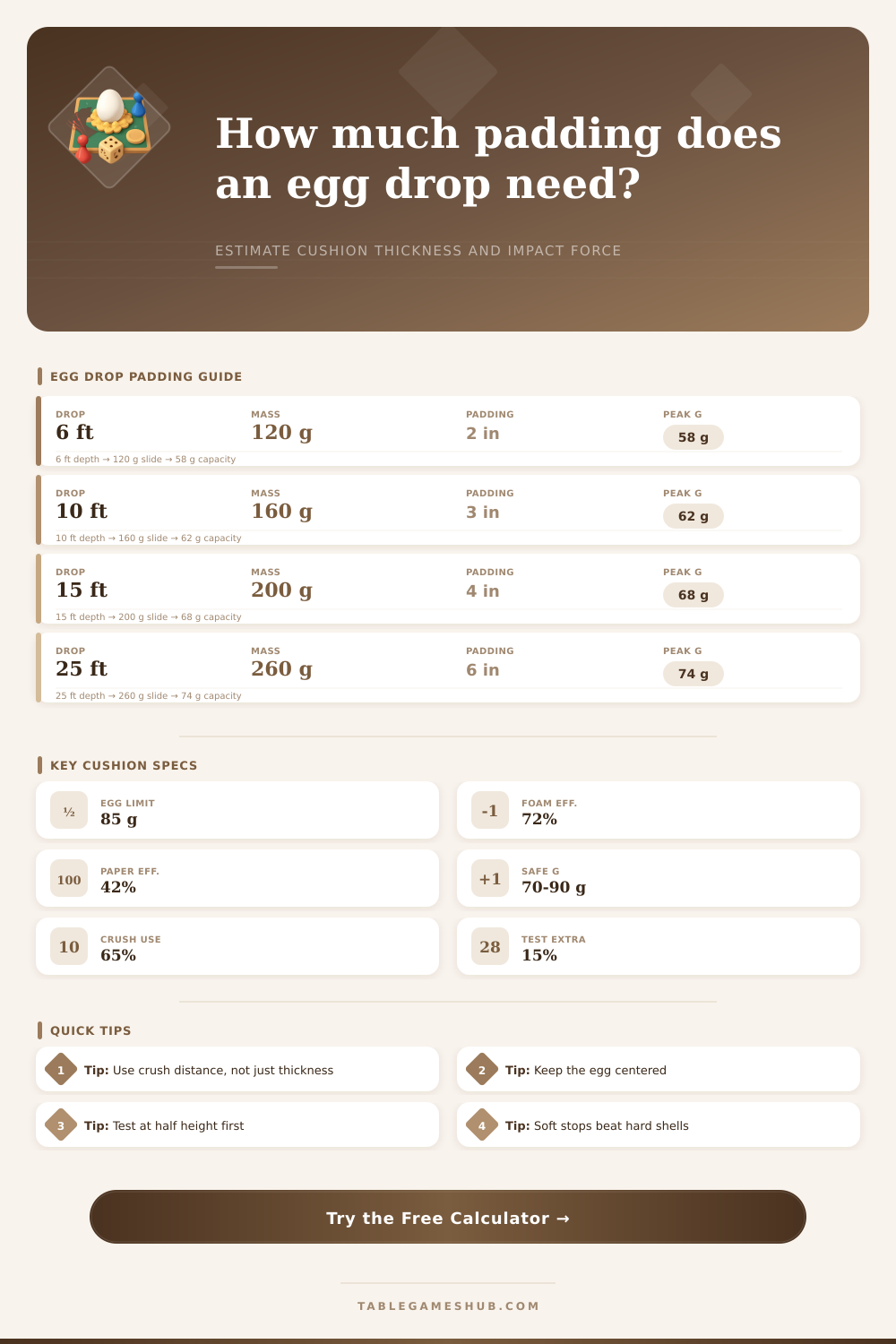
The calculator allows you to input the height from which you would like to drop the package and the mass of the package; the calculator will output the amount of cushioning material that will be required for the selected height. Another of the main variables to consider in the egg drop challenge is the mass of the package. The mass of the package is equal to the mass of an egg plus the mass of the container, the tape, and the structure of the package.
The more massive the package, the more energy the package will have upon impact with the ground. Thus, the more massive the package, the more force with which the package will hit the ground. Additionally, if the package is too massive for example, it may land on a single point.
If the package lands on a single point, the force will be distributed to that one point. Many student make the mistake of creating a massive package that may land on only a corner of the package. Another of the variables that many students focus on with the egg drop challenge is the thickness of the padding.
However, the thickness of the padding alone will not ensure the survival of the egg. What matters is the usable compression of the padding. The usable compression of the padding is the amount of thickness of the padding that will compress before the egg makes contact with a rigid surface.
For instance, if a material crushes completely when only half of its thickness is used for padding, then that material can be considered as a material of less thickness than the original material. The calculator will ask for the usable compression of the padding material so that it can calculate the amount of cushioning material that will absorb the impact of the dropped package. For instance, a three-inch block of foam that can compress two inches is more useful than a four-inch block of paper that can only compress one inch.
The material that you select for the padding is also important to the egg drop challenge. The ability of a material to absorb energy is crucial. For instance, if you use foam of even thickness for the padding for the package, the resistance of the material will even throughout the fall of the package.
However, if paper is used for the padding but it is crumpled, the paper will absorb the fall of the package for a split second but will become rigid when the package hits the ground. Straw structure are similarly likely to fail if not constructed properly. The calculator allows for the selection of the padding material for the egg drop challenge.
The peak G-force is the number that indicates whether the egg will survive the fall. The egg will not break due to the average G-force; rather, the egg will break due to one spike in the force of the fall of the package. Because of this, a safety margin is built into the calculator; the design calculations may indicate that the egg will survive if it is dropped on the package on paper.
However, due to the fact that the drop may not land exactly as calculated, the calculated peak G-force must be increased to ensure that the egg does not crack or break. Thus, a safety factor that is increased from one will ensure the survival of the egg shell. Drag forces created by a parachute or a wide capsule can be considered in the egg drop challenge.
Any air drag will slow the package prior to it reaches the ground. Thus, the less drag created by the package, the more energy the padding will have to absorb upon impact. The calculator includes an input box for reducing the drag created by the falling package; less speed of the package means less padding are required to ensure the survival of the egg.
There are some common mistake made by students in the egg drop challenge. For instance, adding padding to the sides of the package but leaving the bottom thin or placing the egg close to the wall of the package are all mistakes. Some packages may use soft padding but it may bottom out too early.
These mistakes can all be tested with the calculator. The calculator helps engineers to understand the relationship between different variables of the egg drop challenge. For instance, adding mass to the package increases the stability of the package but also increases the amount of energy that the padding must absorb.
Using a lighter material for the package may reduce the mass of the falling object but it may require more thickness of the padding to ensure the survival of the egg. The area on which the package lands will create more pressure on the padding material. The goal of the egg drop challenge is to understand the physics behind the egg drop challenge.
Simply adding more padding to the package will not ensure that the egg will survive the fall. If the egg do survive the fall, it is due to the increase in the stopping distance of the package or the reduction of the peak force that is directed towards the egg. The calculator will help to indicate to the engineers how to increase the stopping distance or the peak force.