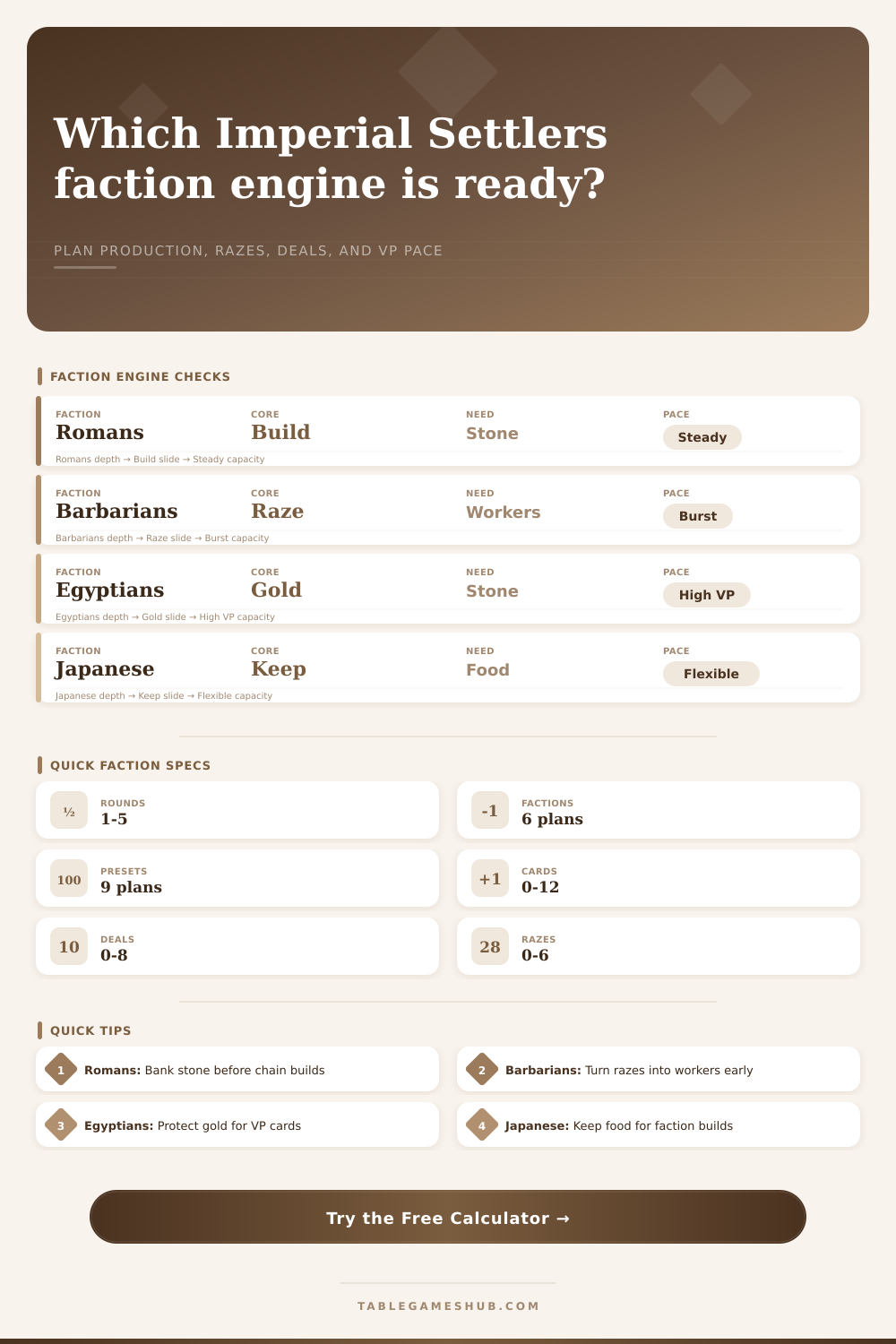
Imperial Settlers Faction Calculator
Estimate production strength, raze pressure, deal income, conversion strain, and victory point tempo for a specific Imperial Settlers faction engine.
| Faction | Engine identity | Primary pressure | Calculator weighting |
|---|---|---|---|
| Romans | Construction chains and efficient building | Stone and wood timing | Higher build capacity from locations |
| Barbarians | Razing, workers, and burst production | Turning razes into actions | Raze tokens add strong resource tempo |
| Egyptians | Gold-backed monuments and VP conversion | Saving gold for scoring cards | Higher VP value from deals and features |
| Japanese | Protected faction locations and flexible food | Balancing defense and conversion | Stable engine score from feature cards |
| Atlanteans | Technology tokens and upgraded actions | Stacking tech before final use | Feature cards scale resource output |
| Aztecs | Blessing and conversion turns | Timing one strong scoring window | Conversion posture has extra impact |
| Input | What to count | Strong range | Planning warning |
|---|---|---|---|
| Production locations | Cards that pay during production | 4 to 8 by midgame | Low count makes deals do too much work |
| Feature and action locations | Cards that convert, store, or score | 3 to 7 active cards | Too many can outpace workers |
| Deals feeding upkeep | Faction cards tucked as deals | 2 to 5 before round four | Too few deals lowers repeat production |
| Workers available | Workers ready after production | 5 to 10 action fuel | Worker shortage blocks conversions |
| Raze tokens or targets | Contact cards and expendable commons | 1 to 4 per active turn | Excess razes can starve building tempo |
| Preset | Faction use | Main resource question | Best timing |
|---|---|---|---|
| Romans Road Build | Common-to-faction construction chain | Can stone support another location? | Round 2 or 3 |
| Barbarian Raze Burst | Contact and raze-heavy production | Are workers enough for the burst? | Round 3 or 4 |
| Egyptian Gold Engine | Gold and feature scoring build-up | Can gold become points this turn? | Round 4 or 5 |
| Japanese Samurai Keep | Protected faction cards and flexible food | Is the engine too defensive to score? | Round 3 onward |
| Atlantean Tech Chain | Technology-enhanced action turns | Do features multiply output enough? | Round 4 setup |
| Aztec Blessing Turn | Conversion window with stored bonuses | Is the burst better now or next round? | Round 4 or 5 |
| Round | Engine goal | Production target | Scoring posture |
|---|---|---|---|
| Round 1 | Open with one repeatable income line | 3 to 5 resource-equivalent | Score only if painless |
| Round 2 | Add deals or a reliable converter | 5 to 8 resource-equivalent | Prefer build tempo |
| Round 3 | Pivot from setup to faction identity | 8 to 12 resource-equivalent | Begin planned VP turns |
| Round 4 | Convert stored engine into points | 10 to 15 resource-equivalent | Score while keeping one build path |
| Round 5 | Spend nearly everything useful | Any output that converts | Push final VP burst |
You are in round three of Imperial Settlers. You have a long line of production cards on your board. Will it be an engine? Or will it just sits there? That’s the divide.
Points. Resources. They is two sides of the same problem. Players tend to think of them separately: I have resources, now what do I do with them? But realy they’re the exact same problem.
How to Use the Game Calculator
And the calculator above solves the math for you when you input where you currently are. It prevents you from guessing whether you’ve got enough X for Y, or need Z, because of some coefficient or conversion factor.
It doesn’t matter how many wood you count. What matters is measuring tempo. Conversion is at the heart of a good faction engine.
Faction abilities needs a way to convert raw materials into something else: Victory Points. For example, the Romans count on a constant stream of building. They save stone in order to build and reap benefits later. That’s slow and sure.
In contrast, the Barbarians focus on burst damage. They tear down buildings and sudden there’s a glut of workers. That’s volatile. That’s why the calculator takes that into account.
If you plug in a lot of raze targets for the Barbarians, the tool will recalculate what they can produce. It knows how much that volatility affect things. Is it worth using all that wood? Can you support all those worker?
Subtle play takes place at deals. A lot of new players see them as storage. They park cards here that do not fit into current engine.
In a close game, however, deals generate active income. Deals provide upkeep. Upkeep keeps your engine running when production falls short.
Ask yourself: How many deals feed my upkeep? That’s the number. Those cards are your invisible efficiency.
Low numbers mean your production areas needs to do all the heavy lifting. High numbers mean you’ve got some wiggle room, you can build riskier engines because you’ve got a safety net. The page’s reference table details how various factions value this stat.
Deals are especially precious for Egyptians, who back their monuments with gold. Each hidden card is a potential scoring chance.
A posture of conversion means that conversion is a critical input. It asks the question, what are you going to do with any spare resources? Push for victory points now, or save it for the next build? It’s a strategic declaration.
Early in the game, the right move is to be conservative (you’re building the engine). Around round four, you should of shift your posture to push for victory points. The posture tells the calculator how fast you’ll get points.
If you are conservative for too long, you will have a beautiful board but no points. Going on offense too soon starves the engine.
The tool gives you a start. What about the Japanese faction? They is another hurdle to overcome. But their engine can’t be disrupted. There’s a price for that though; it comes at the cost of flexibility.
Food is now one of the limiting factors. Using the calculator, you’ll discover whether you can produce enough food to defend yourself as well as score points. It’s a delicate game.
A few bad moves lead to wasted resources building things that don’t work. Everything has to count toward scoring and staying alive. It’s about matching your round count to your resources.
Round one: seeds are planted. Round five: everything gets harvested. The calculator lets you see that shift. It lets you visualize when your engine is stable, it also shows when you are straining the engine. It flags warning signs before they become fatal.
Maybe you believe you have enough wood to erect a temple. The tool tells you that doing so results in having no workers who can score. That information is worth its weight in gold.
It takes ideas and turns them into real decisions. Guessing gives way to engineering. When you know what your engine can do, the panic of round three dissapears. You stop wondering whether or not it’ll fire and instead know when it will.