Imperial Settlers Calculator
Estimate an Imperial Settlers empire from faction production, deals, production locations, action locations, razes, goods, workers, swords, VP tokens, card VP, and end-game tie-break goods.
Pick a common empire shape, then adjust the faction engine, goods, card rows, and end scoring fields to match the table state.
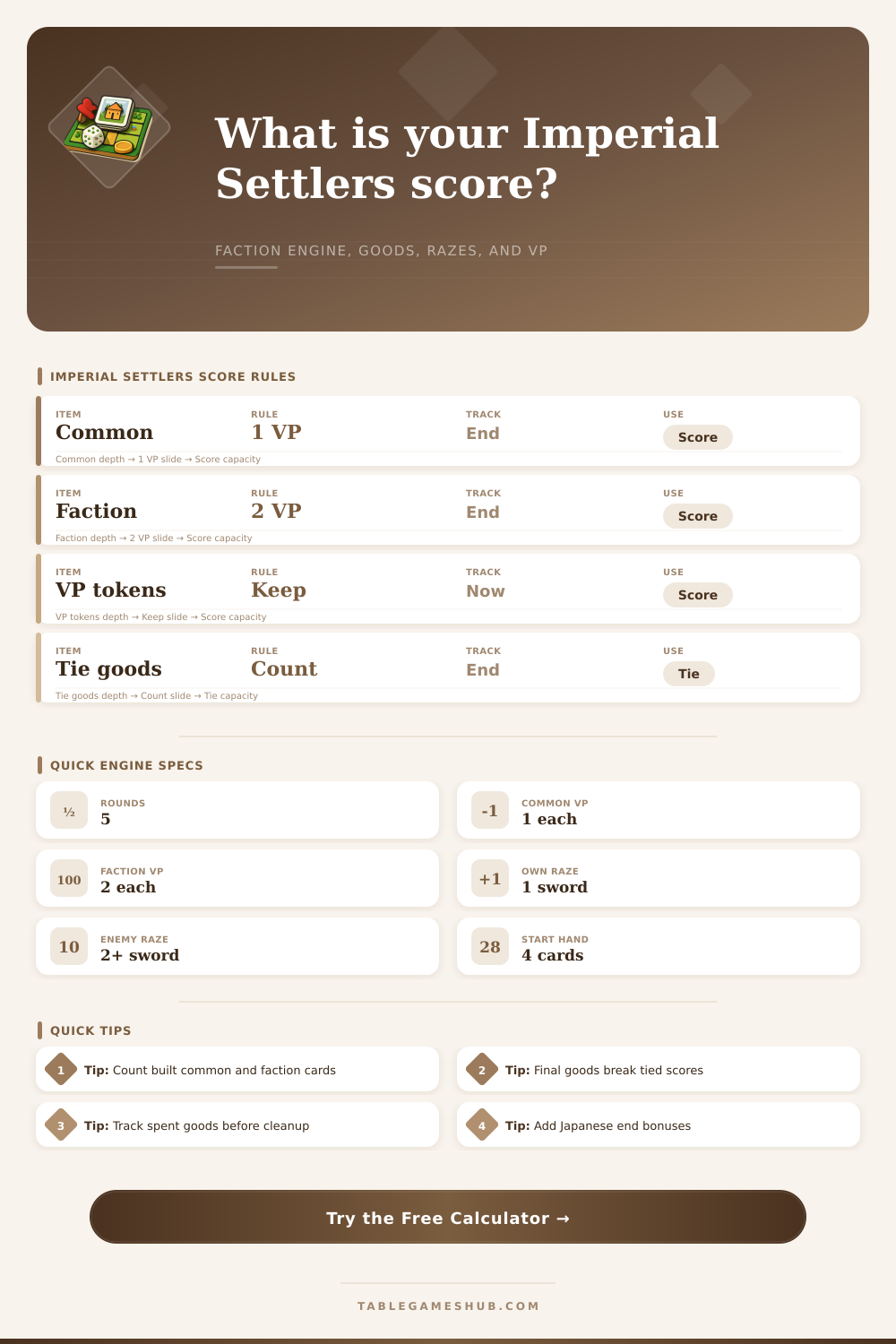
Base end scoring adds 1 VP for each Common Location and 2 VP for each Faction Location. Add any card-specific printed or end bonuses separately.
| Step | Calculated Value | Reason | Check |
|---|
| Category | Calculator Input | Rule Value | When It Counts |
|---|---|---|---|
| Common Locations | Common production + feature + action cards | 1 VP each | Added after round 5 |
| Faction Locations | Faction production + feature + action cards | 2 VP each | Added after round 5 |
| VP Tokens / Marker | Current VP marker / tokens | Already scored | During play and final total |
| Card End Bonuses | Japanese / card end bonus VP | Manual VP input | After printed card text resolves |
| Tie Goods | Workers, resources, gold, swords, stored goods | Count goods first | Only if players tie on VP |
| Cards in Hand | Cards left in hand | Second tie-break | Only if tied goods also match |
| Row | Main Input | Engine Effect | Calculator Use |
|---|---|---|---|
| Production Locations | Production card counts + VP produced | Goods in Production phase and on build | Raises round income and final location VP |
| Feature Locations | Feature card counts + card bonus VP | Passive modifiers and end scoring text | Manual bonus captures special card text |
| Action Locations | Action cards, workers, resources, activation cost | Repeatable turn actions | Caps planned activations by available goods |
| Deals | Active deal cards + deal VP | Immediate and future Production goods | Tracks engine size and VP gained this round |
| Razed Cards | Own razes, enemy razes, defended targets | One-use goods from raze fields | Checks sword cost and goods injection |
| Good | Common Sources | Common Uses | End-Round Handling |
|---|---|---|---|
| Wood | Faction board, production cards, razes, deals | Build costs and action costs | Discard unless stored by an ability |
| Stone | Faction board, production cards, razes, deals | Build costs and action costs | Discard unless stored by an ability |
| Food | Faction board, production cards, razes, deals | Deals, builds, and action costs | Discard unless stored by an ability |
| Gold | Deals, production cards, faction abilities | May replace wood, stone, or food | Discard unless stored by an ability |
| Workers | Faction board, deals, production cards, razes | Action cards and some card effects | Discard unless stored by an ability |
| Swords | Faction board, production cards, razes, deals | Raze hand cards or enemy locations | Discard unless stored by an ability |
| Preset | Engine Bias | Watch Number | Healthy Signal |
|---|---|---|---|
| Roman Stone Builder | Locations and resource builds | Location VP | Faction card VP exceeds action VP |
| Barbarian Raze Rush | Swords, workers, and raze goods | Sword gap | Raze goods pay for extra builds |
| Egyptian Deal Engine | Deals, gold, and flexible resources | Deal count | Gold smooths action and build costs |
| Japanese Feature Web | Features, defense, and end bonuses | Bonus VP | End card text pushes final score |
| Final Tie-Break Count | Stored goods and hand cards | Tie goods | Goods lead before hand-card check |
End scoring: Count every built Common Location at 1 VP and every built Faction Location at 2 VP, then add printed card text bonuses manually.
Goods timing: Resources, workers, gold, swords, and defense tokens are normally discarded in cleanup unless a card or faction ability stores them.
Raze check: Cards from hand usually cost 1 sword to raze. Enemy common locations usually cost 2 swords, plus 1 more if defended.
Tie-break: If final VP ties, compare remaining workers and resources first, then cards left in hand if the goods count is also tied.
Imperial Settlers has one last round where everything comes down to a nail biter of an ending, often won or lost by a margin so thin it feels like luck. You’ll be sitting there with piles of cards all over the board, glancing back and forth at your opponent’s engine and yours. What matters isn’t who have the biggest pile of stones, or the most swords. You need to know what those will turn into in terms of victory points once time runs out.
Most players focus too much on their immediate next turn and forget to look ahead at the end-game math. That’s where this calculator shines. It take the jumbled mess of a board state and projects out to give you a clear picture of how you’ll finish.
Why You Need This Calculator
Engine building is the meat of the game, but each faction has radically different types of engine. The Romans probably have some combination of stone piles stacked up and locations built out that give them a constant trickle of points. The Barbarians use their swords to take down cards, flooding the marketplace with wares. Egyptians love gold and deals, while the Japanese spin webs of features that slowly accrue massive point totals at the last minute. Every style requires a unique approach to scoring. A Japanese empire can’t be judged like a Roman one.
This is where the tool shines. It helps you tell these different engines apart. You can see if what you’re doing is truly producing enough points to compete, or if you’re just gathering resources that won’t ever be used.
The scoring system at the end of the game is also deceptive. Players often look at their massive amounts of stone and wood and assume they’re doing well, after all, that’s an army of workers! But if you don’t turn it into something that generates points (either by building with it or activating high-value cards) then it counts for nothing at score time. Common locations is worth one point. Faction locations are worth two. That makes a huge difference. A couple more faction buildings can completely swing the game.
The calculator causes you to split out that number, so you won’t make the mistake that many people do: overvaluing production capacity but undervaluing how much you’re actualy generating points. It emphasizes whether you’ve got an engine that produces points or just produces stuff that dissapears when it comes time to clean up.
Intuition isn’t great with destroying either, until you add in some math. Each time you do it, you spend swords, possibly defense tokens too. And then you get something back. But that something gets old eventually. Should you attack the other player right now? Or hold off so that you can still win after accounting for the cost of your attack and what you’ll gain?
That’s where the interface comes in. It simulates all those destructions, displaying what goods you’ll get and how few swords you’ll be left with. That way, you can decide whether attacking now is worth more than holding out for a stronger finish (and it shows you how many swords you have left and what goods you will gain). It takes away the guesswork when making aggressive moves. It gives you clear numbers about whether you are ahead in points or just setting up your enemy’s return.
The silent killer in this game is the tie-breaker. The game doesn’t end in a draw if two people has the exact same amount of victory points at the end of the game. Rather, it compares the total goods each player has left, and then it compares cards in hand. If goods are tied, whoever has more cards in their hand wins.
Most players forget about this and only realize it when it’s too late, suddenly finding out they ran out of resources while their opponent didn’t and lost because of a technicality. Keeping an eye on your leftovers (workers, food, stone, wood) right up to the very last minute is planning for the tie-breakers. And it could of mean holding back on spending a resource because you’re close on points, knowing that an extra bit may just be enough to save yourself.
The tool provides presets so that you can try visualizing various strategies before committing to it. You can get a benchmark as to what’s possible with a peaceful variant build, or a high score solo run. It will show you how efficient other engine shapes are and identify inefficiencies in your own gameplay. Perhaps you’re spending too much on action activations that yield diminishing returns. Maybe you notice your production output is higher then your Japanese end-of-turn bonuses.
In conclusion, the point is to no longer play reactively, but rather plan ahead for the game. Everything you do, every sword you swing, every resource you spend, each card you lay down; should contribute towards some number on your side of the board. And the calculator gives you that number: removing all the noise of the board and showing you the actual numbers that determine the winner. It transforms a complex engine-building puzzle into an equation that can be solved.
By the time you reach the last round, you won’t wonder if you’ll get enough points. You’ll know exactly how many you need, and exactly what it will take to close out the victory. And that peace of mind is worth all the minutes you spend planning ahead.