Concordia Score Calculator
Score deity cards, province spread, city goods, colonists, goods stock, money, and Minerva specialization in one Concordia endgame total.
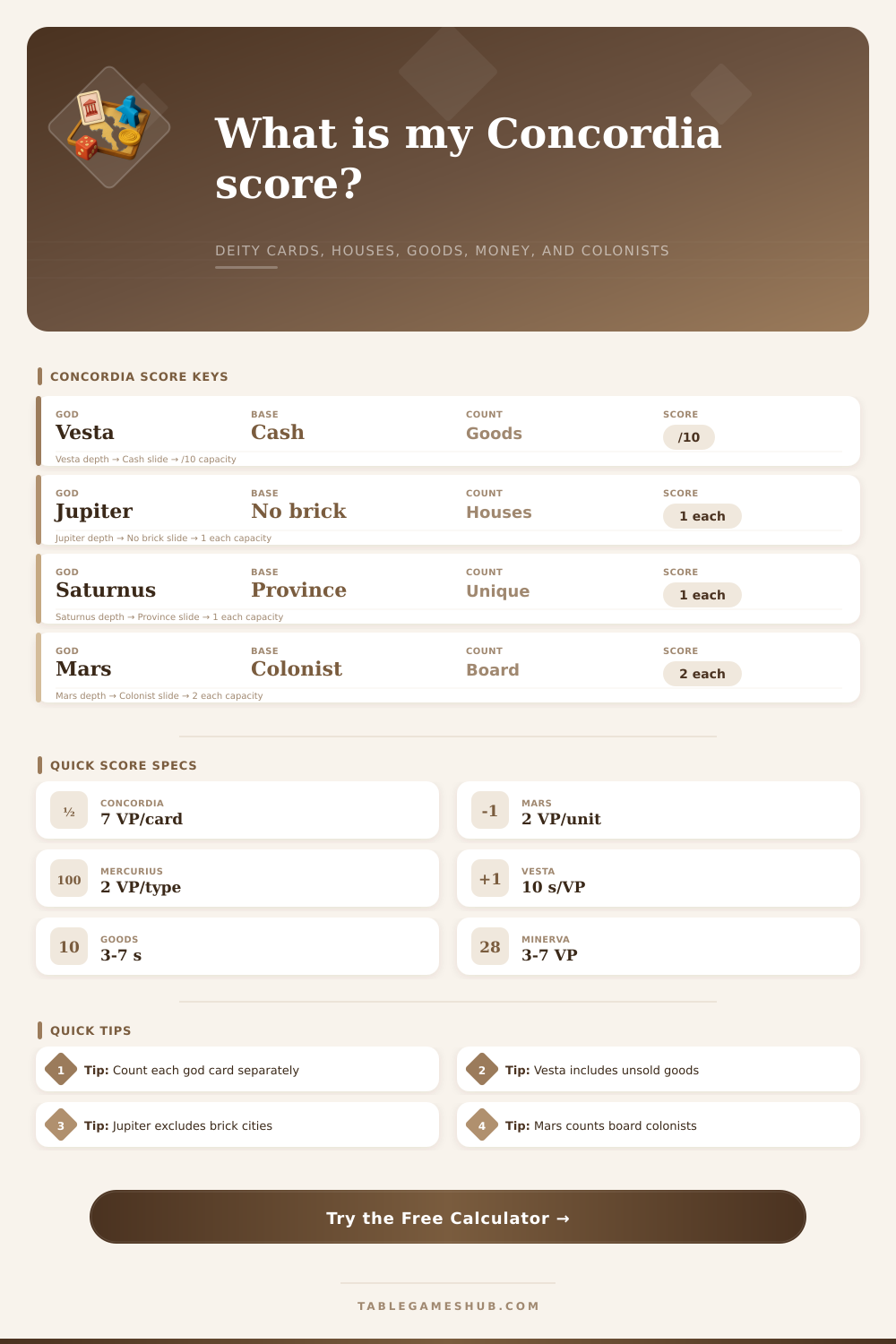
| Deity Card | Scoring Base | Multiplier per Card | Calculator Field |
|---|---|---|---|
| Concordia | Every Concordia card in hand | 7 VP each | Concordia Cards |
| Vesta | Money plus remaining goods value | 1 VP per 10 sestertii value | Money and Storehouse Goods |
| Jupiter | All non-brick city houses | 1 VP per qualifying house | Food, Tool, Wine, Cloth City Houses |
| Saturnus | Provinces where you have at least one house | 1 VP per province | Provinces With At Least One House |
| Mercurius | Distinct produced goods types represented by houses | 2 VP per goods type | Houses by City Goods Type |
| Mars | Colonists on the board | 2 VP per colonist | Colonists on the Board |
| Good Type | Vesta Value | Minerva VP per City | Jupiter Treatment |
|---|---|---|---|
| Brick | 3 sestertii | 3 VP per brick city | Excluded |
| Food | 4 sestertii | 4 VP per food city | Included |
| Tool | 5 sestertii | 5 VP per tool city | Included |
| Wine | 6 sestertii | 6 VP per wine city | Included |
| Cloth | 7 sestertii | 7 VP per cloth city | Included |
| Score Shape | Typical Inputs | Strong Deities | Watch Item |
|---|---|---|---|
| Wide Province Network | 8 to 11 provinces, 9 to 13 houses | Saturnus, Mercurius | Too few deity cards for spread |
| Dense City Builder | 11 to 15 houses, low brick share | Jupiter, Minerva | Brick cities do not help Jupiter |
| Colonist Expansion | 5 to 6 colonists on board | Mars, Saturnus | Colonists score only with Mars |
| Storehouse Finish | High money, wine or cloth goods left | Vesta, Mercurius | Vesta rounds down by tens |
| Specialist Production | Several houses in one goods type | Minerva, Jupiter | Match Minerva type to city mix |
| Audit Step | Count Once | Common Mistake | Calculator Output |
|---|---|---|---|
| Sort cards by deity | Every personality card in hand | Forgetting duplicate god cards | Deity subtotal lines |
| Mark city goods | One house per city built | Putting brick cities into Jupiter | House and Jupiter bases |
| Count province coverage | Each province with a player house | Counting multiple houses twice | Saturnus base |
| Total storehouse value | Money plus goods at printed values | Rounding each good type separately | Vesta conversion |
| Check colonists | Only colonists deployed on the board | Counting unused colonist pieces | Mars subtotal |
Scoring in the game Concordia requires that you calculate the value of the cards, the house placements, and the sestertii that each player accumulate throughout the game. You must calculate each of these values because each of these items have the potential to impact the final score for each player. For instance, one player may have chosen to place there houses in many of the different provinces of the game, while another may have chosen to place many of their houses in only a few of the game’s cities.
Each of these different strategy will lead to different values applied to the game board according to each of the game’s deities, though. While the calculation of each of the deity values is relatively simple, players can easily mishandle the calculation of each of those values because each of the deities utilize slightly different rules for calculating the value of the player’s boards. Some deities, like Saturnus, reward different strategies than others.
How to Score in Concordia
For example, Saturnus rewards the number of different provinces that a player touch with one or more houses, regardless of the total number of houses within those provinces. In contrast, deities like Jupiter only score cities that dont contain any brick building. Furthermore, Mars scoring is based upon the number of colonists that are actually deployed on the game board, not the total number of colonists that a player has in their colony reserve.
Thus, each of these different deities can lead to different total score even with similar game boards. One of the deities, Vesta, uses a slightly different system than the others. Vesta scores the player according to the value of the goods that the player has left over at the end of the game and the value of the goods that are present in the players storehouse.
Vesta applies a rule that it rounds the total value of those goods down by tens in value. Thus, the player who accumulated more goods of high value will score more points from Vesta than a player that accumulated fewer high value goods. Furthermore, small amount of low value goods will score zero points from Vesta.
Thus, some players may opt to sell their goods to earn the sestertii rather than risk losing value of those goods. The inclusion of Minerva and Mercurius cards create a different system of calculated values than the other deities. Minerva and Mercurius score different type of production for the game board.
For example, Minerva only scores for cities that produce the good that is indicated on the Minerva card. Thus, a player that has a cloth Minerva card will score for any cities that contain only cloth production, but will score little or nothing for cities that contain only other types of goods. In contrast, Mercurius scores according to the total number of different types of goods that is on the game board.
Thus, these different scoring systems allows for each player to focus their development of the game board along with only one or two of the game’s deities. While it is possible to use a calculator to calculate the total points for each of the players, there are some advantages to using a calculator to calculate these values. For instance, a calculator will prevent a player from forgetting to apply some of the deity scoring multiplier to the game board’s value, and it will prevent the player from inadvertently double-counting the value of one of the game’s provinces.
However, a calculator will not prevent the player from making a mistake in strategy. For instance, a player may discover while using a calculator that their game board contains too many brick building for those Jupiter scoring cards. Furthermore, a player may realize at the end of the game that their total number of colonists is too low relative to the number of houses that they placed on the game board for Mars to score well for them.
Thus, players are encouraged to use a calculator during the game to review their scores, rather than after the game end. Some of the most common mistakes among Concordia players include treating all of their houses as if they contribute equally to their score for each of the deities, treating each province as if it contain only those buildings of type, or forgetting that colonists that are still in reserve dont score for Mars. While each of these mistake is relatively small in relation to the game’s total score, each of those mistakes can compound over time, especially since many of the game’s deities are still in play at the same time.
For these reasons, some of the best strategies for winning the game are to calculate the score for only the two or three deities that is most common within a player’s hand. For instance, a player may choose to develop their game board in a way that favor one or two of the deities with the intention of earning points from those deities, since they will provide the primary means of earning a score for that player. Thus, each player should focus on creating their game board to include only those buildings, goods, and populations that will ensure that those primary scoring deities scores highly for the player.
Each of the differences between the scores of the players will result from that single decision that is made during the first few rounds of the game, and that decision is the most important decision for each player during the game.