Gloomhaven Gold Value Calculator
Total your loot tokens, scenario rewards, item sales, party bonuses, discounts, and spending to see the real gold swing from a Gloomhaven session.
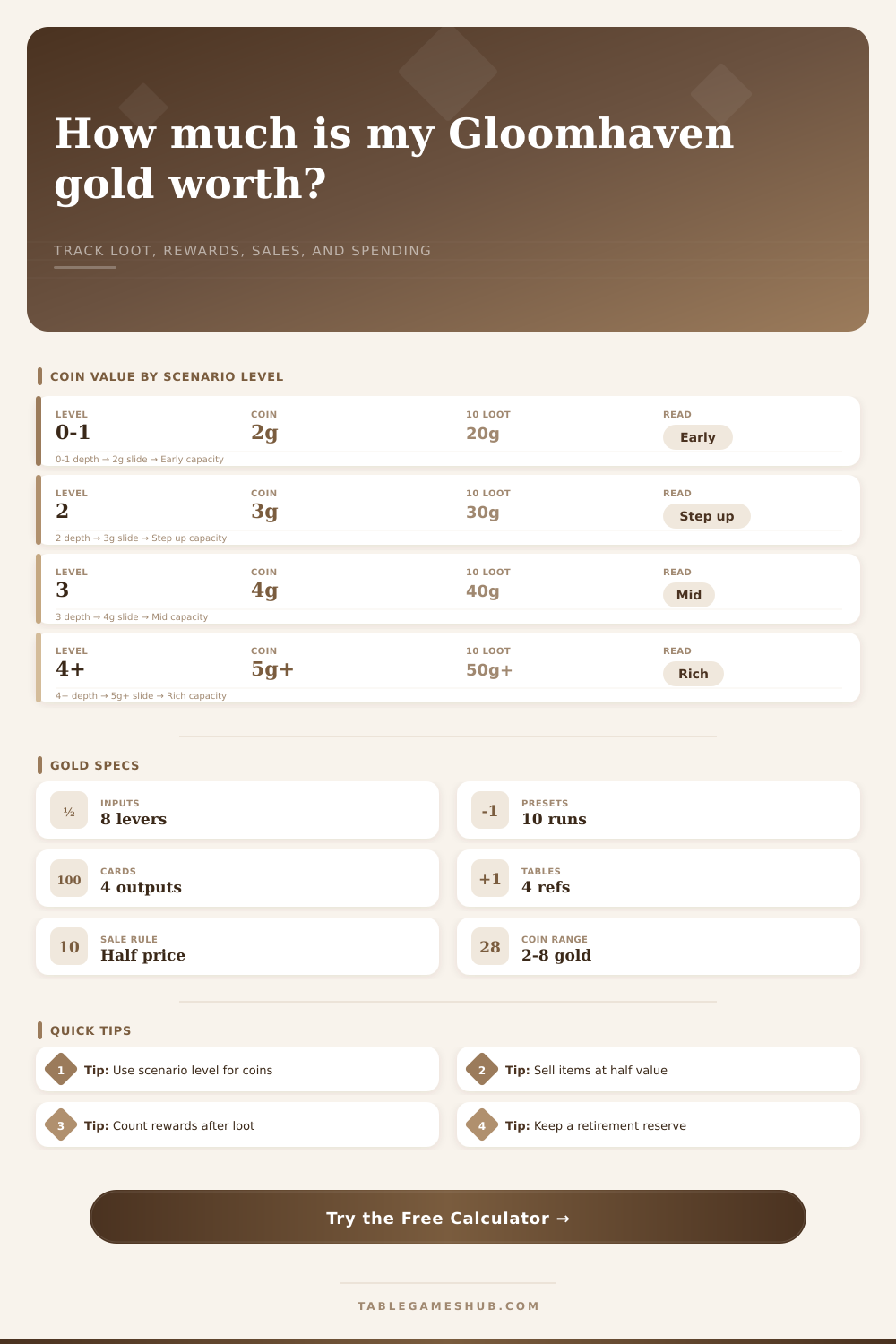
| Scenario Level | Coin Value | 8 Loot | 12 Loot |
|---|---|---|---|
| 0-1 | 2 gold | 16 gold | 24 gold |
| 2 | 3 gold | 24 gold | 36 gold |
| 3 | 4 gold | 32 gold | 48 gold |
| 4 | 5 gold | 40 gold | 60 gold |
| 5 | 6 gold | 48 gold | 72 gold |
| 6 | 7 gold | 56 gold | 84 gold |
| 7 | 8 gold | 64 gold | 96 gold |
| Gold Source | Calculator Field | Timing | Notes |
|---|---|---|---|
| Money tokens | Loot x coin | During scenario | Level-scaled |
| Conclusion reward | Scenario reward | After win | Flat gold |
| Treasure payout | Scenario reward | On reveal | Add once |
| Item sale | Item sell value | Town phase | Usually half |
| Party assignment | Party bonus | Town phase | Per character |
| Spending Band | Net Swing | Read | Best Use |
|---|---|---|---|
| Loss | Below 0g | Draining | Delay buys |
| Lean | 0-14g | Slow build | Save first |
| Stable | 15-34g | Good run | Small item |
| Rich | 35-59g | Shop push | Upgrade gear |
| Windfall | 60g+ | Major jump | Enhance plan |
| Character Level | Reserve Target | Pressure | Planning Note |
|---|---|---|---|
| 1-2 | 25 gold | Low | Basic gear |
| 3-4 | 40 gold | Medium | Item swap |
| 5-6 | 55 gold | High | Big purchase |
| 7-8 | 70 gold | Very high | Enhance save |
| 9 | 80 gold | Retire ready | Final build |
Gloomhaven: It’s Tuesday night and you’re feeling optimistic as you sit down to play. The mission look like it’ll be a cinch. Everything goes smoothly. Your team works together, they complete their tasks. They grab a bunch of money tokens. But then you get home and look at your character sheet and realize that you spent half your money on mundane necessities and healing cards. After accounting for every expense, you sold off excess items and found yourself about 10 gold in the hole. Why did this suck?
Accumulating tokens isn’t what actualy measures how much money you have. Town phase accounting determine true worth; and measuring the gold swing should be more important than counting table coins. This all comes together in the calculator at the top of this post, which perform this calculation for you and converts random tokens into a clear view of your money situation.
How to Track Your Money in Gloomhaven
First, it multiplies every single loot token you collect by its worth based off the level of the scenario instead of the level of your character. This is key because early game scenarios reward lower value tokens that only becomes important when counted by the dozens. Advanced scenarios award fewer tokens but they’re the high-value kind. Level four will make each one worth as much than five gold. It is time to go all-out hunting for any special situations that could drop extra loot. Finally, it adds in any fixed payment earned from treasure payouts and conclusion conditions. These are your sure-thing floors because they is flat payments regardless of how well you play or how lucky you get after reaching certain condition.
After tallying your gross income, the calculator switches gears into the expenses and adjustments column. It notes that you generally only get half of what you sell something for. This is a harsh truth that make you consider keeping your stuff more often than trying to grab a few bucks. The discount field accounts for any party negotiations or shop modifiers that effectively boost buying power. You then take away expenses spent upgrading, donating, and enhancing until you arrive at net swing.
This shows whether you’re burning money to keep up or building wealth to move ahead in life. That’s your real measure of advancement: it shows you just how much closer you are to retiring, saving up for an epic purchase, etc. This part of the game is hard for most players because they don’t consider town spending in terms of scenario success, they do not realize that buying a new weapon now affects their ability to afford an enhancement later.
The character level/reserve target table helps here (see reference table). It shows you how little gold low-level characters require, as they can scrape by on 25 gold. This is compared to high-level hero who requires 80 or more gold to save up for retirement. As you reach level eightish and then push toward nine, every gold spent on repairing gear take away from your money needed to escape, which increases the urgency.
Once you realize the tradeoff, you have to change how you play during the game. You must push yourself to save health and other items even when it feels dangerous to do so. Your decisions about saving things in the short term matter for the long term. The tool provides presets for common examples like a boss payday, which offers brief relief or a lean loss run that drains your reserves. They’re meant to show how they fit into the bigger pattern of your sessions.
If it’s always negative, then collecting more loot won’t help… The core problem is an inability to spend sustainably. Maybe you hoard too many item that aren’t tactically relevant anymore. Perhaps you overspend on consumables. That kind of insight comes with knowing what to cut back on, not simply how much you’ll get in return.
But at the end of the day, Gloomhaven is part combat strategy and part resource management. Your cards are resources, but so is your money. Keeping accurate track of how much you have will keep you from slowly bleeding out. This happens to a lot of campaigns that lose momentum once their characters plateau because they’ve run out of funds to invest in the next item or ability.
The trick is managing your economy, separating rewards from loot, and tracking every discount and sale. This way, you know exactly when you can buy something new instead of guessing. That is how a messy town phase can turn into a real strategic advantage. Suddenly you’re not wondering if you can afford another card; you know exactly when you’ll be able to buy one. That’s when you realize that the wealth you hold in your hand is what truly wins the game, not all that gold sitting on the table.