Golf Club Swing Speed Distance Calculator
Turn club speed, smash factor, launch, spin, strike quality, and conditions into a realistic carry and total yardage readout.
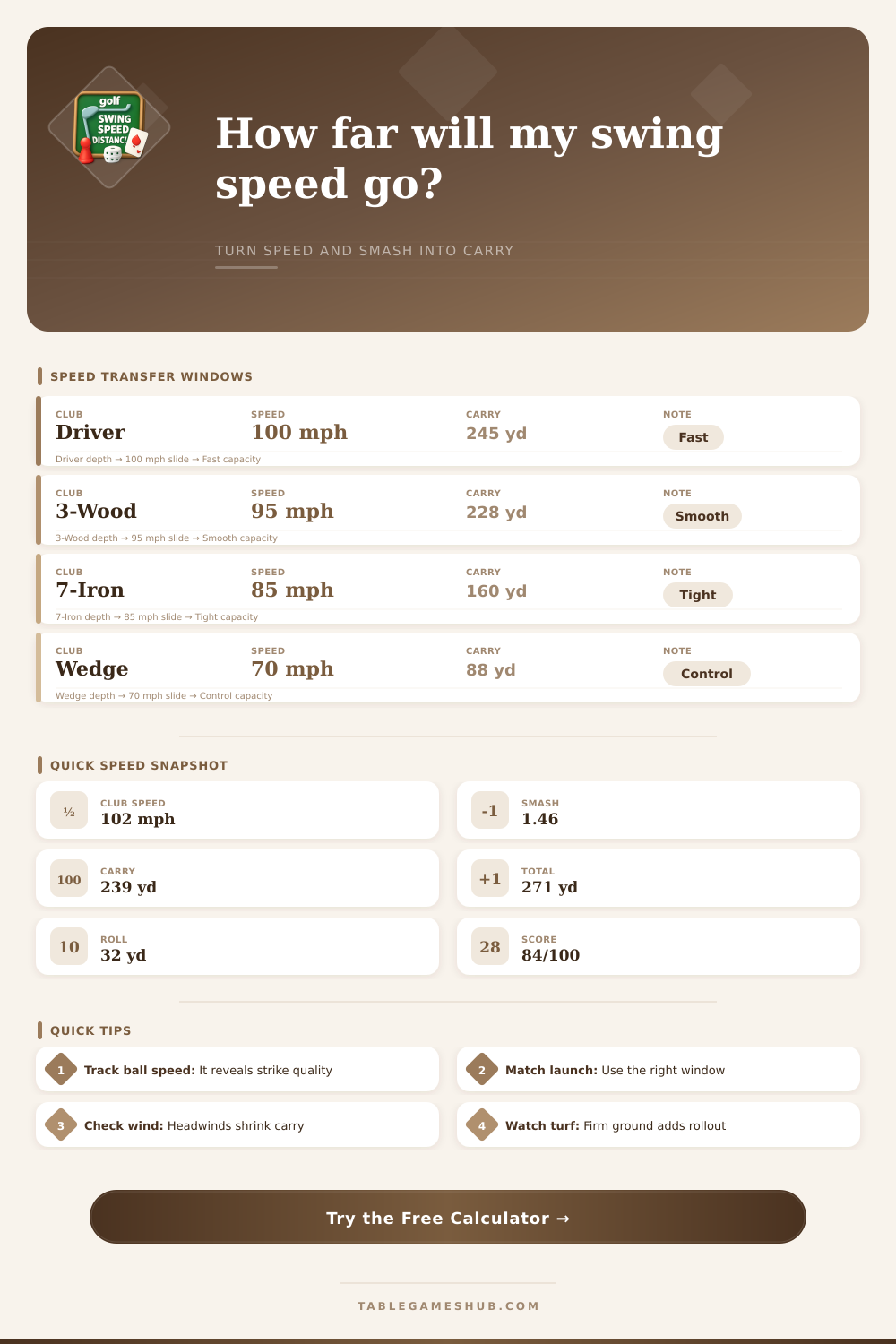
| Club | Speed Band | Carry Window | Notes |
|---|---|---|---|
| Driver | 95-115 mph | 220-265 yd | Fast launch |
| 3-Wood | 90-105 mph | 205-245 yd | High launch |
| 7-Iron | 75-90 mph | 145-175 yd | Tight window |
| Wedge | 60-80 mph | 70-105 yd | Short runout |
| Club | Launch | Spin | Strike |
|---|---|---|---|
| Driver | 10-14° | 2200-3000 | 97%+ |
| 3-Wood | 11-15° | 2800-3800 | 95%+ |
| Hybrid | 13-18° | 3500-4500 | 93%+ |
| 7-Iron | 16-21° | 5500-7500 | 92%+ |
| Condition | Carry Shift | Roll Shift | Best Use |
|---|---|---|---|
| Headwind | -4 to -8% | -5 to -9% | Lower flight |
| Tailwind | +2 to +5% | +4 to +7% | Runout boost |
| Soft turf | -1 to -2% | -12 to -18% | More bite |
| Firm turf | 0 to +2% | +10 to +18% | Extra chase |
| Club | Carry Factor | Roll Factor | Feel Cue |
|---|---|---|---|
| Driver | 1.72 | 0.18 | High speed |
| Hybrid | 1.38 | 0.10 | Easy launch |
| 7-Iron | 1.12 | 0.06 | Mid window |
| Wedge | 0.72 | 0.03 | Short chase |
Club speed is a measurement of how fast a person swing their golf club. However, club speed does not necesarily determine how far the persons golf ball will travel. A person may have high club speed but still find their ball distance to be low.
This is due to the energy that is transferred between the club and the ball, which a value called smash factor measures. Smash factor are the ratio of the ball speed to club speed. For a driver, the perfect smash factor is 1.50.
What Makes a Golf Ball Go Far
This means that the clubhead is transferring its energy to the ball at maximum efficiency. If a person hits the ball off of the center of the clubface, the smash factor will be high. However, if a person hits the ball close to the toe or heel of the club, the smash factor will be more lower.
Lower ball speed will result in the ball traveling a lower distance. In addition to club speed and smash factor, two other variable impact the distance of the ball. The first is the launch angle of the ball.
A launch angle that is too low will cause the ball to quickly lose speed. However, if the launch angle is too high, the ball will travel too high off the club and will also lose distance. Golfers need a driver launch angle of around 12 degrees.
For irons, the launch angle should be between 18 and 20 degrees. The second variable is the spin rate of the ball. Spin rate influence how long the ball will stay in the air and how it will interact with the ground.
For example, the three wood spin rate should be 3,200 rpm. Environmental conditions can also impact the distance of the golf ball. Conditions such as wind, turf, and altitude play a role in the distance of the ball.
Wind can be a headwind or a tailwind. A headwind will slow the ball and create a more steeper descent. This will reduce the distance of the ball.
A tailwind will push the ball forward, thus, increasing the distance. The quality of the turf impacts the distance of the ball. Soft turf will create more friction and spin for the ball.
This will cause the ball to stop quickly on the turf. On firm turf, the ball will roll further, thus, increasing the distance. Finally, the altitude of the golf course impacts the distance of the ball.
At high altitudes, the air are thinner. This means that the ball will travel farther on thin air then in dense air. A person can use the presets on a launch monitor to understand these variables.
A person can preset a club to a seven iron with a club speed of 84 mph. This setting will show the distance of the ball with a clean strike. If the person changes the turf from soft to firm, they will observe that the rollout and total distance of the ball increases.
A transfer score is given to the ball to rate the total performance of the persons swing. A high transfer score mean that the clubhead makes a clean strike on the ball, the launch angle is good and the spin rate is optimal. A low transfer score shows that the persons swing is inefficiently.
Many people makes the mistake of trying to increase their club speed without focusing on their strike efficiency. Strike efficiency is the measurement of how centered the persons club strike is on the clubface. The best scenario would of been to increase a persons club speed to 110 mph but also maintain a high strike efficiency.
If a person has a high club speed but low strike efficiency, the ball speed will be low. Therefore, it is important for a person to focus on making a centered strike with the club to maximize their club speed into ball speed. Thus, a person should always focus on making a clean contact with the ball to maximize their club speed and allow the ball to travel the most maximum distance.