Gloomhaven Experience Level Calculator
Add scenario XP, bonus XP, personal quest rewards, and a short campaign horizon to see the mercenary level reached, XP to the next threshold, and the pace needed for your target level.
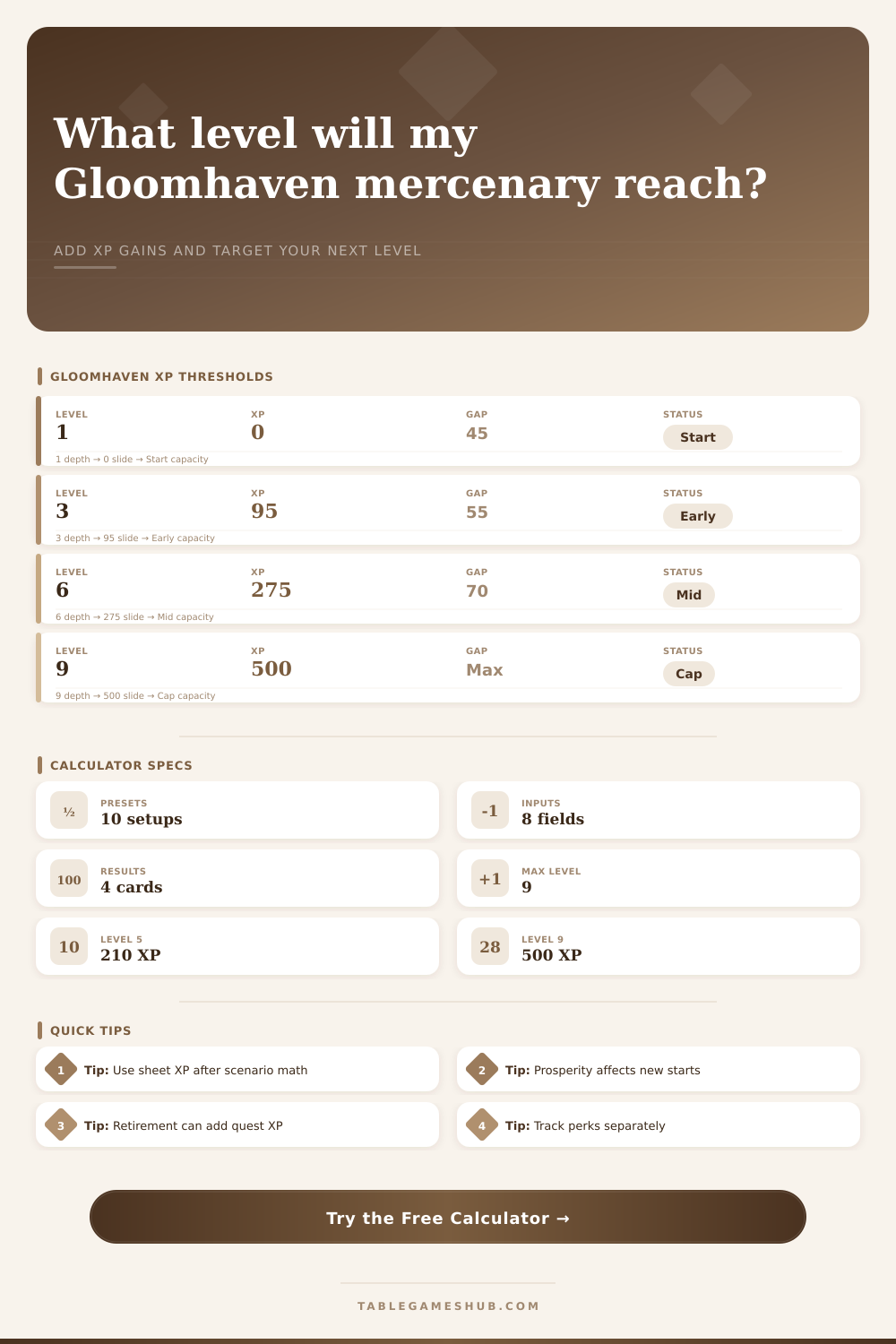
| Level | Total XP | Gap From Prior | Planning Read |
|---|---|---|---|
| 1 | 0 | Start | Fresh mercenary baseline. |
| 2 | 45 | 45 | First perk and card choice pressure. |
| 3 | 95 | 50 | Early build identity starts to show. |
| 4 | 150 | 55 | Common campaign power step. |
| 5 | 210 | 60 | Mid campaign stamina check. |
| 6 | 275 | 65 | Higher-level card replacement tension. |
| 7 | 345 | 70 | Late campaign specialization. |
| 8 | 420 | 75 | Endgame build refinement. |
| 9 | 500 | 80 | Maximum level threshold. |
| Scenario Gain | Typical Use | 4-Scenario Total | Pace Read |
|---|---|---|---|
| 4-6 XP | Low XP support round | 16-24 XP | Slow leveling unless rewards land. |
| 7-9 XP | Normal scenario performance | 28-36 XP | Reliable early-level movement. |
| 10-12 XP | XP-heavy class or long scenario | 40-48 XP | Fast enough for threshold pushes. |
| 13+ XP | Burst turn or reward stack | 52+ XP | Can cross multiple early gaps. |
| Prosperity | New Character Option | Calculator Use | Note |
|---|---|---|---|
| 1-2 | Low-level starts | Check if target exceeds party baseline. | Fresh mercenaries need more catch-up. |
| 3-4 | Early campaign lift | Good for level 3 and 4 planning. | Common retirement replacement range. |
| 5-6 | Mid campaign starts | Compare earned level to available start. | Useful for unlocked classes. |
| 7-9 | Late campaign starts | Target high card picks directly. | Level 9 still requires 500 total XP. |
| Preset | Best For | Main Input | Expected Result |
|---|---|---|---|
| Fresh Mercenary | New class at low XP | Current XP | Shows the level 2 gap. |
| Level 3 Push | Crossing 95 XP soon | Scenario XP | Checks early card timing. |
| Retirement Sprint | Final few plays | Quest reward XP | Shows realistic pace to target. |
| Level 9 Check | Endgame mercenary | Scenarios left | Shows whether 500 XP is reachable. |
After three years playing through Gloomhaven, you finally pull out the campaign sheet and see that your favorite character has been stuck on level seven as everyone else inches closer and closer to nine. They’re within spitting distance of the cap, but the math just doesn’t seem to add up with how much longer you have until you retire. That’s where this experience calculator comes in, it turns all those separate sources of XP into a clear estimate of how far along you’ll go.
First, there’s some truth telling required: How many points do you have? Don’t ask what you earned last session; ask how much you have in total. New player often mistakenly think they are only tracking what they’ve gained since their last session. And while that works fine when you’re getting started, the thresholds is cumulative. They are also hard. They are zero, forty-five, ninety-five, and then go up through five-hundred.
How to Use the XP Calculator
Knowing those cold numbers makes all the difference as you consider what comes next. Are you at ninety-six XP? Well, you’ve already jumped over the level three hump. Now you need to keep an eye out for the one-fifty benchmark for level four. That’s a gulf of fifty-five points, but break that down into real world play sessions, and it doesn’t seem like such a big deal.
How does all this work out? That depends very heavily on what class you play and how well you do. Damage dealer may be able to pull 10 or more for a particularly difficult enemy wave. Support characters may barely make it to six points in a round of light combat. You’ll need to plug these expected gains into the calculator along with any additional experience granted by prosperity events and/or battle goals. Why? Because a lot of groups overlook the fact that there is extra bits of experience scattered across other areas besides primary victory condition(s).
Once you take those little bits into account, road to the next level no longer seems so far away than it did on Tuesday night. That’s just one more layer to plan for… And prosper from. Another feature is setting a prosperity cap. If you do, it will tell you whether or not a new mercenary can catch up with the rest of your party in terms of levels. Having high prosperity will also mean that newer players begins at higher levels, reducing the catch-up grind for those veterans that are attempting to balance power around the table.
You might look at it and say “oh, well a fresh recruit is going to drag down the average,” but in fact they may get to level three or four almost right away, due to starting boost. It impacts long term viability and team composition. Of all these outputs, the one I found most helpful was the pace metric, which will tell you exactly how many points of XP it takes to reach your target in X amount of scenarios. So if you have four scenarios until forced retirement, and need eight points on each, you can make do with that.
Chances are good you can’t do 12 points per round if you’re not min-maxing your battle goals. It’s a feedback loop that avoids the “I’m so close! It is the “let’s hope this last boss fight has the miracle level up” type of frustration. Because chances are, you aren’t really even close at all; you’re just two scenarios away. This is also factored in with personal quest rewards which are sporadic and occasionally ignored altogether. Many players view these as too situational to bank on. However, an additional five points from a successful quest could of mean crossing an edge that normaly requires another hard scenario.
To put those rewards in context, the following reference tables details usual scenario returns versus normal level differences. So what does all this mean? At its core, it’s not as much about remembering each threshold level. It is more about getting an idea of how quickly you move through experiences compared to amount of time you have available. If you want to know when it’s finally worth starting to save up for unlocking a new class, or pushing hard for one last perk, then the tool helps make those decisions easier by taking away the guessing.
From there, when you no longer find yourself asking “Am I close?” but instead “How many more scenarios do I need?”, the campaign doesn’t feel quite as much of a grind and it becomes more of a collection of solvable puzzles. It also makes each win feel earned, insted of lucky.