Scythe Popularity Track Calculator
Test how popularity gains, combat penalties, stars, territories, resources, structures, recruits, and coin reserves change a Scythe end-game scoring tier.
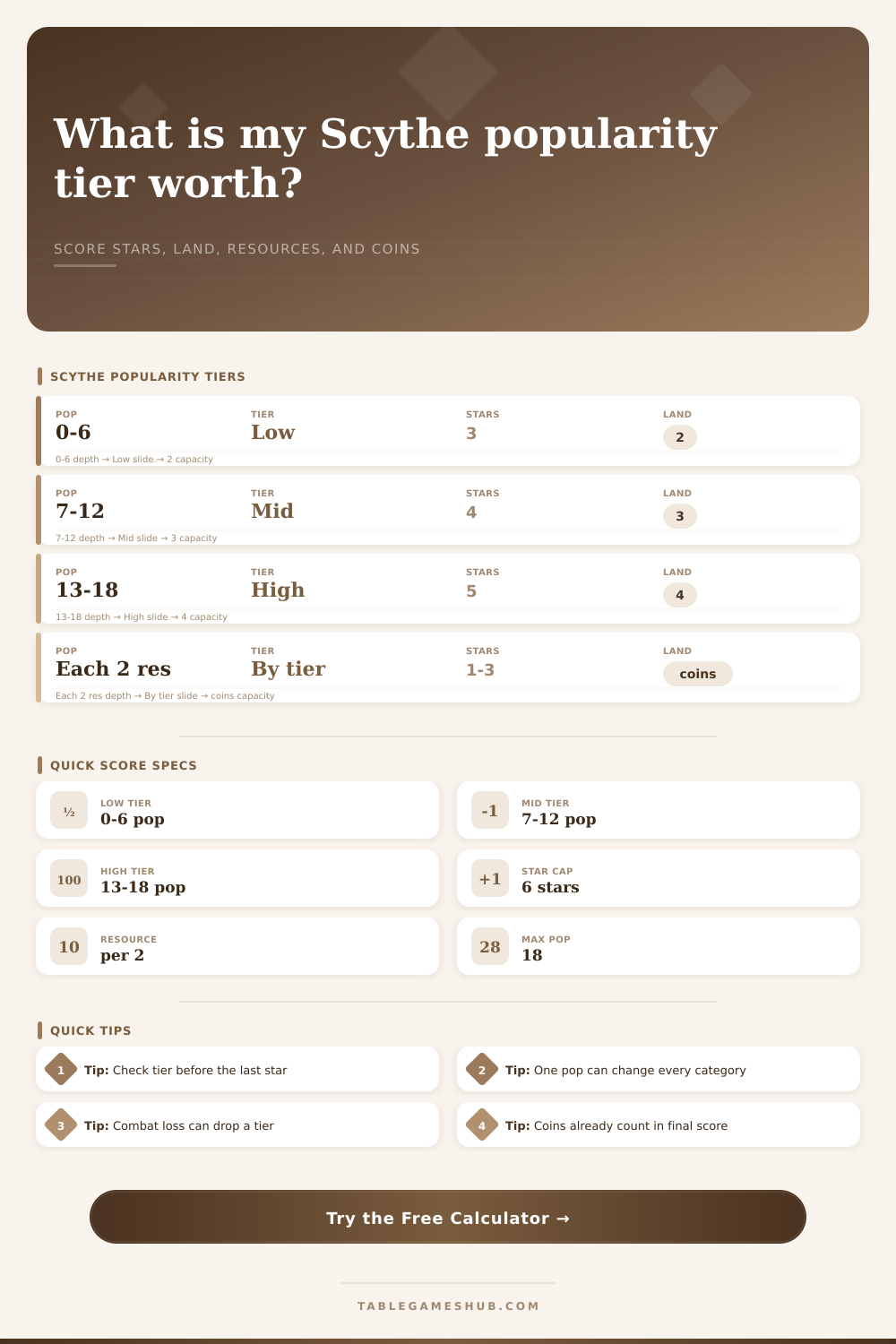
Load a board-state preset or enter your own numbers. The calculator clamps popularity from 0 to 18, chooses the Scythe scoring tier, and values stars, territories, and every pair of resources at that tier.
| Final popularity | Tier name | Each star | Each territory | Each 2 resources |
|---|---|---|---|---|
| 0 to 6 | Tier 1 / low popularity | 3 coins | 2 coins | 1 coin |
| 7 to 12 | Tier 2 / mid popularity | 4 coins | 3 coins | 2 coins |
| 13 to 18 | Tier 3 / high popularity | 5 coins | 4 coins | 3 coins |
| Preset | Popularity event | Board pressure | Best card to watch | Calculator note |
|---|---|---|---|---|
| Tier-One Factory Grab | Low popularity, no gain | Factory territory can matter | Territory + resource value | Good for seeing whether extra land beats a tier climb. |
| Enlist Popularity Bump | Small positive swing | Coins and recruits are already banked | Popularity tier | A one-step gain near 7 or 13 can change every category. |
| Encounter Gain | Large positive swing | Often paired with territories and resources | Final score | Strong when it crosses from tier 2 to tier 3 before scoring. |
| Combat Loss | Negative worker penalty | Star gained but popularity can fall | Star value | The extra star may lose value if the penalty drops a tier. |
| Resource Hoard High Tier | High popularity hold | Many resources controlled | Territory + resource value | Every two resources become three coins at tier 3. |
| Board item | Direct end scoring | Why it is included | Common scoring signal | Input handling |
|---|---|---|---|---|
| Structures | Structure bonus card | They can add a separate end-game bonus | 0 to 9 coins, depending on card and placement | The calculator uses a conservative count estimate in breakdown. |
| Recruits | No direct final category | They often create popularity, power, card, or coin tempo | One-time enlist rewards plus neighbor bonuses | Coins already held should include recruit coin gains. |
| Coins | One coin equals one final point | They are added after tier-based scoring | High coin count can beat one more low-value star | Entered coins are carried straight into final score. |
| Popularity | Sets the scoring multiplier tier | It changes stars, territories, and resource-pair value | Thresholds at 7 and 13 popularity | Gain/loss is applied before final scoring. |
| Category | Count source | Popularity effect | Rounding | Watch point |
|---|---|---|---|---|
| Stars | Star tokens on triumph track | 3, 4, or 5 coins each | Whole stars only | Sixth star may end the game before a tier climb. |
| Territories | Controlled hexes at game end | 2, 3, or 4 coins each | Whole territories only | The Factory counts as one territory. |
| Resources | Controlled resource tokens | 1, 2, or 3 coins per pair | Round down to pairs | An odd leftover resource does not score by itself. |
| Coins | Coins held during scoring | No tier change | Whole coins only | Coins from actions and bonuses are already points. |
| Structure bonus | Structure bonus tile/card | Separate from popularity tier | Depends on the selected bonus | Use this calculator estimate as a reminder, not a tile rule. |
Scythe’s final turn plays out like a high stakes auction with fluctuating currency values that change every few seconds. You stare down your board and consider whether you should grab nearby star for immediate comfort or climb that popularity track for long term investment. This is the moment when one player play casually and the other understands what lies under cardboard mechanics.
The popularity track isn’t just a path to more victory points; it’s a multiplier altering value of all that you’ve constructed. While most players consider popularity track as an afterthought, mindlessly focusing only on hoarding resources or controlling territory, their marker stays comfortabley in the middle. They overlook tier breaks and how this results in a compounding effect. It’s why running the numbers before taking your final action carry so much weight.
Why the Popularity Track Matters in Scythe
Don’t count total, think threshold. Final score is split into three different tiers depending on level of popularity your marker settles on. Zero-to-six? Discounted payout for all territories/stars held. Seven-to-twelve? Payouts go way up. Thirteen-or-higher? Your stuff starts getting realy valuable.
When you enter any of these brackets, the calculator (above) do the math for you, saving you from having to do mental math while the clock ticks down in the final moments. It allows you to pretend you gained a single popularity point, see what happens when you bump up against that next break point, and whether it’s enough to trigger the multiplier increase on four or five other category. Sometimes that one point is worth more then winning a whole battle, because it opens the floodgates on everything else.
That’s where the star rush strategy tends to fail. Getting your sixth star as soon as possible feels like it should of give you control over when to end the game, except that you’ve neglected your popularity, which is a huge part of what you lose. Each territory counts for only a fraction of its total value if you’re still on the bottom rung, and each resource pair do too.
By allowing you to plug in what you already have, the tool lets you see the trade-off between your resources and different popularity scenarios. You are rewarded for completing sets of resources because single items does not count unless you also control a matching one (or some other number). This slight pressure forces people to expand beyond their current necessities ever so slightly to round up those pairs.
Making things even more complex is the rules of combat, which will cost you points if you win. A strong mech could boost your score, or capturing an important area could get you bonus points. However, those will get wiped away if you suffer too many worker losses and drop a tier. The handy reference table below shows why a seemingly decisive combat victory might actualy cost you points because of your multiplier penalties.
If you win a battle, you must consider the short-term benefit versus long-term harm done to your scoring multipliers. Those who love combat but hate keeping track will learn this lesson the hard way.
There is another layer to consider: structures and, to a lesser extent, recruits. While they don’t score points in the same way as other elements, they each still add their own layer of nuance to the calculation. Structures provide end-game bonuses based off various card effects, creating some wiggle room in the equation. Recruits contribute coin tempo, as well as nudging your popularity upward when you need it most. The estimator offers a baseline which is conservative for these factors, giving you a full view of how you stack up.
It’s not just about coin-counting; it’s about organizing a system whose individual parts feed into one another. It’s the beauty of the system: It rewards forethought. Watch your score approach these thresholds during the game. By the last turn, you’ll be in a great position, with your popularity marker placed to get the most out of what you’ve already built.
And if you ignore it till the very end? You will need to take desperate actions, and you will probably give up too much at the finish line to make a move that you might have made three turns earlier. That one extra point of focus at the beginning of the game can be the difference between first and second.
Mastering Scythe isn’t just about dealing with the current situation on the board; it’s about weighing those immediate tactical gains against your long-term scoring multipliers. Rather, it’s about understanding where and why your units are worth more or less than they were previously. To do this, you have to understand what is coming next, look beyond the board and at the final equation that will determine your score.
Through experimentation ahead of time, you eliminate the need to guess what the right choice should be. Instead, you begin playing out a plan you’ve already tried and found to be most efficient. That’s what transforms a good game into a dominating one. The track isn’t just the route forward, but rather the way by which all other successes are judged.